

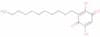
CAS 550-24-3
:Embelin
Beschreibung:
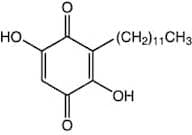
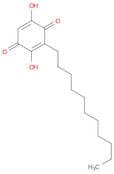
Embelin, mit der CAS-Nummer 550-24-3, ist eine natürlich vorkommende Verbindung, die als Derivat der Benzochinon klassifiziert ist. Es wird hauptsächlich aus den Früchten der Pflanze Embelia ribes gewonnen, die für ihre traditionellen medizinischen Anwendungen bekannt ist. Embelin zeigt eine Reihe biologischer Aktivitäten, einschließlich antioxidativer, entzündungshemmender und antimikrobieller Eigenschaften, was es für die pharmakologische Forschung von Interesse macht. Die Verbindung ist durch ihre molekulare Formel gekennzeichnet, die typischerweise Kohlenstoff-, Wasserstoff- und Sauerstoffatome umfasst, die zu ihren strukturellen Eigenschaften beitragen. Embelin wird häufig auf seine potenziellen therapeutischen Anwendungen untersucht, insbesondere im Kontext der Krebsbehandlung und metabolischer Störungen. Darüber hinaus wurde festgestellt, dass es in der Lage ist, verschiedene biochemische Wege zu modulieren, was seine Bedeutung in der medizinischen Chemie weiter erhöht. Seine Löslichkeit und Stabilität können je nach Lösungsmittel und Umweltbedingungen variieren, was wichtige Faktoren für seine Anwendung und Untersuchung sind. Insgesamt stellt Embelin eine wertvolle Verbindung sowohl in der Naturstoffchemie als auch in der pharmazeutischen Entwicklung dar.
Formel:C17H26O4
InChl:InChI=1S/C17H26O4/c1-2-3-4-5-6-7-8-9-10-11-13-16(20)14(18)12-15(19)17(13)21/h12,18,21H,2-11H2,1H3
InChI Key:InChIKey=IRSFLDGTOHBADP-UHFFFAOYSA-N
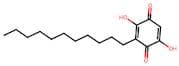
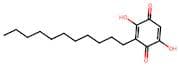
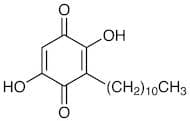
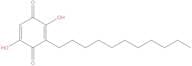
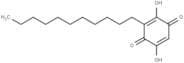
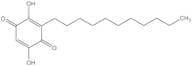
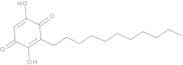
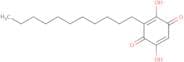
SMILES:C(CCCCCCCCCC)C=1C(=O)C(O)=CC(=O)C1O
Synonyme:- 2,5-Cyclohexadiene-1,4-dione, 2,5-dihydroxy-3-undecyl-
- 2,5-Dihydroxy-3-Undecylcyclohexa-2,5-Diene-1,4-Dione
- 2,5-Dihydroxy-3-undecyl-1,4-benzoquinone
- 2,5-Dihydroxy-3-undecyl-2,5-cyclohexadiene-1,4-dione
- 2,5-Dihydroxy-3-undecyl-p-benzoquinone
- 2,5-Dihydroxy-3-undecylcyclohexa-2,5-dien-1,4-dione
- Embelic acid
- Embelin
- Emberine
- NSC 91874
- p-Benzoquinone, 2,5-dihydroxy-3-undecyl-
Sortieren nach
Reinheit (%)
0
100
|
0
|
50
|
90
|
95
|
100
12 Produkte.
Embelin
CAS:An inhibitor of XIAP (X-linked inhibitor-of-apoptosis protein) that contains antitumor and anti-inflammatory activity This Thermo Scientific Chemicals brand product was originally part of the Alfa Aesar product portfolio. Some documentation and label information may refer to the legacy brand. The orFormel:C17H26O4Molekulargewicht:294.4Embelin
CAS:Formel:C17H26O4Reinheit:>95.0%(T)(HPLC)Farbe und Form:Light yellow to Yellow to Orange powder to crystalMolekulargewicht:294.39Embelin
CAS:Embelin (Embelic acid), isolated from the Japanese Ardisia herb, is an inhibitor of the X-linked inhibitor of apoptosis (IC50: 4.1 uM).Formel:C17H26O4Reinheit:97.07% - 99.88%Farbe und Form:SolidMolekulargewicht:294.39Embelin
CAS:QuinoneFormel:C17H26O4Reinheit:≥ 90.0 % (HPLC)Farbe und Form:PowderMolekulargewicht:294.39Embelin
CAS:Kontrolliertes ProduktApplications Embelin is a natural benzoquinone found in plants of the Myrsinaceae family. Embelin has a wide range of biological activity as it inhibits the growth of bacteria, fungi, protozoa and parasites. Embelin also displays contraceptive and pro-apoptotic properties.
References Stasiuk, M. et al.: Glob. J. Biochem., 2, 262 (2011); Brahmeshwari, G. et al.: Adv. Plant Sci., 24, 467 (2011); Hu, R. et al.: Med. Oncol., 28, 1598 (2011);Formel:C17H26O4Farbe und Form:OrangeMolekulargewicht:294.39Embelin
CAS:Embelin is a phytochemical compound that functions as an active ingredient derived from the plant Embelia ribes. This compound, known for its quinone structure, operates primarily through the inhibition of X-linked inhibitor of apoptosis protein (XIAP), which plays a crucial role in the regulation of apoptotic pathways. By targeting XIAP, Embelin promotes apoptosis in cancer cells, making it a potential candidate for anticancer therapies. Additionally, Embelin exhibits anti-inflammatory, analgesic, and antioxidant properties through various pathways, including modulation of inflammatory cytokine production and reactive oxygen species scavenging.Formel:C17H26O4Reinheit:Min. 95%Farbe und Form:PowderMolekulargewicht:294.39 g/mol










![2,5-Dihydroxy-3-undecyl-[1,4]benzoquinone](/_next/image/?url=https%3A%2Fstatic.cymitquimica.com%2Fproducts%2F10%2Fthumb%2FF032344.jpg&w=3840&q=75)
