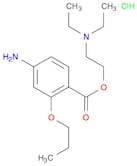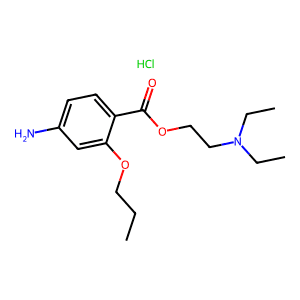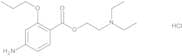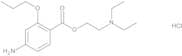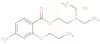
CAS 550-83-4
:Propoxycainehydrochlorid
Beschreibung:
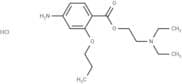
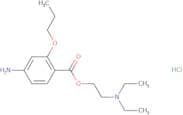
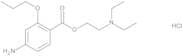
Propoxycainehydrochlorid ist ein Lokalanästhetikum, das zur Esterklasse von Verbindungen gehört. Es wird hauptsächlich wegen seiner anesthetischen Eigenschaften bei medizinischen und zahnmedizinischen Eingriffen verwendet. Die Substanz zeichnet sich durch ihre Fähigkeit aus, die Nervenleitung zu blockieren, was einen vorübergehenden Verlust des Gefühls in den gezielten Bereichen ermöglicht. Propoxycainehydrochlorid wird typischerweise durch Injektion oder topische Anwendung verabreicht. Seine chemische Struktur umfasst eine Propoxygruppe, die zu seiner anesthetischen Wirksamkeit und seinem pharmakokinetischen Profil beiträgt. Die Hydrochlorid-Salzform verbessert seine Löslichkeit in Wasser, was es für verschiedene Formulierungen geeignet macht. Die Verbindung zeigt eine relativ schnelle Wirksamkeit, obwohl die Wirkungsdauer je nach spezifischer Anwendung und verwendeter Konzentration variieren kann. Wie bei anderen Lokalanästhetika können potenzielle Nebenwirkungen allergische Reaktionen, systemische Toxizität oder lokale Reizungen umfassen. Eine angemessene Dosierung und Verabreichung sind entscheidend, um Risiken zu minimieren und eine effektive Schmerzbehandlung sicherzustellen. Insgesamt ist Propoxycainehydrochlorid ein wertvolles Werkzeug in klinischen Einrichtungen zur Bereitstellung von lokaler Anästhesie.
Formel:C16H26N2O3·ClH
InChl:InChI=1S/C16H26N2O3.ClH/c1-4-10-20-15-12-13(17)7-8-14(15)16(19)21-11-9-18(5-2)6-3;/h7-8,12H,4-6,9-11,17H2,1-3H3;1H
InChI Key:InChIKey=GITPCGSPKUQZTE-UHFFFAOYSA-N
SMILES:C(OCCN(CC)CC)(=O)C1=C(OCCC)C=C(N)C=C1.Cl
Synonyme:- 2-(Diethylamino)Ethyl 4-Amino-2-Propoxybenzoate Hydrochloride (1:1)
- 2-(Diethylamino)ethyl 4-amino-2-propoxybenzoate monohydrochloride
- 2-Diethylaminoethyl 4-amino-2-propoxybenzoate hydrochloride
- 2′-Diethylaminoethyl 2-propoxy-4-aminobenzoate hydrochloride
- 4-Amino-2-propoxybenzoic acid 2-(diethylamino)ethyl ester hydrochloride
- 4-Amino-2-propoxybenzoic acid 2-diethylaminoethyl ester hydrochloride
- Benzoic acid, 4-amino-2-propoxy-, 2-(diethylamino)ethyl ester, hydrochloride (1:1)
- Benzoic acid, 4-amino-2-propoxy-, 2-(diethylamino)ethyl ester, monohydrochloride
- Blockain
- Blockain hydrochloride
- Blockaine hydrochloride
- Pravocaine hydrochloride
- Propoxycaine HCl
- Ravocaine hydrochloride
- Rovocaine hydrochloride
- Unii-K490D39G46
- Win 3459
- Weitere Synonyme anzeigen
Sortieren nach
Reinheit (%)
0
100
|
0
|
50
|
90
|
95
|
100
9 Produkte.
Propoxycaine Hydrochloride
CAS:Kontrolliertes ProduktFormel:C16H26N2O3·ClHFarbe und Form:NeatMolekulargewicht:330.85Propoxycaine Hydrochloride
CAS:Kontrolliertes ProduktApplications Propoxycaine is used as a local anaesthetic, an analogue of Procaine (P755150), a local anesthetic of the amino ester group that is primarily used as a topical anesthetic. Procaine is also used to control the pain of intramuscular injection of penicillin as well as in dentistry.
References Kania, B.H. et al.: Pol. J. Vet. Sci., 6, 279 (2003); Jussi, L. et al.: Cont. Derm., 60, 150 (2009); Gangarosa, L.P. Sr.: J. Dent. Res., 60, 1471 (1981); Torrens, F. et al.: Int. J. Mol. Sci., 7, 12 (2006);Formel:C16H26N2O3·ClHFarbe und Form:NeatMolekulargewicht:330.85Propoxycaine hydrochloride
CAS:Propoxycaine hydrochloride is an ester local anesthetic that inhibits voltage-gated sodium channels, modulates nerve impulses, and induces loss of sensation.Formel:C16H27ClN2O3Reinheit:97.25%Farbe und Form:SolidMolekulargewicht:330.85Propoxycaine-d4 Hydrochloride
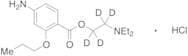
CAS:Kontrolliertes ProduktFormel:C16D4H22N2O3·HClFarbe und Form:NeatMolekulargewicht:334.875Propoxycaine hydrochloride
CAS:Kontrolliertes ProduktPropoxycaine hydrochloride is a vasoconstrictor that is used as a local anesthetic. It is converted to procaine in the body and is thought to act by blocking sodium channels in nerve cells, thereby preventing the transmission of pain signals. Studies have shown that propoxycaine hydrochloride can be used to treat trigeminal neuralgia, which causes pain on one side of the face that feels like an electric shock.Formel:C16H27ClN2O3Reinheit:Min. 95%Farbe und Form:PowderMolekulargewicht:330.85 g/mol