CAS 55056-80-9
:Protodioscin
Beschreibung:
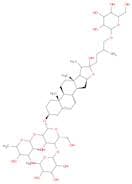
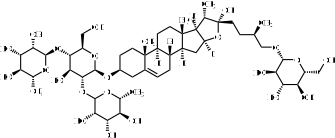
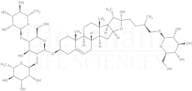
Protodioscin ist ein natürlich vorkommendes steroidales Saponin, das hauptsächlich in verschiedenen Pflanzenarten vorkommt, insbesondere in der Gattung Dioscorea, die allgemein als Yams bekannt ist. Es wird für seine potenziellen pharmakologischen Eigenschaften anerkannt, einschließlich seiner Rolle als Adaptogen und seiner Fähigkeit, die körperliche Leistung und Libido zu steigern. Strukturell besteht Protodioscin aus einem steroidalen Rückgrat mit einer Zuckerkomponente, die zu seiner biologischen Aktivität beiträgt. Die Verbindung wird häufig auf ihre Auswirkungen auf den Hormonspiegel, insbesondere Testosteron, und ihre potenzielle Verwendung in der traditionellen Medizin zur Verbesserung der sexuellen Gesundheit und Vitalität untersucht. Darüber hinaus zeigt Protodioscin antioxidative und entzündungshemmende Eigenschaften, was es zu einem interessanten Thema im Bereich der Forschung zu Naturstoffen macht. Sein Sicherheitsprofil und seine Wirksamkeit sind noch in Untersuchung, und obwohl es allgemein als sicher in moderaten Mengen angesehen wird, sind weitere Studien erforderlich, um sein therapeutisches Potenzial und die Wirkmechanismen vollständig zu verstehen. Wie bei jeder bioaktiven Verbindung ist es wichtig, ihren Gebrauch mit Vorsicht und unter angemessener Anleitung anzugehen.
Formel:C51H84O22
InChl:InChI=1S/C51H84O22/c1-20(19-65-45-39(60)38(59)35(56)30(17-52)69-45)9-14-51(64)21(2)32-29(73-51)16-28-26-8-7-24-15-25(10-12-49(24,5)27(26)11-13-50(28,32)6)68-48-44(72-47-41(62)37(58)34(55)23(4)67-47)42(63)43(31(18-53)70-48)71-46-40(61)36(57)33(54)22(3)66-46/h7,20-23,25-48,52-64H,8-19H2,1-6H3/t20-,21+,22+,23+,25+,26-,27+,28+,29+,30-,31-,32+,33+,34+,35-,36-,37-,38+,39-,40-,41-,42+,43-,44-,45-,46+,47+,48-,49+,50+,51-/m1/s1
InChI Key:InChIKey=LVTJOONKWUXEFR-UEZXSUPNSA-N
SMILES:C[C@@]12[C@]([C@]3([C@](CC1)([C@]4(C)C(=CC3)C[C@@H](O[C@H]5[C@H](O[C@H]6[C@H](O)[C@H](O)[C@@H](O)[C@H](C)O6)[C@@H](O)[C@H](O[C@H]7[C@H](O)[C@H](O)[C@@H](O)[C@H](C)O7)[C@@H](CO)O5)CC4)[H])[H])(C[C@]8([C@@]2([C@H](C)[C@](CC[C@H](CO[C@@H]9O[C@H](CO)[C@@H](O)[C@H](O)[C@H]9O)C)(O)O8)[H])[H])[H]
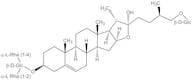
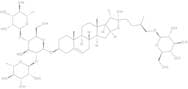
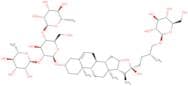
Synonyme:- (3beta,22R,25R)-26-(beta-D-glucopyranosyloxy)-22-hydroxyfurost-5-en-3-yl 6-deoxy-alpha-L-mannopyranosyl-(1->2)-[6-deoxy-alpha-L-mannopyranosyl-(1->4)]-beta-D-glucopyranoside
- (3β,22α,25R)-26-(β-<span class="text-smallcaps">D</smallcap>-Glucopyranosyloxy)-22-hydroxyfurost-5-en-3-yl O-6-deoxy-α-<smallcap>L</smallcap>-mannopyranosyl-(1→2)-O-[6-deoxy-α-<smallcap>L</smallcap>-mannopyranosyl-(1→4)]-β-<smallcap>D</span>-glucopyranoside
- 26-O-beta-D-Glycopyranosyl-22-hydroxyfurost-5-ene-3beta,26-diol-3-O-beta-diglucorhamnoside
- 26-O-β-<span class="text-smallcaps">D</smallcap>-Glucopyranosyl-(25R)-furost-5-ene-3β,22α,26-triol 3-O-α-<smallcap>L</smallcap>-rhamnopyranosyl-(1-2)-[α-<smallcap>L</smallcap>-rhamnopyranosyl-(1-4)]-β-<smallcap>D</span>-glucopyranoside
- 3β,22α,26-Trihydroxyfurost-5-ene 3-O-β-chacotrioside 26-O-β-<span class="text-smallcaps">D</span>-glucopyranoside
- β-<span class="text-smallcaps">D</smallcap>-Glucopyranoside, (3β,22α,25R)-26-(β-<smallcap>D</smallcap>-glucopyranosyloxy)-22-hydroxyfurost-5-en-3-yl O-6-deoxy-α-<smallcap>L</smallcap>-mannopyranosyl-(1→2)-O-[6-deoxy-α-<smallcap>L</span>-mannopyranosyl-(1→4)]-
- 26-O-β-D-Glucopyranosyl-(25R)-furost-5-ene-3β,22α,26-triol 3-O-α-L-rhamnopyranosyl-(1-2)-[α-L-rhamnopyranosyl-(1-4)]-β-D-glucopyranoside
- 3β,22α,26-Trihydroxyfurost-5-ene 3-O-β-chacotrioside 26-O-β-D-glucopyranoside
- β-D-Glucopyranoside, (3β,22α,25R)-26-(β-D-glucopyranosyloxy)-22-hydroxyfurost-5-en-3-yl O-6-deoxy-α-L-mannopyranosyl-(1→2)-O-[6-deoxy-α-L-mannopyranosyl-(1→4)]-
- (3β,22α,25R)-26-(β-D-Glucopyranosyloxy)-22-hydroxyfurost-5-en-3-yl O-6-deoxy-α-L-mannopyranosyl-(1→2)-O-[6-deoxy-α-L-mannopyranosyl-(1→4)]-β-D-glucopyranoside
- Protodioscin
Sortieren nach
Reinheit (%)
0
100
|
0
|
50
|
90
|
95
|
100
9 Produkte.
Protodioscin
CAS:Protodioscin has been shown to exhibit multiple biological actions, such as anti-hyperlipidemia, anti-cancer, sexual effects and cardiovascular properties. It appears to possess aphrodisiac activity probably due to its androgen increasing property, it will be useful in developing health food supplement(s) and/or drug(s) against hyperlipidemia.Formel:C51H84O22Reinheit:95%~99%Molekulargewicht:1049.21Protodioscin
CAS:Protodioscin (Furostanol I) is a major steroidal saponin in dioscoreae rhizome, with anti-hyperlipidemia, anti-cancer properties.Formel:C51H84O22Reinheit:98% - 99.66%Farbe und Form:Brown Yellow PowderMolekulargewicht:1049.20Ref: TM-T2321
2mg34,00€5mg52,00€10mg71,00€1mL*10mM (DMSO)80,00€25mg114,00€50mg167,00€100mg240,00€200mg355,00€Protodioscin
CAS:Natural glycosideFormel:C51H84O22Reinheit:≥ 90.0 % (HPLC)Farbe und Form:PowderMolekulargewicht:1049.22Protodioscin
CAS:Applications Protodioscin is a steroidal saponin compound found in a number of plant species. It is known to be the active component of the herbal aphrodisiac plant Tribulus terrestris. It has also shown to produce significant increases in the levels of the hormonal levels in animal studies.
References Gauthaman, K., et al.: Inter. J. Phytother. Phytopharm., 15, 44 (2008); Ganzera, M., et al.: J. Pharmac. Sci., 90(11), 1752 (2001);Formel:C51H84O22Farbe und Form:Off-White To Light BeigeMolekulargewicht:1049.2Protodioscin
CAS:Protodioscin is a steroidal saponin, which is a naturally occurring glycoside. It is predominantly sourced from the plant Tribulus terrestris but can also be found in other medicinal plants such as Dioscorea species. The mode of action of protodioscin involves its ability to influence the levels of dehydroepiandrosterone (DHEA) and other hormones, potentially affecting physiological functions related to vitality and performance.Formel:C51H84O22Reinheit:Min. 95%Farbe und Form:PowderMolekulargewicht:1,049.22 g/mol