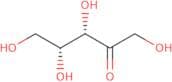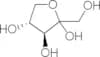
CAS 551-84-8
:D-Xylulose
Beschreibung:
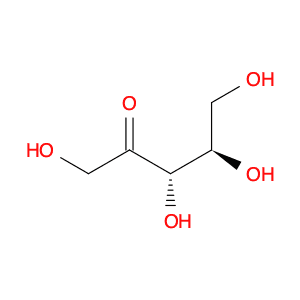
D-Xylulose ist ein Zucker mit fünf Kohlenstoffatomen, spezifisch ein Ketopentose, mit der chemischen Formel C5H10O5. Es ist ein farbloser, kristalliner Feststoff, der in Wasser löslich ist und einen süßen Geschmack aufweist. D-Xylulose spielt eine bedeutende Rolle im Kohlenhydratstoffwechsel, insbesondere im Pentosephosphatweg, der für die Zellatmung und die Synthese von Nukleotiden entscheidend ist. Dieser Zucker existiert in zwei stereoisomeren Formen, wobei D-Xylulose die biologisch aktive Form ist. Er kann durch Hydrolyse von Xylan, einem in pflanzlichen Zellwänden vorkommenden Hemicellulose, hergestellt werden und ist auch an verschiedenen biochemischen Prozessen beteiligt, einschließlich der Synthese von Ribose und anderen essentiellen Biomolekülen. In Bezug auf seine chemische Reaktivität kann D-Xylulose an Maillard-Reaktionen teilnehmen, die zur Entwicklung von Geschmack und Farbe in Lebensmitteln beitragen. Seine CAS-Nummer, 551-84-8, wird zur Identifizierung in chemischen Datenbanken und regulatorischen Kontexten verwendet. Insgesamt ist D-Xylulose eine wichtige Verbindung sowohl in biologischen Systemen als auch in industriellen Anwendungen.
Formel:C5H10O5
InChl:InChI=1/C5H10O5/c6-1-3(8)5(10)4(9)2-7/h3,5-8,10H,1-2H2/t3-,5+/m1/s1
InChI Key:InChIKey=ZAQJHHRNXZUBTE-WUJLRWPWSA-N
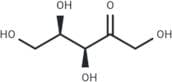
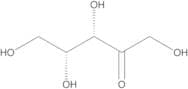
SMILES:[C@H]([C@@H](CO)O)(C(CO)=O)O
Synonyme:- <span class="text-smallcaps">D</span>-Xylulose
- <span class="text-smallcaps">D</span>-threo-2-Pentulose
- <span class="text-smallcaps">D</span>-threo-Pentulose
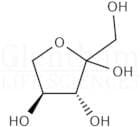
- D-xylulofuranose
- D-xylulose approx. 95%
- Xylulose
- D-threo-2-Pentulose
- D-threo-Pentulose
- D-Xylulose
- D-Xylulose - Aqueous solution
- D-threo-2-Pentulose (9CI)
- D-Xylulosecas
- D-Xylulose,D-threo-Pentulose
- D-Xylulose (0.5 M in Water)
- (3S,4R)-1,3,4,5-tetrahydroxypentan-2-one
- D-XYLULOSE USP/EP/BP
- D-THREO-PENT-2-ULOSE
- D-Xylulose ,98%
- Weitere Synonyme anzeigen
Sortieren nach
Reinheit (%)
0
100
|
0
|
50
|
90
|
95
|
100
7 Produkte.
D-Xylulose, solution in water
CAS:Formel:C5H10O5Reinheit:≥ 98.0%Farbe und Form:Clear, colourless to light-yellow liquidMolekulargewicht:150.13D-Xylulose
CAS:D-Xylulose is made from xylitol by NAD+ xylitol dehydrogenase in mammals' main metabolic pathway.Formel:C5H10O5Reinheit:98%Farbe und Form:SolidMolekulargewicht:150.13D-Xylulose (0.5 M in Water)
CAS:Kontrolliertes ProduktApplications D-Xylulose can be used through fermentation to produce ethanol.
References Yuan, D. et al.: Biores. Tech., 102, 3246 (2011);Formel:C5H10O5Farbe und Form:Single SolutionMolekulargewicht:150.13D-Xylulose - Aqueous solution
CAS:D-Xylulose is a sugar monomer found in the cell walls of bacteria. It is also present in human blood, where it is converted to xylitol. D-Xylulose has been shown to be an important component of bacterial cell wall synthesis and can be used as a probiotic for humans. The enzyme xylitol dehydrogenase catalyses the conversion of D-xylulose to xylitol. The reaction mechanism is thought to be similar to that of other enzymes in the glycolysis pathway, such as ribitol dehydrogenase, which converts ribitol to ribose 5-phosphate. This conversion can be achieved through two different methods: hydrogen fluoride or sodium hydroxide. D-Xylulose can also be used for analytical purposes, such as in the detection of trifluoroacetic acid (TFA) by gas chromatography and mass spectrometry.Formel:C5H10O5Reinheit:Min. 99 Area-%Farbe und Form:Clear LiquidMolekulargewicht:150.13 g/mol