CAS 5518-52-5
:Tri(2-furyl)phosphin
Beschreibung:
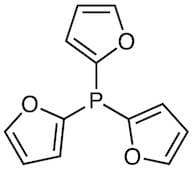
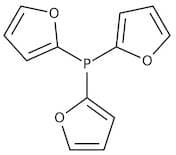
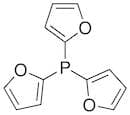
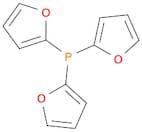
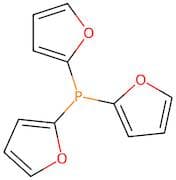
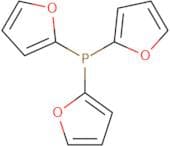
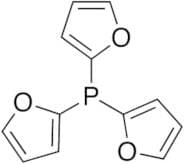
Tri(2-furyl)phosphin ist eine organophosphorverbindung, die durch das Vorhandensein von drei 2-Furylgruppen, die an ein zentrales Phosphoratome gebunden sind, gekennzeichnet ist. Diese Verbindung erscheint typischerweise als farblose bis blassgelbe Flüssigkeit oder Feststoff, abhängig von ihrer Reinheit und Temperatur. Sie ist bekannt für ihre charakteristischen aromatischen Eigenschaften aufgrund der Furanringe, die zu ihrer Reaktivität und potenziellen Anwendungen in der organischen Synthese und der Koordinationschemie beitragen. Tri(2-furyl)phosphin kann als Ligand in Koordinationskomplexen wirken und die Bildung von Metall-Ligand-Interaktionen erleichtern. Ihre Struktur ermöglicht verschiedene chemische Reaktionen, einschließlich Oxidation und Koordination mit Übergangsmetallen. Darüber hinaus kann sie aufgrund des konjugierten Systems der Furanringe interessante elektronische Eigenschaften aufweisen. Sicherheitsüberlegungen sollten beim Umgang mit dieser Verbindung berücksichtigt werden, da sie gesundheitliche Risiken darstellen kann, wenn sie eingeatmet oder eingenommen wird. Insgesamt ist Tri(2-furyl)phosphin eine wertvolle Verbindung im Bereich der organophosphorchemie mit potenziellen Anwendungen in der Katalyse und Materialwissenschaft.
Formel:C12H9O3P
InChl:InChI=1/C12H9O3P/c1-4-10(13-7-1)16(11-5-2-8-14-11)12-6-3-9-15-12/h1-9H
SMILES:c1cc(oc1)P(c1ccco1)c1ccco1
Synonyme:- Phosphine, tri-2-furanyl-
- Tri-2-furylphosphine
- Tris-furan-2-yl-phosphine
- Trifuran-2-Ylphosphane
Sortieren nach
Reinheit (%)
0
100
|
0
|
50
|
90
|
95
|
100
9 Produkte.
Tri(2-furyl)phosphine
CAS:Formel:C12H9O3PReinheit:>98.0%(GC)Farbe und Form:White to Yellow to Orange powder to crystalMolekulargewicht:232.17Tri(2-furyl)phosphine, 97%
CAS:This Thermo Scientific Chemicals brand product was originally part of the Alfa Aesar product portfolio. Some documentation and label information may refer to the legacy brand. The original Alfa Aesar product / item code or SKU reference has not changed as a part of the brand transition to Thermo SciFormel:C12H9O3PReinheit:97%Farbe und Form:White to cream to pale brown or yellow to orange, Crystals or powder or crystalline powder or fused solidMolekulargewicht:232.18Tri-2-furylphosphine, 98+%
CAS:Tri-2-furylphosphine, 98+%
Formel:(C4H3O)3PReinheit:98+%Farbe und Form:white pwdr.Molekulargewicht:232.17Tri(fur-2-yl)phosphine
CAS:Tri(fur-2-yl)phosphineFormel:C12H9O3PReinheit:≥95%Farbe und Form: white solidMolekulargewicht:232.17g/molTri(2-furyl)phosphine
CAS:Tri(2-furyl)phosphine (TFP) is a homogeneous catalyst that catalyzes the palladium-catalyzed coupling of aryl bromides and chlorides to form new chiral organic molecules. The reaction mechanism involves the formation of an activated Pd(0) species, which is converted to a Pd(II) species by the addition of a nucleophile. TFP also has been used in asymmetric synthesis, as it can be used for the synthesis of diastereomeric alcohols, nitriles, amines and amino acids. The use of TFP in cross-coupling reactions has been reported to be both reactive and selective. It has been shown that TFP can be used to synthesize ferrocenecarboxylic acid and chloride derivatives. TFP is also able to cleave prochiral bonds with trifluoroacetic acid or hydrogen bonding interactions with chloride ions.Formel:C12H9O3PReinheit:Min. 97.5%Farbe und Form:PowderMolekulargewicht:232.17 g/molTri(2-furyl)phosphine
CAS:Kontrolliertes ProduktApplications A phopshine ligand used in transition-metal mediated organic synthesis, in particular in wittig reactions to improved (Z) selectivity.
References Andersen N.G. et al.: Chem. Rev., 101, 997 (2001); Appel M. et al.: Eur. J. Org. Chem., 1143, (2002);Formel:C12H9O3PFarbe und Form:NeatMolekulargewicht:232.17