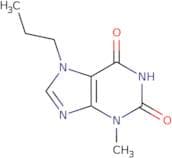
CAS 55242-64-3
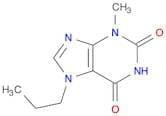
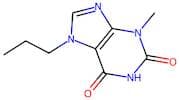
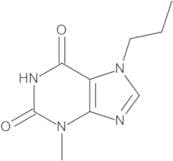
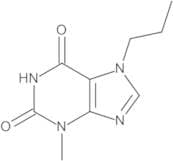
:3,7-Dihydro-3-methyl-7-propyl-1H-purin-2,6-dion
Beschreibung:
3,7-Dihydro-3-methyl-7-propyl-1H-purin-2,6-dion, auch bekannt als ein Derivat der Purin, ist eine chemische Verbindung, die durch ihre bicyclische Struktur gekennzeichnet ist, die aus einem fusionierten Imidazol- und Pyrimidinring besteht. Diese Verbindung weist eine Methylgruppe und eine Propylgruppe an den Positionen 3 und 7 auf, was zu ihren einzigartigen Eigenschaften beiträgt. Sie wird als Purinderivat klassifiziert, das in der Biochemie wichtig ist, insbesondere in der Struktur von Nukleotiden und Nukleinsäuren. Das Vorhandensein von Carbonylgruppen an den Positionen 2 und 6 erhöht ihre Reaktivität und potenzielle biologische Aktivität. Diese Verbindung kann verschiedene pharmakologische Eigenschaften aufweisen, was sie in der medizinischen Chemie von Interesse macht. Ihre Löslichkeit, Stabilität und Reaktivität können je nach Umweltbedingungen wie pH und Temperatur variieren. Wie viele Purinderivate kann sie mit biologischen Systemen interagieren, metabolische Wege beeinflussen oder als Vorläufer für andere biologisch relevante Moleküle dienen. Weitere Studien sind oft erforderlich, um ihre biologischen Rollen und potenziellen Anwendungen vollständig zu klären.
Formel:C9H12N4O2
InChl:InChI=1S/C9H12N4O2/c1-3-4-13-5-10-7-6(13)8(14)11-9(15)12(7)2/h5H,3-4H2,1-2H3,(H,11,14,15)
InChI Key:InChIKey=MHNVSFOURBQRPK-UHFFFAOYSA-N
SMILES:C(CC)N1C2=C(N(C)C(=O)NC2=O)N=C1
Synonyme:- 1H-Purine-2,6-dione, 3,7-dihydro-3-methyl-7-propyl-
- 3,7-Dihydro-3-methyl-7-propyl-1H-purine-2,6-dione
- 3-Methyl-7-Propyl-Xanthine
- 3-Methyl-7-n-propylxanthine
- 3-Methyl-7-propyl-2,3,6,7-tetrahydro-1H-purine-2,6-dione
- 3-Methyl-7-propyl-3,7-dihydro-1H-purine-2,6-dione
- 3-Methyl-7-propylpurine-2,6-dione
- 6,8-Dichloro-9-(tetrahydro-2H-pyran-2-yl)purine
- 3-Methyl-7-propylxanthine
Sortieren nach
Reinheit (%)
0
100
|
0
|
50
|
90
|
95
|
100
7 Produkte.
3-Methyl-7-propylxanthine
CAS:Formel:C9H12N4O2Reinheit:98%Farbe und Form:SolidMolekulargewicht:208.21723-Methyl-7-propylxanthine
CAS:Kontrolliertes ProduktFormel:C9H12N4O2Farbe und Form:NeatMolekulargewicht:208.223-Methyl-7-propylxanthine
CAS:Kontrolliertes ProduktFormel:C9H12N4O2Farbe und Form:White To Light YellowMolekulargewicht:208.223-Methyl-7-propylxanthine
CAS:Kontrolliertes Produkt3-Methyl-7-propylxanthine is a xanthine derivative that is used in the manufacture of medicines for animals. It has been shown to be a competitive inhibitor of theophylline, which is a bronchodilator. 3-Methyl-7-propylxanthine has been shown to bind to theophylline at sites on the enzyme that are not occupied by caffeine and also inhibits its ability to stimulate adenosine receptors. This compound was synthesized in an attempt to identify compounds that would have fewer side effects than caffeine, such as increased heart rate, nervousness, and stomach irritation. The synthesis of 3-methyl-7-propylxanthine involved modifying the xanthinone ring with substituents that would cause steric interactions with endogenous adenosine when it binds to its receptor. The reaction temperature was also manipulated so that supramolecular structures were formed and energy metabolism was enhanced.Formel:C9H12N4O2Reinheit:Min. 95%Farbe und Form:PowderMolekulargewicht:208.22 g/mol