CAS 553-97-9
:Methyl-1,4-benzochinon
Beschreibung:
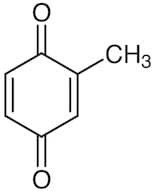
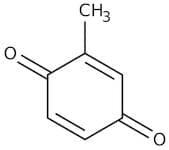
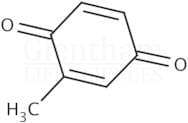
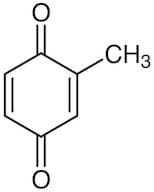
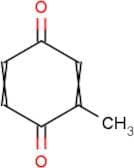
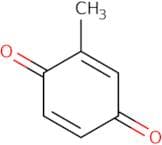
Methyl-1,4-benzochinon, auch bekannt als 2-Methyl-1,4-benzochinon, ist eine organische Verbindung mit der chemischen Formel C7H6O2. Sie ist durch eine Chinonstruktur gekennzeichnet, die einen sechsgliedrigen aromatischen Ring mit zwei Carbonylgruppen (C=O) an den Positionen 1 und 4 sowie einer Methylgruppe an der Position 2 aufweist. Diese Verbindung erscheint typischerweise als gelbes bis orangefarbenes Feststoff und ist in organischen Lösungsmitteln wie Ethanol und Aceton löslich. Methyl-1,4-benzochinon ist bekannt für seine Reaktivität, insbesondere in Redoxreaktionen, wo es als Elektronenakzeptor fungieren kann. Es wird häufig in der organischen Synthese und als Zwischenprodukt in der Herstellung verschiedener Farbstoffe und Arzneimittel verwendet. Darüber hinaus zeigt es antimikrobielle Eigenschaften und wurde auf seine potenziellen Anwendungen in der Biochemie und Medizin untersucht. Aufgrund seiner reaktiven Natur erfordert der Umgang mit dieser Verbindung geeignete Sicherheitsvorkehrungen, um eine Exposition zu vermeiden und sichere Laborpraktiken zu gewährleisten.
Formel:C7H6O2
InChl:InChI=1S/C7H6O2/c1-5-4-6(8)2-3-7(5)9/h2-4H,1H3
InChI Key:InChIKey=VTWDKFNVVLAELH-UHFFFAOYSA-N
SMILES:CC=1C(=O)C=CC(=O)C1
Synonyme:- 2-Methyl-1,4-benzoquinone
- 2-Methyl-2,5-cyclohexadien-1,4-dione
- 2-Methyl-2,5-cyclohexadiene-1,4-dione
- 2-Methyl-p-benzoquinone
- 2-Methylbenzoquinone
- 2-Methylquinone
- Benzoquinone, 4-Methyl-
- Cresoquinone
- Methyl-1,4-benzoquinone
- Methyl-p-benzochinon
- Methyl-p-benzoquinone
- Methyl-p-quinone
- Metil-P-Benzoquinona
- Monomethyl-p-benzoquinone
- Nsc 405002
- p-Benzoquinone, 2-methyl-
- p-Benzoquinone, methyl-
- p-Toluquinone
- 2,5-Cyclohexadiene-1,4-dione, 2-methyl-
- Toluquinone
- Weitere Synonyme anzeigen
Sortieren nach
Reinheit (%)
0
100
|
0
|
50
|
90
|
95
|
100
10 Produkte gefunden.
p-Toluquinone
CAS:Formel:C7H6O2Reinheit:>99.0%(GC)(T)Farbe und Form:Light yellow to Amber to Dark green powder to crystalMolekulargewicht:122.12Methyl-p-benzoquinone, 98%
CAS:Methyl-p-benzoquinone imine is the products were the tetrahedral adducts. Synthesis of 2H-indazole-4,7-dione derivatives from3-phenylsydnone and p-toluquinone. A Michael addition of 2-methylcyclopentane-1,3-dione to various p-toluquinone imides exclusively afforded the sole products in a regiospeciFormel:C7H6O2Reinheit:98%Farbe und Form:Crystalline powder, Yellow to brownMolekulargewicht:122.122,5-Cyclohexadiene-1,4-dione, 2-methyl-
CAS:Formel:C7H6O2Reinheit:97%Farbe und Form:SolidMolekulargewicht:122.12132-Methylcyclohexa-2,5-diene-1,4-dione
CAS:2-Methylcyclohexa-2,5-diene-1,4-dione exhibits inhibitory activity against cancer cells such as A2780, HT-29, HL-60, and K562 (IC50 = 2.8–12.1 µM) and antibacterial activity against Bacillus subtilis.Formel:C7H6O2Reinheit:99.89% - 99.90%Farbe und Form:SolidMolekulargewicht:122.12p-Toluquinone
CAS:Formel:C7H6O2Reinheit:>98.0%(GC)(T)Farbe und Form:Light yellow to Brown powder to crystalMolekulargewicht:122.12Methyl-p-benzoQuinone
CAS:Methyl-p-benzoquinone is a chemical compound that is used in wastewater treatment. It has been shown to inhibit the activity of enzymes involved in oxidative injury, such as superoxide dismutase and catalase. Methyl-p-benzoquinone also inhibits the oxidation of sulfhydryl groups by forming stable complexes with proteins. The redox cycle of this compound is essential for its function. Methyl-p-benzoquinone has been shown to have an inhibitory effect on cellular respiration, which may be due to its ability to reduce proton levels and prevent the formation of reactive oxygen species (ROS). This compound also has anti-inflammatory properties that may be due to its role in the regulation of gene expression and cell proliferation.Formel:C7H6O2Reinheit:Min. 95%Farbe und Form:PowderMolekulargewicht:122.12 g/molp-Toluquinone
CAS:p-Toluquinone is a reactive substance that is used in organic synthesis as a building block and an intermediate. It can be used to synthesize various types of compounds, such as fine chemicals and pharmaceuticals. This chemical is also used as a reagent for the production of other substances. p-Toluquinone has a CAS number of 553-97-9 and is classified under the category of useful scaffolds, high quality research chemicals, and speciality chemicals.Formel:C7H6O2Reinheit:Min. 99.0 Area-%Molekulargewicht:122.12 g/mol