CAS 556-02-5
:3-(4-Hydroxyphenyl)-D-alanin
Beschreibung:
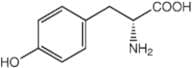
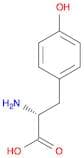
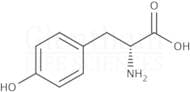
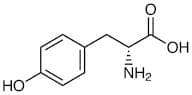
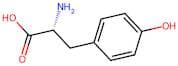
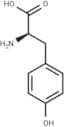
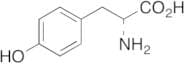
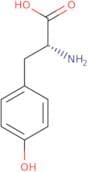
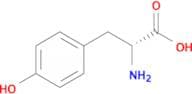
3-(4-Hydroxyphenyl)-D-alanin, auch bekannt als D-Tyrosin, ist ein Aminosäurederivat, das durch das Vorhandensein einer Hydroxylgruppe im phenylischen Ring gekennzeichnet ist, was seine Löslichkeit und Reaktivität verbessert. Diese Verbindung weist ein chirales Zentrum auf, was bedeutet, dass sie in zwei enantiomeren Formen existiert, wobei die D-Form biologisch relevant ist. Es handelt sich um eine nicht essentielle Aminosäure, die eine entscheidende Rolle bei der Biosynthese von Neurotransmittern, insbesondere Dopamin, spielt und an verschiedenen Stoffwechselwegen beteiligt ist. Die Hydroxylgruppe trägt zu seiner polaren Natur bei, was es ihm ermöglicht, an Wasserstoffbrückenbindungen teilzunehmen und mit anderen Biomolekülen zu interagieren. D-Tyrosin wird häufig in der biochemischen Forschung verwendet und hat potenzielle Anwendungen in der Pharmazie und in Nahrungsergänzungsmitteln, insbesondere aufgrund seiner Rolle bei der Verbesserung der kognitiven Funktion und der Stimmung. Darüber hinaus kann es durch verschiedene chemische Methoden synthetisiert oder aus Nahrungsquellen wie Milchprodukten, Fleisch und bestimmten Nüssen gewonnen werden. Seine Stabilität und Reaktivität unter physiologischen Bedingungen machen es zu einer wichtigen Verbindung sowohl in biologischen als auch in synthetischen chemischen Kontexten.
Formel:C9H11NO3
InChl:InChI=1/C9H11NO3/c10-8(9(12)13)5-6-1-3-7(11)4-2-6/h1-4,8,11H,5,10H2,(H,12,13)/t8-/m1/s1
InChI Key:InChIKey=OUYCCCASQSFEME-MRVPVSSYSA-N
SMILES:C([C@H](C(O)=O)N)C1=CC=C(O)C=C1
Synonyme:- (2R)-2-Amino-3-(4-hydroxyphenyl)propanoic acid
- (2R)-2-Azaniumyl-3-(4-hydroxyphenyl)propanoate
- (R)-2-Amino-3-(4-hydroxyphenyl)propanoic acid
- (R)-Tyrosine
- 3-(4-Hydroxyphenyl)-<span class="text-smallcaps">D</span>-alanine
- <span class="text-smallcaps">D</span>-4-Hydroxyphenylalanine
- <span class="text-smallcaps">D</span>-Tyrosine
- <span class="text-smallcaps">D</span>-p-Tyrosine
- D-Tyr-OH
- D-Tyrosine
- H-<span class="text-smallcaps">D</span>-Tyr-OH
- H-D-Tyr-OH
- Tyrosine, <span class="text-smallcaps">D</span>-
- D-p-Tyrosine
- Tyrosine, D-
- RARECHEM AB PP 1343
- TYROSINE, D-(RG)
- D-TYROSINE, 99% (99% EE/GLC)
- D-β-(p-hydroxyphenyl) alanine
- D-Tyrosine98%
- D-3-(4-HYDROXYPHENYL)ALANINE
- D-THREONINOL
- D-TYROSINE extrapure
- (R)-2-Amino-3-(4-hydroxyphenyl)propionic acid, 3-(4-Hydroxyphenyl)-D-alanine
- (R)-2-AMINO-3-(4-HYDROXYPHENYL)PROPIONIC ACID
- (R)-(+)-3-(4-HYDROXYPHENYL)-D-ALANINE
- D(+)-TYROSINE 99%
- 3-(4-HYDROXYPHENYL)-D-ALANINE
- Weitere Synonyme anzeigen
Sortieren nach
Reinheit (%)
0
100
|
0
|
50
|
90
|
95
|
100
11 Produkte.
D-Tyrosine, 99%
CAS:D-Tyrosine is synthesized from phenylalanine. It is also the precursor of epinephrine, thyroid hormones, and melanin. This Thermo Scientific Chemicals brand product was originally part of the Alfa Aesar product portfolio. Some documentation and label information may refer to the legacy brand. The orFormel:C9H11NO3Reinheit:99%Farbe und Form:Powder, WhiteMolekulargewicht:181.19Ref: IN-DA0037N3
5kgNachfragen10kgNachfragen1g25,00€5g25,00€10g28,00€25g43,00€50g61,00€100g91,00€250g166,00€500g214,00€1kg516,00€D-Tyrosine
CAS:Formel:C9H11NO3Reinheit:≥ 98.5%Farbe und Form:White to off-white powderMolekulargewicht:181.19D-Tyrosine
CAS:Formel:C9H11NO3Reinheit:>98.0%(T)Farbe und Form:White to Light yellow powder to crystalMolekulargewicht:181.19D-Tyrosine
CAS:D-Tyrosine inhibits melanin production and biofilm formation, promoting biofilm dispersal without hindering bacterial growth.Formel:C9H11NO3Reinheit:99.86%Farbe und Form:White CrystalsMolekulargewicht:181.19D-Tyrosine
CAS:Kontrolliertes ProduktApplications D-Tyrosine, the stereoisomer to L-Tyrosine (T899975), is an amino acid used in various organic syntheses for antibiotics. It is used in the synthesis of (-)-anisomycin, as well as BATSI (boronic acid transition state inhibitors) which act on β-lactamases. It has also been studied as an inhibitor of microbial growth on surfaces, reducing microbial attachment to hydrophillic glass and hydrophobic polypropylene surfaces.
References Li, Ji. et al.: Chin. Chem. Lett., 23, 647 (2012); Xu, H. et al.: Water Res., 45, 5796 (2011); Ke, W. et al.: Antimicrob. Agents Chemother., 55, 174 (2011);Formel:C9H11NO3Farbe und Form:NeatMolekulargewicht:181.19D-Tyrosine
CAS:D-Tyrosine is an amino acid that is synthesized from the essential amino acid phenylalanine. It has been shown to have antimicrobial properties in vitro, where it inhibits the growth of bacteria by causing the disruption of the bacterial cell membrane. D-Tyrosine has also been shown to be active against gram-positive and gram-negative bacteria, as well as fungi and yeast. The antimicrobial activity may be due to its ability to form hydrogen bonds with nitrogen atoms on the surface of these microorganisms. D-Tyrosine has also been shown to have antiinflammatory properties in vitro by inhibiting prostaglandin synthesis through inhibition of enzymes such as diphenolase activity or synthetase. D-Tyrosine is classified as a nonessential amino acid because it can be synthesized from other amino acids such as phenylalanine or leucine. It has been shown to have inhibitory effects on skin cells when applied topically, which couldFormel:C9H11NO3Farbe und Form:PowderMolekulargewicht:181.19 g/molH-D-Tyr-OH
CAS:M02937 - H-D-Tyr-OH
Formel:C9H11NO3Reinheit:97%Farbe und Form:Solid, Crystalline Powder or PowderMolekulargewicht:181.191D-Tyrosine extrapure, 98%
CAS:Formel:C9H11NO3Reinheit:min. 98.0%Farbe und Form:White to off-white, Crystalline powderMolekulargewicht:181.2