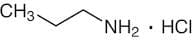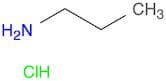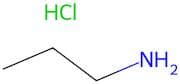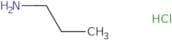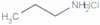
CAS 556-53-6
:Propylammoniumchlorid
Beschreibung:
Propylammoniumchlorid, mit der CAS-Nummer 556-53-6, ist eine organische Verbindung, die zur Klasse der Ammoniumsalze gehört. Sie ist gekennzeichnet durch das Vorhandensein einer Propylgruppe, die an ein Ammoniumion gebunden ist, was zu einer quartären Ammoniumverbindung führt. Diese Substanz erscheint typischerweise als weißes kristallines Feststoff und ist in Wasser löslich, was eine häufige Eigenschaft vieler Ammoniumsalze ist. Propylammoniumchlorid ist bekannt für seine hygroskopischen Eigenschaften, was bedeutet, dass es Feuchtigkeit aus der Umgebung aufnehmen kann. Es wird häufig in verschiedenen chemischen Anwendungen verwendet, einschließlich als Reagenz in der organischen Synthese und in der Formulierung bestimmter Arzneimittel. Die Verbindung zeigt basische Eigenschaften aufgrund des Vorhandenseins des Ammoniumions, das an Säure-Base-Reaktionen teilnehmen kann. Darüber hinaus kann es Anwendungen im Bereich der Biochemie und Materialwissenschaften haben, wo seine ionischen Eigenschaften von Vorteil sein können. Sicherheitsdaten sollten für den Umgang und die Lagerung konsultiert werden, wie bei jeder chemischen Substanz.
Formel:C3H9N·ClH
InChl:InChI=1S/C3H9N.ClH/c1-2-3-4;/h2-4H2,1H3;1H
InChI Key:InChIKey=PYNUOAIJIQGACY-UHFFFAOYSA-N
SMILES:C(CN)C.Cl
Synonyme:- 1-Aminopropane hydrochloride
- 1-Propanamine hydrochloride
- 1-Propanamine, Hydrochloride (1:1)
- 1-Propylammonium chloride
- Propan-1-amine hydrochloride (1:1)
- Propan-1-aminium chloride
- Propylamine, hydrochloride
- Propylammonium chloride
- n-Propylammonium chloride
Sortieren nach
Reinheit (%)
0
100
|
0
|
50
|
90
|
95
|
100
5 Produkte.
Propylamine Hydrochloride
CAS:Formel:C3H9N·HClReinheit:>98.0%(T)(N)Farbe und Form:White to Almost white powder to crystalMolekulargewicht:95.57Propan-1-amine hydrochloride
CAS:Formel:C3H10ClNReinheit:97%Farbe und Form:SolidMolekulargewicht:95.5712Propylamine hydrochloride
CAS:Propylamine hydrochloride is a cationic surfactant that is used in pharmaceutical preparations. It has been shown to be effective against autoimmune diseases such as multiple sclerosis, rheumatoid arthritis, and chronic inflammatory bowel disease. The reactivity of propylamine hydrochloride with caproic acid has been studied through kinetic analysis and quantum mechanical calculations. This compound binds to the fatty acid receptor by hydrogen bonding and electrostatic forces. The basic structure of propylamine hydrochloride consists of two nitrogen atoms and one hydrogen atom bound to a carbon atom with three hydrogens attached to it. The reaction mechanism of propylamine hydrochloride involves the formation of an ion pair between the positively-charged nitrogen atoms and the negatively-charged oxygen atoms on the fatty acid receptor, leading to its binding.Formel:C3H9N·HClReinheit:Min. 95%Molekulargewicht:95.57 g/mol