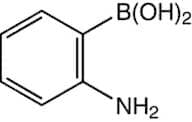
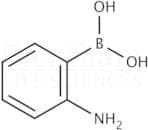
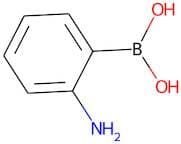
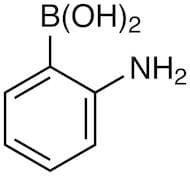
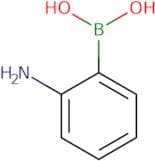
CAS 5570-18-3
:B-(2-Aminophenyl)borsäure
Beschreibung:
B-(2-Aminophenyl)borsäure, mit der CAS-Nummer 5570-18-3, ist eine Organoborverbindung, die durch das Vorhandensein einer boronsäurefunktionellen Gruppe, die an ein 2-Aminophenyl-Moiety gebunden ist, gekennzeichnet ist. Diese Verbindung erscheint typischerweise als weißer bis off-white fester Stoff und ist in polaren Lösungsmitteln wie Wasser und Alkoholen löslich, was auf die Anwesenheit der Boronsäuregruppe zurückzuführen ist, die Wasserstoffbrückenbindungen bilden kann. Sie zeigt Eigenschaften, die typisch für Boronsäuren sind, einschließlich der Fähigkeit, reversible kovalente Bindungen mit Diolen zu bilden, was sie in verschiedenen Anwendungen wie organischer Synthese, medizinischer Chemie und als Baustein in der Entwicklung von Arzneimitteln nützlich macht. Die Aminogruppe im aromatischen Ring kann an weiteren chemischen Reaktionen teilnehmen, was ihre Vielseitigkeit erhöht. Darüber hinaus kann B-(2-Aminophenyl)borsäure als Ligand in der Koordinationschemie wirken und wird häufig in der Synthese komplexer organischer Moleküle durch Kreuzkupplungsreaktionen, wie z.B. der Suzuki-Miyaura-Kupplung, verwendet. Ihre Reaktivität und Funktionalisierungspotenzial machen sie zu einer wertvollen Verbindung sowohl in der Forschung als auch in industriellen Anwendungen.
Formel:C6H8BNO2
InChl:InChI=1S/C6H8BNO2/c8-6-4-2-1-3-5(6)7(9)10/h1-4,9-10H,8H2
InChI Key:InChIKey=DIRRKLFMHQUJCM-UHFFFAOYSA-N
SMILES:B(O)(O)C1=C(N)C=CC=C1
Synonyme:- 2-Aminobenzeneboronic acid
- 2-Aminophenylboronic Acid Hcl
- 2-Aminophenylboronic acid
- B-(2-Aminophenyl)boronic acid
- Benzeneboronic acid, o-amino-
- Boronic acid, (2-aminophenyl)-
- Boronic acid, B-(2-aminophenyl)-
- N'-[(1Z)-(2,5-dimethoxyphenyl)methylidene]-2-[(4-methylphenyl)amino]acetohydrazide (non-preferred name)
- o-Aminophenylboronic acid
Sortieren nach
Reinheit (%)
0
100
|
0
|
50
|
90
|
95
|
100
7 Produkte.
2-Aminobenzeneboronic acid, 96%
CAS:2-Aminobenzeneboronic acid derivative is used in the synthesis of quinolines by reacting with alpha, beta unsaturated ketones. Its hydrochloride derivative is used in the preparation of designed boronate ligands for glucose-selective holographic sensors. This Thermo Scientific Chemicals brand producFormel:C18H21N3O3Reinheit:96%Farbe und Form:White to cream to brown to gray, PowderMolekulargewicht:327.382-Aminophenylboronic acid
CAS:Formel:C6H8BNO2Reinheit:95%Farbe und Form:SolidMolekulargewicht:136.94422-Aminobenzeneboronic acid
CAS:2-Aminobenzeneboronic acidFormel:C6H8BNO2Reinheit:98%Farbe und Form: light yellow solidMolekulargewicht:136.94g/mol2-Aminophenylboronic Acid (contains varying amounts of Anhydride)
CAS:Formel:C6H8BNO2Farbe und Form:White to Light yellow powder to crystalMolekulargewicht:136.952-Aminophenylboronic acid
CAS:2-Aminophenylboronic acid is an organic compound that can be used as a cross-coupling agent in the Suzuki coupling reaction. It has been used to synthesize amides and β-unsaturated ketones. It has also been used to prepare fluorescent molecules for use in clinical diagnostics. The phase transition temperature of 2-aminophenylboronic acid is approximately -6°C, which makes it useful for the synthesis of amides and β-unsaturated ketones at low temperatures. This compound is not reactive towards nucleophiles due to its acidic character, but it can undergo a nucleophilic attack when protonated. Its fluorescence assay can be used to detect the presence of low concentrations of hydrogen sulfide gas in natural gas pipelines.
Formel:C6H8BNO2Reinheit:Min. 95%Farbe und Form:PowderMolekulargewicht:136.94 g/molRef: 3D-FA10483
Ausgelaufenes produkt