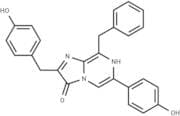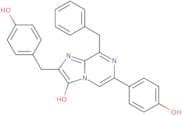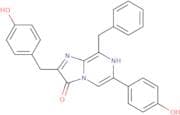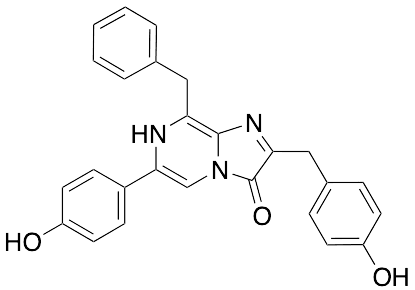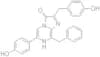
CAS 55779-48-1
:Coelenterazin
Beschreibung:
Coelenterazin ist eine biolumineszente Verbindung, die hauptsächlich in verschiedenen Meeresorganismen vorkommt, einschließlich bestimmter Arten von Quallen und Tiefsee-Kreaturen. Es wird als Luciferin klassifiziert, eine Art von lichtemittierender Molekül, das in Gegenwart von Sauerstoff eine chemische Reaktion durchläuft, die durch das Enzym Luciferase katalysiert wird, um Licht zu erzeugen. Coelenterazin hat eine chemische Formel, die Kohlenstoff, Wasserstoff, Stickstoff und Sauerstoff umfasst, was zu seinen einzigartigen Eigenschaften beiträgt. Diese Verbindung ist bemerkenswert für ihre Rolle in der Biolumineszenz, die verschiedene ökologische Funktionen wie Prädation, Kommunikation und Tarnung erfüllt. Neben ihrem natürlichen Vorkommen wird Coelenterazin in Laborumgebungen für biolumineszente Tests und Bildgebungstechniken verwendet, was sie in der biologischen Forschung wertvoll macht. Ihre Fähigkeit, Licht bei der Reaktion mit spezifischen Enzymen auszusenden, macht sie zu einem nützlichen Werkzeug in der Molekularbiologie und Biochemie. Die Verbindung ist auch von Interesse für das Studium der Meeresbiologie und die Entwicklung von Biosensoren.
Formel:C26H21N3O3
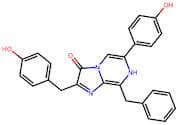
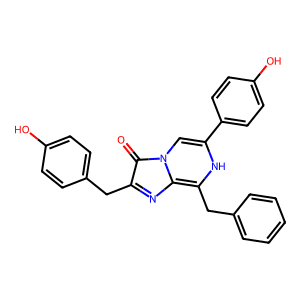
InChl:InChI=1S/C26H21N3O3/c30-20-10-6-18(7-11-20)15-23-26(32)29-16-24(19-8-12-21(31)13-9-19)27-22(25(29)28-23)14-17-4-2-1-3-5-17/h1-13,16,27,30-31H,14-15H2
InChI Key:InChIKey=YHIPILPTUVMWQT-UHFFFAOYSA-N
SMILES:C(C1=C2N(C=C(N1)C3=CC=C(O)C=C3)C(=O)C(CC4=CC=C(O)C=C4)=N2)C5=CC=CC=C5
Synonyme:- 2-[(4-Hydroxyphenyl)Methyl]-6-(4-Hydroxyphenyl)-8-(Phenylmethyl)-Imdazo[1,2-A]Pyrazin-3-(7H)-One
- 6-(4-Hydroxyphenyl)-2-[(4-hydroxyphenyl)methyl]-8-(phenylmethyl)imidazo[1,2-a]pyrazin-3(7H)-one
- 8-Benzyl-2-(4-Hydroxybenzyl)-6-(4-Hydroxyphenyl)Imidazo[1,2-A]Pyrazin-3(7H)-One
- Coelenterazin
- Coelenterazine
- Coelenterazine luciferin
- Coelenterazine ntv
- Imidazo[1,2-a]pyrazin-3(7H)-one, 6-(4-hydroxyphenyl)-2-[(4-hydroxyphenyl)methyl]-8-(phenylmethyl)-
- Luciferin
- Luciferin (Oplophorus)
- NanoFuel
- Native coelenterazine
- Preluciferin
- Preluciferin (Watasenia)
- Weitere Synonyme anzeigen
Sortieren nach
Reinheit (%)
0
100
|
0
|
50
|
90
|
95
|
100
12 Produkte.
Coelenterazine, native, Aequorea sp.
CAS:Coelenterazine, native, Aequorea sp.Formel:C26H21N3O3Molekulargewicht:423.468-benzyl-6-(4-hydroxyphenyl)-2-[(4-hydroxyphenyl)methyl]-7H-imidazo[1,2-a]pyrazin-3-one
CAS:Formel:C26H21N3O3Reinheit:98%Farbe und Form:SolidMolekulargewicht:423.4632Coelenterazine
CAS:CoelenterazineFormel:C26H21N3O3Farbe und Form: yellow to brown crystalline powderMolekulargewicht:423.46g/molCoelenterazine
CAS:Formel:C26H21N3O3Reinheit:≥ 95.0%Farbe und Form:Yellow to brown solidMolekulargewicht:423.46Coelenterazine
CAS:Coelenterazine is a superoxide anion-sensitive chemiluminescent probe.Cost-effective and quality-assured.Formel:C26H21N3O3Reinheit:97.05% - 99.02%Farbe und Form:Yellow SolidMolekulargewicht:423.46Ref: TM-T6808
500µg57,00€1mg94,00€2mg138,00€5mg288,00€10mg442,00€25mg648,00€50mg888,00€100mg1.234,00€200mg1.648,00€Coelenterazine - lyopholised
CAS:Coelenterazine is a bio-luminescent substrate of luciferases such as Renilla luciferase (Rluc) and Gaussia luciferase (Gluc). The main applications of Coelenterazine are monitoring of reporter genes and chemiluminescence-based methods for Calcium detection. The substrate is also used in bioluminescence resonance energy transfer (BRET), ELISA, HTS and chemiluminescent detection of superoxide anion and peroxynitritein cells or tissues. About this grade Coelenterazine, native, dried (C-7002): in order to provide milligram and sub-milligram quantities of native Coelenterazine we pre-dissolve the substance; defined amounts of Coelenterazine are subsequently dried under nitrogen in individual vials. Coelenterazine, native, dried is identical in quality and chemistry to our product Coelenterazine, native which is provided as a powder. Information to the user: since Coelenterazine is sensitive to oxygen, degas your solvents for stock solutions, if possible. To dissolve Coelenterazine, native, dried please proceed as follows. 1) Add the appropriate amount of solvent. If possible through the septum using a needle. Otherwise open the cap with pliers. 2) Vortex the closed vial briefly to completely dissolve the content of the vial. 3) Take out the solution, if possible with a needle through the septum.Formel:C26H21N3O3Reinheit:Min. 95 Area-%Molekulargewicht:423.48 g/molCoelenterazine, native
CAS:Coelenterazine is the substrate for the enzymes Renilla luciferase, Gaussia luciferase and other luciferase enzymes. Marine organisms like squids, shrimps, fish and jellyfish use coelenterazine to produce spectacular bioluminescence (in analogy with insects which utilize firefly luciferine). Today, coelenterazine is used in numerous applications like immunoassays, ELISA, monitoring of reporter genes, chemiluminescence detection of superoxide anion and peroxynitritein cells or tissues. The substrate is also used in bioluminescence resonance energy transfer (BRET), HTS and protein based methods for Calcium detection. The isolation and structure determination of coelenterazine was reported independently by two different groups in the seventies who discovered the molecule in sea pansy (Renilla reniformis) and in the cnidarian Aequorea victoria, respectively. Interestingly it was also found that the luminescent jellyfish Aequorea victoria does not produce coelenterazine itself but it rather assimilates it through ingestion of small preys like shrimps and copepods. This product Coelenterazine, native, which is provided as a powder, is identical in quality and chemistry to our product Coelenterazine, native, dried.Formel:C26H21N3O3Reinheit:Min. 95 Area-%Molekulargewicht:423.48 g/molCoelenterazine Native (CLZN) ex. Aequorea Sp., 95%
CAS:Formel:C26H21N3O3Reinheit:min 95% by TLCFarbe und Form:Slightly brownish yellow to yellow orange, Crystalline powderMolekulargewicht:423.46Coelenterazine, native
CAS:Kontrolliertes ProduktApplications Coelenterazine is a luminophore of the aequorin complex which is oxidized by oxygen to illuminate at 465nm when Ca2+ binds to the complex. Used to measure Ca2+ concentration in cells with high sensitivity an dlarge dynamic range.
References Fluck, R.A., et al.: J. Cell Biol., 115, 1259 (1991), Jones, K., et al.: Trends Biotechnol., 17, 477 (1999), Dubuisson, M.L., et al.: Biochem. Pharmacol., 60, 471 (2000)Formel:C26H21N3O3Farbe und Form:NeatMolekulargewicht:423.46
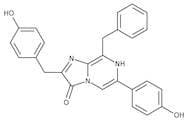

![8-benzyl-6-(4-hydroxyphenyl)-2-[(4-hydroxyphenyl)methyl]-7H-imidazo[1,2-a]pyrazin-3-one](/_next/image/?url=https%3A%2Fstatic.cymitquimica.com%2Fproducts%2FIN%2Fthumb%2FDA00I9Y7.jpg&w=3840&q=75)