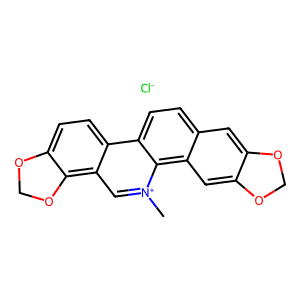
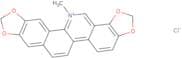
CAS 5578-73-4
:Sanguinarin-Hydrochlorid
- 13-Methyl[1,3]Benzodioxolo[5,6-C][1,3]Dioxolo[4,5-I]Phenanthridin-13-Ium Chloride
- 13-Methyl[1,3]benzodioxolo[5,6-c]-1,3-dioxolo[4,5-i]phenanthridinium chloride
- Sanguinarine hydrochloride
- Sanguinarium Chloride
- [1,3]Benzodioxolo[5,6-c]-1,3-dioxolo[4,5-i]phenanthridinium, 13-methyl-, chloride
- [1,3]Benzodioxolo[5,6-c]-1,3-dioxolo[4,5-i]phenanthridinium, 13-methyl-, chloride (1:1)
- Sanguinarine, chloride
Sanguinarine chloride
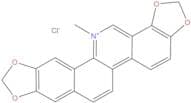
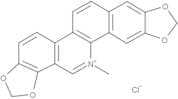
CAS:Sanguinarine chloride analytical standard provided with chromatographic purity, to be used as reference material for qualitative determination.Formel:C20H14NO4ClReinheit:(HPLC) ≥90%Farbe und Form:PowderMolekulargewicht:367.79[1,3]Benzodioxolo[5,6-c]-1,3-dioxolo[4,5-i]phenanthridinium,13-methyl-, chloride (1:1)
CAS:Formel:C20H14ClNO4Reinheit:95%Farbe und Form:SolidMolekulargewicht:367.7825Sanguinarine chloride
CAS:Sanguinarine chloride (Pseudochelerythrine chloride), a benzophenanthridine alkaloid, stimulates apoptosis by activating the production of reactive oxygen
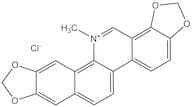
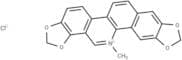
Formel:C20H14ClNO4Reinheit:98% - 99.41%Farbe und Form:SolidMolekulargewicht:367.7813-Methyl-[1,3]Dioxolo[4',5':4,5]Benzo[1,2-C][1,3]Dioxolo[4,5-I]Phenanthridin-13-Ium Chloride
CAS:13-Methyl-[1,3]Dioxolo[4',5':4,5]Benzo[1,2-C][1,3]Dioxolo[4,5-I]Phenanthridin-13-Ium ChlorideReinheit:99+%Molekulargewicht:367.78g/molSanguinarine chloride hydrate
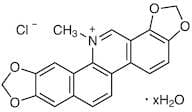
CAS:Formel:C20H14ClNO4·xH2OReinheit:≥ 98.0%Farbe und Form:Red to orange crystalline powderMolekulargewicht:367.78 (anhydrous)Sanguinarine Chloride Hydrate
CAS:Formel:C20H14ClNO4·xH2OReinheit:>98.0%(HPLC)Farbe und Form:Light yellow to Brown powder to crystalMolekulargewicht:367.79 (as Anhydrous)Sanguinarine chloride
CAS:Natural alkaloidFormel:C20H14NO4ClReinheit:≥ 95.0 % (HPLC)Farbe und Form:PowderMolekulargewicht:367.79Sanguinarium Chloride
CAS:Stability Hygroscopic
Applications Sanguinarium Chloride is a natural product with antimicrobial, anti-inflammatory, and anti-oxidant properties. Sanguinarium Chloride has antiproliferative, pro-apoptosis effects in some cancer cell lines.
References Ahmad, N., et al.: Clin. Cancer Res., 6, 1524 (2000), Adhami, V., et al.: Mol. Cancer Ther., 3, 933 (2004),Formel:C20H14NO4·ClFarbe und Form:NeatMolekulargewicht:367.78Sanguinarium-13CD3 Chloride
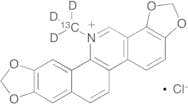
CAS:Kontrolliertes ProduktFormel:C19CH11D3ClNO4Farbe und Form:NeatMolekulargewicht:371.8Sanguinarium chloride
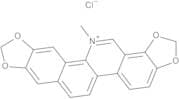
CAS:Sanguinarium chloride is a bioactive compound, which is an alkaloid derived from plants of the Papaveraceae family, particularly the bloodroot (Sanguinaria canadensis). This compound exhibits its mode of action primarily through its ability to disrupt cellular processes by binding to DNA and interfering with the transcriptional machinery of microbes and existing as an antimicrobial agent. Furthermore, Sanguinarium chloride has shown inhibitory effects on bacterial proliferation, making it of interest in the development of antimicrobial and antiplaque products.
Formel:C20H14ClNO4Reinheit:Min. 95%Farbe und Form:PowderMolekulargewicht:367.78 g/mol

![[1,3]Benzodioxolo[5,6-c]-1,3-dioxolo[4,5-i]phenanthridinium,13-methyl-, chloride (1:1)](/_next/image/?url=https%3A%2Fstatic.cymitquimica.com%2Fproducts%2FIN%2Fthumb%2FDA0038NA.jpg&w=3840&q=75)


![13-Methyl-[1,3]Dioxolo[4',5':4,5]Benzo[1,2-C][1,3]Dioxolo[4,5-I]Phenanthridin-13-Ium Chloride](/_next/image/?url=https%3A%2Fstatic.cymitquimica.com%2Fproducts%2F54%2Fthumb%2FOR1025452.jpg&w=3840&q=75)