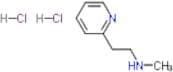
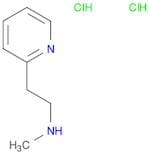
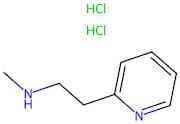
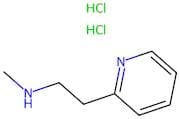
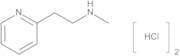
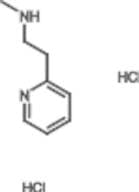
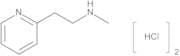
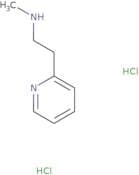
CAS 5579-84-0
:Betahistindihydrochlorid
- 2-Pyridineethanamine, N-methyl-, dihydrochloride
- 2-Pyridineethanamine, N-methyl-, hydrochloride (1:2)
- Betahistine dihydrochloride
- Betahistine hydrochloride
- Betaserc
- N-methyl-2-(pyridin-2-yl)ethanamine dihydrochloride
- Pyridine, 2-[2-(methylamino)ethyl]-, dihydrochloride
- Sinmenier
- Vasomotal
- PT 9
- 2-(2-(METHYLAMINO)ETHYL)PYRIDINE DIHYDROCHLORIDE 99%
- n-methyl-2-pyridineethanamindihydrochloride
- 2-(BETA-METHYLAMINOETHYL)PYRIDINE DIHYDROCHLORIDE
- METHYL[2-(2-PYRIDYL)ETHYL]AMINE DIHYDROCHLORIDE
- Betahistine Hydrochloride CP2000
- BetahistineHCl
- BETAHISTINE DIHYDROCHLORIDE:METHYL(2-[2-PYRIDYL]ETHYL)AMINE
- 2-(2-(METHYLAMINO)ETHYL)PYRIDINE DIHYDROCHLORIDE
- BETAHISTINE DIHYDROCHLORIDE (2-(2-(METHYLAMINO)ETHYL)PYRIDINE DIHYDROCHLORIDE)
- Betahistine 2 hcl
- Serc
- BETA-HISTINE DIHDROCHLORIDE
- N-Methyl-2-pyridin-2-ylethanamine dihydrochloride
- Microser
- Weitere Synonyme anzeigen
Betahistine dihydrochloride
CAS:Betahistine dihydrochlorideFormel:C8H12N2HClReinheit:99.5%Farbe und Form:White. To. Off-WhiteMolekulargewicht:172.07673BETAHISTINE DIHYDROCHLORIDE CRS
CAS:BETAHISTINE DIHYDROCHLORIDE CRSFormel:C8H14Cl2N2Farbe und Form:White. Whitish. Powder.Molekulargewicht:209.1162Betahistine Hydrochloride
CAS:Compounds containing an unfused pyridine ring in the structure, nesoiFormel:C8H12N2·2HCIFarbe und Form:White Light Yellow Crystalline PowderMolekulargewicht:415.924642-Pyridineethanamine, N-methyl-, dihydrochloride
CAS:Formel:C8H14Cl2N2Reinheit:98%Farbe und Form:SolidMolekulargewicht:209.1162Betahistine-13C-d3 DiHCl
CAS:Formel:C713CH9D3N2·2HClFarbe und Form:Pale Orange SolidMolekulargewicht:140.21 2*36.46Betahistine Dihydrochloride, 10mM (in DMSO)
CAS:Betahistine Dihydrochloride, 10mM (in DMSO)Reinheit:≥98%Molekulargewicht:209.12g/molBetahistine DiHCl
CAS:Formel:C8H12N2·2HClFarbe und Form:Pale Orange SolidMolekulargewicht:136.20 2*36.46Betahistine dihydrochloride
CAS:Betahistine dihydrochloride (Betahistine 2HCl) is a histamine analog and H1 receptor agonist that serves as a vasodilator.Formel:C8H14Cl2N2Reinheit:99.22% - 99.88%Farbe und Form:White To Light Yellow Crystalline PowderMolekulargewicht:209.12Betahistine Dihydrochloride
CAS:Applications Betahistine is most commonly used to treat the symptoms of Ménière's disease and vertigo. Vasodilator.
References Gilligan, P., et al.: J. Med. Chem., 43, 1641 (2000), Keller, P., et al.: Bioorg. Med. Chem., 8, 1213 (2000), Hauger, R., et al.: Pharmacol. Rev., 55, 21 (2003), Han, X., et al.: Bioorg. Med. Chem. Lett., 15, 3870 (2005),Formel:C8H12N2·2ClHFarbe und Form:NeatMolekulargewicht:209.12Betahistine dihydrochloride
CAS:Betahistine dihydrochloride is a medication used to treat Ménière's disease, vertigo, and dizziness. It is an antihistamine that acts on histamine H1 receptors in the vestibular system. Betahistine also has vasodilatory effects, which are mediated by its ability to activate the α-adrenergic receptors in the vascular endothelium. This drug is approved for use as a treatment for Ménière's disease and vertigo, but is not approved for treating dizziness. Betahistine dihydrochloride can be administered either intravascularly or orally. The drug undergoes a phase transition from liquid to solid at low temperatures, so it should be stored at room temperature in sealed ampoules and vials to prevent crystallization. Treatment trials have shown that low-dose betahistine (less than 40 mg) may be as effective as higher doses of betahistine (40-120 mg) in the
Formel:C8H12N2·2HClReinheit:Min. 95%Farbe und Form:White PowderMolekulargewicht:209.12 g/molN-methyl-N-(2-pyridin-2-ylethyl)amine dihydrochloride
CAS:Formel:C8H14Cl2N2Reinheit:95+%Farbe und Form:SolidMolekulargewicht:209.11