CAS 55881-07-7
:Miocamycin
Beschreibung:
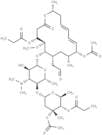
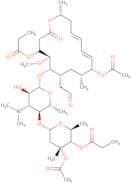
Miocamycin ist ein Makrolid-Antibiotikum, das hauptsächlich aus der Fermentation bestimmter Streptomyces-Arten gewonnen wird. Es weist antibakterielle Eigenschaften auf, insbesondere gegen grampositive Bakterien, was es nützlich bei der Behandlung verschiedener bakterieller Infektionen macht. Die chemische Struktur von Miocamycin weist einen großen Laktonring auf, der für Makrolide charakteristisch ist, und enthält mehrere Hydroxylgruppen, die zu seiner Löslichkeit und biologischen Aktivität beitragen. Diese Verbindung wirkt, indem sie die bakterielle Proteinsynthese hemmt und somit das Wachstum und die Fortpflanzung von Bakterien verhindert. Miocamycin wird häufig in klinischen Umgebungen aufgrund seiner Wirksamkeit gegen Atemwegsinfektionen und Hautinfektionen eingesetzt. Darüber hinaus kann es einige antifungale Eigenschaften haben, obwohl seine Hauptanwendung in der antibakteriellen Therapie bleibt. Wie bei vielen Antibiotika ist das Potenzial zur Entwicklung von Resistenzen ein Anliegen, das einen sorgfältigen Einsatz und die Berücksichtigung alternativer Behandlungen erfordert, wenn dies angemessen ist. Insgesamt stellt Miocamycin ein wichtiges Werkzeug im Arsenal gegen bakterielle Infektionen dar, insbesondere in Fällen, in denen andere Antibiotika weniger wirksam sein können.
Formel:C45H71NO17
InChl:InChI=1S/C45H71NO17/c1-13-34(50)59-33-23-36(52)55-26(4)18-16-15-17-19-32(58-29(7)48)25(3)22-31(20-21-47)41(42(33)54-12)62-44-39(53)38(46(10)11)40(27(5)57-44)61-37-24-45(9,63-30(8)49)43(28(6)56-37)60-35(51)14-2/h15-17,19,21,25-28,31-33,37-44,53H,13-14,18,20,22-24H2,1-12H3/b16-15+,19-17+/t25-,26-,27-,28+,31+,32+,33-,37+,38-,39-,40-,41+,42+,43+,44+,45-/m1/s1
InChI Key:InChIKey=GQNZGCARKRHPOH-RQIKCTSVSA-N
SMILES:O([C@@H]1[C@@H](OC)[C@H](OC(CC)=O)CC(=O)O[C@H](C)C\C=C\C=C\[C@H](OC(C)=O)[C@H](C)C[C@@H]1CC=O)[C@H]2[C@H](O)[C@@H](N(C)C)[C@H](O[C@H]3C[C@](OC(C)=O)(C)[C@@H](OC(CC)=O)[C@H](C)O3)[C@@H](C)O2
Synonyme:- (4R,5S,6S,7S,9R,10R,11E,13E,16R)-10-(acetyloxy)-6-{[(2S,3R,4R,5S,6R)-5-{[(2S,4R,5S,6S)-4-(acetyloxy)-4,6-dimethyl-5-(propanoyloxy)tetrahydro-2H-pyran-2-yl]oxy}-4-(dimethylamino)-3-hydroxy-6-methyltetrahydro-2H-pyran-2-yl]oxy}-5-methoxy-9,16-dimethyl-2-oxo-7-(2-oxoethyl)oxacyclohexadeca-11,13-dien-4-yl propanoate (non-preferred name)
- 3′′,9-Diacetylmydecamycin
- 9,3′′-Di-O-acetylmidecamycin
- Acecamycin
- Leucomycin V, 3<sup>B</sup>,9-diacetate 3,4<sup>B</sup>-dipropanoate
- Mikamycin
- Miocamycin
- Miokamycin
- Oxacyclohexadecane, leucomycin V deriv.
- Ponsinomycin
- Mom
- Weitere Synonyme anzeigen
Sortieren nach
Reinheit (%)
0
100
|
0
|
50
|
90
|
95
|
100
2 Produkte.
Midecamycin acetate
CAS:Midecamycin acetate is a broad-spectrum antibiotic active against Gram-positive and some Gram-negative strains.Formel:C45H71NO17Reinheit:98%Farbe und Form:White Or Offt-White Crystalline PowderMolekulargewicht:898.04Midecamycin acetate
CAS:Midecamycin is the active form of midecamycin acetate. It is an antibiotic that has been used mainly in the treatment of inflammatory bowel disease, although it has also been used to treat streptococcal pharyngitis and other bacterial infections. Midecamycin acetate binds to DNA gyrase and topoisomerase IV, which are enzymes that maintain the integrity of bacterial DNA. This binding prevents the formation of an antibiotic-inhibitor complex with the enzyme cell wall synthesis that is required for cell wall biosynthesis, inhibiting protein synthesis and cell division. Midecamycin acetate may have clinical relevance in infectious diseases such as human serum and monoclonal antibody production. There are no toxicity studies available for this drug at this time. Midecamycin acetate may cause side effects such as nausea, vomiting, diarrhea, abdominal pain, fever, headache or rash.br>br>Formel:C45H71NO17Reinheit:Min. 95%Molekulargewicht:898.04 g/mol