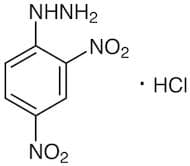
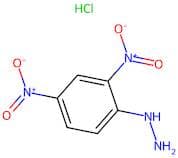
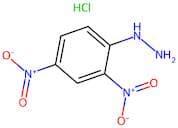
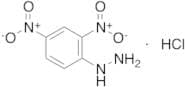
CAS 55907-61-4
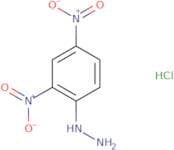
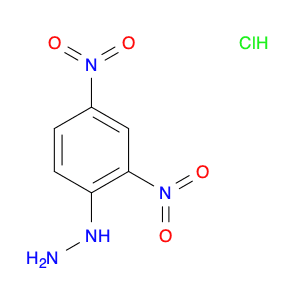
:2,4-Dinitrophenylhydrazinhydrochlorid
Beschreibung:
2,4-Dinitrophenylhydrazinhydrochlorid (häufig abgekürzt als DNPH-HCl) ist eine chemische Verbindung, die in der organischen Chemie weit verbreitet ist, insbesondere zur Identifizierung und Charakterisierung von Carbonylverbindungen. Es handelt sich um einen gelb-orangefarbenen kristallinen Feststoff, der in Wasser und organischen Lösungsmitteln löslich ist. Die Verbindung weist eine Hydrazin-Funktionalgruppe auf, die es ihr ermöglicht, mit Aldehyden und Ketonen zu reagieren, um stabile Hydrazone zu bilden, was sie zu einem wertvollen Reagenz in der analytischen Chemie macht. DNPH-HCl ist bekannt für seine Empfindlichkeit und Spezifität bei der Detektion von Carbonylgruppen und wird häufig zur Bestimmung von Zuckern und anderen carbonylhaltigen Substanzen eingesetzt. Es ist jedoch wichtig, diese Verbindung mit Vorsicht zu behandeln, da sie gefährlich sein kann; sie ist als potenzielles Karzinogen eingestuft und sollte in einem gut belüfteten Bereich mit geeigneter persönlicher Schutzausrüstung verwendet werden. Darüber hinaus wird DNPH-HCl häufig zur Vorbereitung von Derivaten für weitere Analysen, wie spektroskopische Methoden, verwendet, was ihre Nützlichkeit sowohl in der Forschung als auch in industriellen Anwendungen erhöht.
Formel:C6H6N4O4·ClH
InChl:InChI=1S/C6H6N4O4.ClH/c7-8-5-2-1-4(9(11)12)3-6(5)10(13)14;/h1-3,8H,7H2;1H
InChI Key:InChIKey=PUYFAZQODQZOFK-UHFFFAOYSA-N
SMILES:N(=O)(=O)C1=C(NN)C=CC(N(=O)=O)=C1.Cl
Synonyme:- (2,4-Dinitrophenyl)Hydrazine Hydrochloride
- 2,4-Dinitrophenylhydrazine hydrochloride
- Hydrazine, (2,4-dinitrophenyl)-, hydrochloride (1:1)
- Hydrazine, (2,4-dinitrophenyl)-, monohydrochloride
- 2,4-Dinitrophenylhydrazinium(1+) chloride
Sortieren nach
Reinheit (%)
0
100
|
0
|
50
|
90
|
95
|
100
9 Produkte.
2,4-Dinitrophenylhydrazine Hydrochloride [for HPLC Labeling]
CAS:Formel:C6H6N4O4·HClReinheit:>98.0%(T)(HPLC)Farbe und Form:Light yellow to Brown powder to crystalMolekulargewicht:234.602,4-Dinitrophenylhydrazine Hydrochloride
CAS:Formel:C6H6N4O4·HClReinheit:>98.0%(T)(HPLC)Farbe und Form:White to Yellow to Orange powder to crystalMolekulargewicht:234.602,4-Dinitrophenylhydrazine hydrochloride
CAS:2,4-Dinitrophenylhydrazine hydrochlorideReinheit:98%Molekulargewicht:234.6g/mol2,4-Dinitrophenylhydrazine hydrochloride
CAS:2,4-Dinitrophenylhydrazine hydrochlorideReinheit:98%Molekulargewicht:234.6g/mol2,4-Dinitrophenylhydrazine Hydrochloride
CAS:Stability Hygroscopic
Applications 2,4-Dinitrophenylhydrazine Hydrochloride (cas# 55907-61-4) is a useful research chemical.
Not a dangerous good if item is equal to or less than 1g/ml and there is less than 100g/ml in the packageFormel:C6H6N4O4·ClHFarbe und Form:NeatMolekulargewicht:234.5972,4-Dinitrophenylhydrazine Hydrochloride
CAS:2,4-Dinitrophenylhydrazine Hydrochloride is a reagent used for labeling biomolecules in HPLC. The reaction time is dependent on the specific molecule and the concentration of reactants. 2,4-Dinitrophenylhydrazine Hydrochloride reacts with carbohydrates and other large molecules to form a hydrazone link. This link can be cleaved by heat or acid to release the labeled molecule. It is also used for labeling oligonucleotides, amino acids, and other small molecules that are not amenable for enzymatic reactions. This reagent has been shown to be useful in determining the molecular weights of anions such as chloride or crystallography. The red shift observed during this reaction is due to the interaction energies between water molecules and chloride ions or dimethylformamide molecules.Formel:C6H6N4O4·HClReinheit:Min. 95%Molekulargewicht:234.6 g/mol2,4-Dinitrophenylhydrazine Hydrochloride
CAS:Formel:C6H7ClN4O4Reinheit:98%Farbe und Form:SolidMolekulargewicht:234.5972Ref: IN-DA003FV7
Ausgelaufenes produkt
![2,4-Dinitrophenylhydrazine Hydrochloride [for HPLC Labeling]](/_next/image/?url=https%3A%2Fstatic.cymitquimica.com%2Fproducts%2F3B%2Fthumb%2FA5531.jpg&w=3840&q=75)