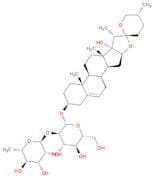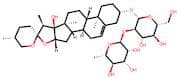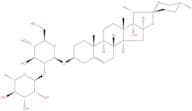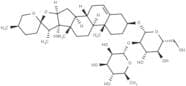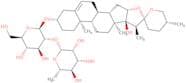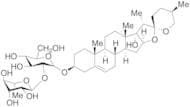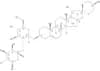
CAS 55916-51-3
:Polyphyllin VI
Beschreibung:
Polyphyllin VI ist eine natürliche steroidale Saponin, die hauptsächlich aus Pflanzenarten der Gattung Paris, insbesondere Paris polyphylla, gewonnen wird. Sie zeichnet sich durch ihre komplexe molekulare Struktur aus, die ein Steroidgerüst und mehrere Zuckermoleküle umfasst, was zu ihren Saponineigenschaften beiträgt. Diese Verbindung ist bekannt für ihre potenziellen pharmakologischen Aktivitäten, einschließlich entzündungshemmender, krebsbekämpfender und immunmodulatorischer Wirkungen. Polyphyllin VI zeigt eine Vielzahl biologischer Aktivitäten, die das Interesse an der medizinischen Chemie und Pharmakologie geweckt haben. Ihr Wirkmechanismus beinhaltet oft die Induktion von Apoptose in Krebszellen und die Modulation verschiedener Signalwege. Darüber hinaus kann sie aufgrund ihrer Saponin-Natur tensioaktive Eigenschaften aufweisen, die die Membranpermeabilität beeinflussen. Der Einsatz von Polyphyllin VI in therapeutischen Anwendungen erfordert jedoch eine sorgfältige Berücksichtigung ihrer Bioverfügbarkeit und potenziellen Toxizität. Während die Forschung fortschreitet, könnte eine weitere Aufklärung ihrer Pharmakokinetik und Wirkmechanismen ihre Anwendbarkeit in klinischen Settings verbessern.
Formel:C39H62O13
InChl:InChI=1S/C39H62O13/c1-18-8-13-38(47-17-18)20(3)39(46)27(52-38)15-25-23-7-6-21-14-22(9-11-36(21,4)24(23)10-12-37(25,39)5)49-35-33(31(44)29(42)26(16-40)50-35)51-34-32(45)30(43)28(41)19(2)48-34/h6,18-20,22-35,40-46H,7-17H2,1-5H3/t18-,19+,20-,22+,23-,24+,25+,26-,27+,28+,29-,30-,31+,32-,33-,34+,35-,36+,37+,38-,39-/m1/s1
InChI Key:InChIKey=WHWWQGPCTUQCMN-JDDKMXSSSA-N
SMILES:O[C@@]12[C@]3(C)[C@@](C[C@@]1(O[C@@]4([C@H]2C)CC[C@@H](C)CO4)[H])([C@]5([C@](CC3)([C@]6(C)C(=CC5)C[C@@H](O[C@H]7[C@H](O[C@H]8[C@H](O)[C@H](O)[C@@H](O)[C@H](C)O8)[C@@H](O)[C@H](O)[C@@H](CO)O7)CC6)[H])[H])[H]
Synonyme:- (3β,25R)-17-Hydroxyspirost-5-en-3-yl 2-O-(6-deoxy-α-<span class="text-smallcaps">L</smallcap>-mannopyranosyl)-β-<smallcap>D</span>-glucopyranoside
- 17-Hydroxyparis V
- Paris VI
- Paris saponin VI
- ParisVI
- Pennogenin 3-O-a-L-rhamnopyranosyl-(1® 2)-b-D-glucopyranoside
- Pennogenin 3-O-α-<span class="text-smallcaps">L</smallcap>-rhamnopyranosyl-(1→2)-β-<smallcap>D</span>-glucopyranoside
- Pennogenin-3-O-α-<span class="text-smallcaps">L</smallcap>-rhamnopyranosyl(1→2)-β-<smallcap>D</span>-glucoside
- Polygonatoside B3
- Polygonatoside B<sup>3</sup>
- Polyphyllin VI
- Saponin Tb
- β-<span class="text-smallcaps">D</smallcap>-Glucopyranoside, (3β,25R)-17-hydroxyspirost-5-en-3-yl 2-O-(6-deoxy-α-<smallcap>L</span>-mannopyranosyl)-
- Pennogenin 3-O-α-L-rhamnopyranosyl-(1→2)-β-D-glucopyranoside
- β-D-Glucopyranoside, (3β,25R)-17-hydroxyspirost-5-en-3-yl 2-O-(6-deoxy-α-L-mannopyranosyl)-
- Weitere Synonyme anzeigen
Sortieren nach
Reinheit (%)
0
100
|
0
|
50
|
90
|
95
|
100
9 Produkte.
Polyphyllin VI
CAS:1. Polyphyllin VI has hemostasis , expectorant , bacteriostasis, anticytotoxic, anti pregnancy kill sperm effects.Formel:C39H62O13Reinheit:99.69% - 99.72%Farbe und Form:SolidMolekulargewicht:738.90Polyphyllin VI
CAS:Polyphyllin VI is a natural compound that belongs to the class of polyphyllins. It is a reactive compound with a p-gp substrate and mitochondrial membrane potential. Polyphyllin VI has been shown to be an effective inhibitor of bacterial growth and is clinically relevant in the treatment of bacterial infections. This drug also inhibits the synthesis of fatty acids, which may cause it to exhibit anti-inflammatory effects due to its ability to inhibit prostaglandin synthesis. Polyphyllin VI also shows antioxidant properties, which may be due to its ability to scavenge free radicals and protect cells from oxidative damage.Formel:C39H62O13Reinheit:Min. 95%Farbe und Form:PowderMolekulargewicht:738.9 g/molPolyhyllin VI
CAS:Kontrolliertes ProduktApplications Polyhyllin VI is a natural saponin extracted from the plant, Rhizoma Paridis, and displays anti-proliferative activity in vivo. Used in the treatment of HepG2 cells for tumor mitigation.
References Ma, D. et al.: J. Int Med. Res., 37, 631 (2009); Yin, X. et al.: Biomed. Chrom., 27, 343 (2013); Jiang, H. et al.: Mol. Med. Rep., 9, 2265 (2014); Cheng, Z. et al.: J. Ethnopharmacol., 120, 129 (2008);Formel:C39H62O13Farbe und Form:NeatMolekulargewicht:738.9