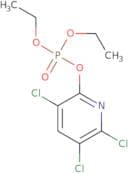
CAS 5598-15-2
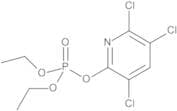
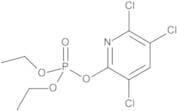
:Chlorpyrifos-Oxon
- 2-Pyridinol, 3,5,6-trichloro-, diethyl phosphate (ester)
- 3,5,6-Trichloro-2-pyridyl diethyl phosphate
- Chloropyrifos oxon
- Chlorpyrifos oxon
- Chlorpyrifos-ethyl oxon
- Chlorpyrifoxon
- Chlorpyriphoxon
- Diethyl 3,5,6-trichloro-2-pyridinyl phosphate
- Diethyl 3,5,6-trichloro-2-pyridyl phosphate
- Diethyl-3,5,6-trichlor-2-pyridinylphosphat
- Dursban oxygen analog
- Dursbanoxon
- Fospirate-ethyl
- O,O-Diethyl O-3,5,6-trichloro-2-pyridyl phosphate
- O-(3,5,6-Trichloro-2-pyridinyl) O,O-diethyl phosphate
- Phosphate de diéthyle et de 3,5,6-trichloro-2-pyridinyle
- Phosphoric Acid, Diethyl 3,5,6-Trichloro-2-Pyridinyl Ester
- Phosphoric acid, diethyl 3,5,6-trichloro-2-pyridinyl ester (9CI)
- Weitere Synonyme anzeigen
Chlorpyrifos-oxon
CAS:Kontrolliertes ProduktFormel:C9H11Cl3NO4PFarbe und Form:NeatMolekulargewicht:334.52Chlorpyrifos Oxon
CAS:Kontrolliertes ProduktStability Moisture Sensitive
Applications Chlorpyrifos Oxon is a metabolite of Chlorpyrifos (C425300) in human.
Not a dangerous good if item is equal to or less than 1g/ml and there is less than 100g/ml in the package
References Atterberry, T., et al.: Toxicol. Appl. Pharmacol., 147, 411 (1997), Karanth, S., et al.: Toxicol. Sci., 58, 282 (2000), Barter, Z., et al.: Drug Metab. Dispos., 36, 2405 (2008),Formel:C9H11Cl3NO4PFarbe und Form:Off-WhiteMolekulargewicht:334.52Chlorpyrifos-oxon
CAS:Chlorpyrifos-oxon, an active metabolite of Chlorpyrifos, is a potent phosphorylating agent that significantly inhibits AChE activity and induces cross-linking between tubulin subunits, thereby disrupting microtubule function [4].Formel:C9H11Cl3NO4PFarbe und Form:SolidMolekulargewicht:334.52Chlorpyrifos oxon
CAS:Chlorpyrifos oxon is a site-specific acetylcholinesterase inhibitor that is used as a sample preparation chemical for the analysis of fatty acids, hydroxyl groups, and pharmacological agents. Chlorpyrifos oxon can be used to study the effects of sublethal doses on probiotic bacteria. It has been found that chlorpyrifos oxon inhibits the activity of human serum acetylcholinesterase by binding to its active site with high affinity. The inhibition of acetylcholinesterase by chlorpyrifos oxon prevents the hydrolysis of acetylcholine at cholinergic synapses in the brain and peripheral nervous system. This leads to accumulation of acetylcholine and an increase in stimulation of postsynaptic receptors, resulting in increased transmission across neuronal synapses. Chlorpyrifos oxon also is known to have immunomodulatory properties and has been shown to stimulate
Formel:C9H11Cl3NO4PReinheit:Min. 95%Molekulargewicht:334.52 g/molRef: 3D-FC20412
Ausgelaufenes produkt