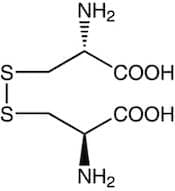
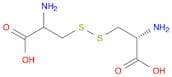
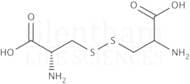
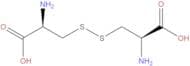
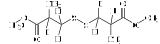
CAS 56-89-3
:(-)-Cystin
Beschreibung:
(-)-Cystin, mit der CAS-Nummer 56-89-3, ist eine natürlich vorkommende Aminosäure, die eine entscheidende Rolle in der Struktur und Funktion von Proteinen spielt. Es ist eine dimerische Form von Cystein, die durch die Oxidation von zwei Cystein-Molekülen gebildet wird, was zu einer Disulfidbindung zwischen ihren Thiolgruppen führt. Diese Verbindung zeichnet sich durch ihr weißes kristallines Aussehen aus und ist in Wasser löslich, was ihre biologischen Funktionen erleichtert. (-)-Cystin ist entscheidend für die Stabilität von Proteinstrukturen, insbesondere bei der Bildung von tertiären und quartären Strukturen aufgrund seiner Fähigkeit, Disulfidbrücken zu bilden. Es ist auch an verschiedenen Stoffwechselprozessen beteiligt und wichtig für die Synthese von Glutathion, einem wichtigen Antioxidans im Körper. In Bezug auf seine biologische Bedeutung ist (-)-Cystin in vielen Proteinen zu finden und ist entscheidend für die Aufrechterhaltung des Redox-Gleichgewichts innerhalb der Zellen. Seine Anwesenheit ist besonders in Keratin zu beobachten, das ein Hauptbestandteil von Haar, Haut und Nägeln ist. Insgesamt ist (-)-Cystin integraler Bestandteil zahlreicher physiologischer Prozesse und trägt zur strukturellen Integrität von Proteinen bei.
Formel:C6H12N2O4S2
InChl:InChI=1/C3H6NO2S3/c5-3(6)2(4-7)1-9-8/h2H,1,4H2,(H,5,6)
InChI Key:InChIKey=LEVWYRKDKASIDU-IMJSIDKUSA-N
SMILES:[C@H](CSSC[C@@H](C(O)=O)N)(C(O)=O)N
Synonyme:- (-)-3,3-Dithiobis(2-aminopropionic acid)
- (2R,2'S)-3,3'-disulfanediylbis(2-ammoniopropanoate)
- (H-Cys-OH)2
- (H-Cys-OH)2 (Disulfide bond)
- 2-Amino-3-[(2-amino-2-carboxyethyl)dithio]propanoic acid
- 3,3'-Dithiobis(2-aminopropanoic acid)
- <span class="text-smallcaps">L</span>-(-)-Cystine
- <span class="text-smallcaps">L</span>-Alanine, 3,3′-dithiobis-
- <span class="text-smallcaps">L</span>-Cysteine disulfide
- <span class="text-smallcaps">L</span>-Cystin
- Alanine, 3,3'-dithiobis-
- Bis(β-amino-β-carboxyethyl) disulfide
- Cistina
- Cystin
- Cystine
- Cystine acid
- Cystine, <span class="text-smallcaps">L</span>-
- Cystine, L-
- Dicysteine
- H-(Cys)_2-OH
- L(-)-3,3-Dithiobis(2-aminopropanoic acid)
- L-(-)-Cysteine
- L-Alanine, 3,3'-dithiobis-
- L-Cysteine disulfide
- L-Cystin
- L-Cystine, synthetically derived
- L-Cystine,food grade
- Nsc 13203
- Oxidized <span class="text-smallcaps">L</span>-cysteine
- Oxidized L-cysteine
- Propanoic acid, 3,3'-dithiobis[2-amino-, [R-(R*,R*)]-
- [R-(R*,R*)]-3,3'-Dithiobis[2-aminopropanoic acid]
- β,β'-Diamino-β,β'-dicarboxydiethyl disulfide
- β,β'-Dithiodialanine
- L-Cystine
- (R,R)-3,3'-DITHIOBIS(2-AMINOPROPIONIC ACID)
- (R)-(-)-CYSTINE
- L-CYTISINE
- (r-(r*,r*))-3,3’-dithiobis(2-aminopropanoicacid)
- L-CYSTINE BASE
- 3,3’-dithiobis(2-aminopropanoicacid)
- H-L-CYSTINE
- 3,3’-dithiobis-l-alanin
- BETA,BETA'-DITHIOBIS-A-AMINOPROPIONIC ACID
- (R,R)-(-)-CYSTINE
- 3,3’-dithiobis(2-amino-,(r-(r*,r*))-propanoicaci
- 1-cystine
- Weitere Synonyme anzeigen
Sortieren nach
Reinheit (%)
0
100
|
0
|
50
|
90
|
95
|
100
L-(-)-Cystine
CAS:Formel:C6H12N2O4S2Reinheit:>98.0%(HPLC)(N)Farbe und Form:White powder to crystalineMolekulargewicht:240.29L-Cystine, 99%
CAS:L-Cystine is used as an antioxidant, protecting tissues against radiation and pollution. It finds application in protein synthesis. It is required for utilization of vitamin B6 and is useful in healing burns and wounds. It is also is required by certain malignant cell lines in the culture medium asFormel:C6H12N2O4S2Reinheit:99%Farbe und Form:White to pale cream, Crystals or powder or crystalline powderMolekulargewicht:240.29L-Cystine, Cell Culture Reagent
CAS:L-cysteine acts as a major source of sulfur in cell culture. Cysteine has been used in pulse-chase experiments to study protein expression from an inducible promoter. L-Cysteine is used to supplement cell culture media. This Thermo Scientific Chemicals brand product was originally part of the Alfa AFormel:C6H12N2O4S2Farbe und Form:White, Crystals or crystalline powderMolekulargewicht:240.29Cystine
CAS:Other organo-sulfur acid compoundsFormel:C6H12N2O4S2Farbe und Form:White Crystalline PowderMolekulargewicht:240.02385L-Cystine, non-animal origin, Ph. Eur. grade
CAS:Formel:C6H12N2O4S2Farbe und Form:White or almost white crystalline powderMolekulargewicht:240.30L-Cystine
CAS:L-CystineFormel:C6H12N2O4S2Reinheit:99% (Typical Value in Batch COA)Farbe und Form: white powderMolekulargewicht:240.30g/molL-Cystine, non-animal origin
CAS:Formel:C6H12N2O4S2Reinheit:≤ 0.2%Farbe und Form:White or almost white crystalline powderMolekulargewicht:240.30L-Cystine
CAS:Formel:C6H12N2O4S2Reinheit:98.5 - 101.0 %Farbe und Form:White crystalline powderMolekulargewicht:240.30L-Cystine
CAS:L-Cystine (Cystine Acid) is not considered one of the 20 amino acids, L-Cystine (Cystine Acid) is a sulfur-containing derivative obtained from oxidation ofFormel:C6H12N2O4S2Reinheit:99.59% - 99.85%Farbe und Form:White Solid PowderMolekulargewicht:240.30L-Cystine
CAS:Impurity Acetylcysteine EP Impurity A
Applications L-Cystine is a non-essential amino acid for human development. L-Cystine is formed by the dimerization of two cysteines through the sulfur. Acetylcysteine EP Impurity A
References Fahey, R.C., et al.: J. Mol. Evol., 10, 155 (1977), Kao, P., et al.: J. Biol.Chem., 261, 8085 ( 1986), Nicke, A., et al.: J. Biol. Chem., 278, 3137 (2003),Formel:C6H12N2O4S2Farbe und Form:WhiteMolekulargewicht:240.3