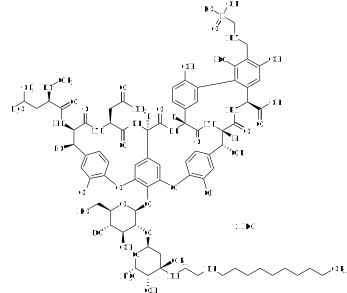
![Vancomycin, N3′′-[2-(decylamino)ethyl]-29-[[(phosphonomethyl)amino]methyl]-, hydrochloride (1:1)](/_next/image/?url=https%3A%2Fstatic.cymitquimica.com%2Fcas-image%2Fthumb-webp%2F400217-telavancin-hydrochloride.webp&w=3840&q=75)
CAS 560130-42-9
:Vancomycin, N3′′-[2-(decylamino)ethyl]-29-[[(phosphonomethyl)amino]methyl]-, hydrochlorid (1:1)
Beschreibung:
Vancomycin, N3′′-[2-(decylamino)ethyl]-29-[[(phosphonomethyl)amino]methyl]-, hydrochlorid (1:1) ist ein synthetisches Derivat des glykopeptidischen Antibiotikums Vancomycin, das hauptsächlich zur Behandlung schwerer bakterieller Infektionen eingesetzt wird, insbesondere solcher, die durch grampositive Bakterien verursacht werden. Diese Verbindung weist eine komplexe Struktur auf, die eine Decylamin-Seitenkette und eine Phosphonomethylgruppe umfasst, die ihre antibakterielle Aktivität verbessern oder ihre pharmakokinetischen Eigenschaften verändern kann. Die Hydrochloridform zeigt an, dass es sich um ein Salz handelt, das die Löslichkeit und Stabilität in wässrigen Lösungen verbessern kann. Das Vorhandensein der Phosphonomethylgruppe deutet auf ein Potenzial für eine erhöhte Interaktion mit der Synthese der bakteriellen Zellwand hin, einem häufigen Wirkmechanismus für Antibiotika. Wie bei vielen Antibiotika würde die Wirksamkeit und das Sicherheitsprofil dieser Verbindung durch klinische Studien bewertet, die sich auf ihr Aktivitätsspektrum, Widerstandsmuster und mögliche Nebenwirkungen konzentrieren. Insgesamt stellt diese Verbindung eine Modifikation eines gut etablierten Antibiotikums dar, mit dem Ziel, die therapeutischen Ergebnisse gegen resistente Bakterienstämme zu verbessern.
Formel:C80H106Cl2N11O27P·HCl
InChl:InChI=1S/C80H106Cl2N11O27P.ClH/c1-7-8-9-10-11-12-13-14-21-85-22-23-87-80(5)32-57(115-37(4)71(80)103)119-70-68(102)67(101)55(34-94)118-79(70)120-69-53-28-41-29-54(69)117-52-20-17-40(27-46(52)82)65(99)63-77(109)91-61(78(110)111)43-30-50(96)44(33-86-35-121(112,113)114)66(100)58(43)42-25-38(15-18-49(42)95)59(74(106)93-63)90-75(107)60(41)89-73(105)48(31-56(83)97)88-76(108)62(92-72(104)47(84-6)24-36(2)3)64(98)39-16-19-51(116-53)45(81)26-39;/h15-20,25-30,36-37,47-48,55,57,59-65,67-68,70-71,79,84-87,94-96,98-103H,7-14,21-24,31-35H2,1-6H3,(H2,83,97)(H,88,108)(H,89,105)(H,90,107)(H,91,109)(H,92,104)(H,93,106)(H,110,111)(H2,112,113,114);1H/t37-,47+,48-,55+,57-,59+,60+,61-,62+,63-,64+,65+,67+,68-,70+,71+,79-,80-;/m0./s1
InChI Key:InChIKey=GSSIWSIRBWAZHG-ACOPVEIWSA-N
SMILES:O(C=1C2=CC3=CC1OC=4C(Cl)=CC(=CC4)[C@@H](O)[C@@H](NC([C@@H](CC(C)C)NC)=O)C(=O)N[C@@H](CC(N)=O)C(=O)N[C@]3(C(=O)N[C@@]5(C=6C=C(C=7C([C@@H](C(O)=O)NC(=O)[C@]([C@H](O)C=8C=C(Cl)C(O2)=CC8)(NC5=O)[H])=CC(O)=C(CNCP(=O)(O)O)C7O)C(O)=CC6)[H])[H])[C@H]9[C@H](O[C@H]%10C[C@@](NCCNCCCCCCCCCC)(C)[C@H](O)[C@H](C)O%10)[C@@H](O)[C@H](O)[C@@H](CO)O9.Cl
Synonyme:- (3S,6R,7R,22R,23S,26S,36R,38aR)-3-(2-Amino-2-oxoethyl)-10,19-dichloro-44-((2-O-(3-((2-(decylamino)ethyl)amino)-3-C-methyl-2,3,6-trideoxy-alpha-L-lyxo-hexopyranosyl)-beta-D-glucopyranosyl)oxy)-7,22,28,30,32-pentahydroxy-6-(((2R)-4-methyl-2-(methylamino)pentanoyl)amino)-2,5,24,38,39-pentaoxo-29-(((phosphonomethyl)amino)methyl)-2,3,4,5,6,7,23,24,25,26,36,37,38,38a-tetradecahydro-8,11:18,21-dietheno-23,36-(iminomethano)-22H-13,16:31,35-dimetheno-1H,13H-(1,6,9)oxadiazacyclohexadecino(4,5-m)(10,2,16)benzoxadiazacyclotetracosine-26-carboxylic acid monohydrochloride
- Td 6424
- Unii-0701472Zg0
- Vancomycin, N3'-(2-(decylamino)ethyl)-29-(((phosphonomethyl)amino)methyl)-, monohydrochloride
- Vancomycin, N<sup>3′′</sup>-[2-(decylamino)ethyl]-29-[[(phosphonomethyl)amino]methyl]-, hydrochloride (1:1)
- Vancomycin, N<sup>3′′</sup>-[2-(decylamino)ethyl]-29-[[(phosphonomethyl)amino]methyl]-, monohydrochloride
- Vibativ
- Vancomycin, N3′′-[2-(decylamino)ethyl]-29-[[(phosphonomethyl)amino]methyl]-, hydrochloride (1:1)
- Telavancin hydrochloride
- Telavancin HCl
- PubChem ID: 9812715
- TelavancinHydrochlorid
- N3''-[2-(Decylamino)ethyl]-29-[[(phosphonomethyl)amino]methyl]vancomycin hydrochloride
- Weitere Synonyme anzeigen
Sortieren nach
Reinheit (%)
0
100
|
0
|
50
|
90
|
95
|
100
2 Produkte.
Telavancin HCl
CAS:Telavancin HCl is a lipoglycopeptide antibiotic with action on bacterial cell wall synthesis and membrane integrity and is used for treating complicated skin infections and hospital-acquired pneumonia caused by gram-positive bacteria.Formel:C80H106Cl2N11O27P·HClReinheit:(%) Min. 92%Farbe und Form:White PowderMolekulargewicht:1,792.1 g/mol