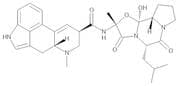
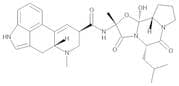
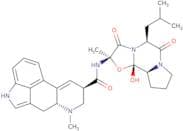
CAS 561-94-4
:Ergosin
Beschreibung:
Ergosin, mit der CAS-Nummer 561-94-4, ist ein Alkaloid, das aus dem Ergot-Pilz, speziell aus der Art Claviceps purpurea, gewonnen wird. Es gehört zu einer größeren Klasse von Verbindungen, die als Ergot-Alkaloide bekannt sind, die für ihre komplexen Strukturen und vielfältigen biologischen Aktivitäten bekannt sind. Ergosin zeichnet sich durch seine Fähigkeit aus, mit verschiedenen Neurotransmitter-Rezeptoren zu interagieren, insbesondere mit denen, die mit Serotonin und Dopamin in Verbindung stehen, was den Gefäßtonus und die neurologischen Funktionen beeinflussen kann. Diese Verbindung wurde auf ihr potenzielles therapeutisches Anwendungspotenzial untersucht, einschließlich ihrer Verwendung zur Behandlung von Erkrankungen wie Migräne und bestimmten Arten von Kopfschmerzen aufgrund ihrer gefäßverengenden Eigenschaften. Es ist jedoch auch wichtig zu beachten, dass Ergot-Alkaloide toxische Wirkungen haben können, die zu Ergotismus führen, wenn sie unangemessen konsumiert werden. Die Substanz wird in Laborumgebungen typischerweise mit Vorsicht behandelt, und ihre Verwendung ist in vielen Ländern aufgrund ihrer starken biologischen Wirkungen reguliert. Insgesamt veranschaulicht Ergosin die komplexe Beziehung zwischen Naturprodukten und Pharmakologie.
Formel:C30H37N5O5
InChl:InChI=1S/C30H37N5O5/c1-16(2)11-23-27(37)34-10-6-9-24(34)30(39)35(23)28(38)29(3,40-30)32-26(36)18-12-20-19-7-5-8-21-25(19)17(14-31-21)13-22(20)33(4)15-18/h5,7-8,12,14,16,18,22-24,31,39H,6,9-11,13,15H2,1-4H3,(H,32,36)/t18-,22-,23+,24+,29-,30+/m1/s1
InChI Key:InChIKey=NESVMZOPWPCFAU-ZPRCMDFASA-N
SMILES:O[C@@]12N([C@@H](CC(C)C)C(=O)N3[C@]1(CCC3)[H])C(=O)[C@@](NC(=O)[C@@H]4C=C5C=6C=7C(C[C@]5(N(C)C4)[H])=CNC7C=CC6)(C)O2
Synonyme:- (5'Alpha)-12'-Hydroxy-2'-Methyl-5'-(2-Methylpropyl)-3',6',18-Trioxoergotaman
- (5′α)-12′-Hydroxy-2′-methyl-5′-(2-methylpropyl)ergotaman-3′,6′,18-trione
- 12'-Hydroxy-2'-Methyl-5'-(2-Methylpropyl)-3',6',18-Trioxoergotaman
- 8H-Oxazolo[3,2-a]pyrrolo[2,1-c]pyrazine, ergotaman-3′,6′,18-trione deriv.
- Brn 0102152
- Ergotaman-3',6',18-trione, 12'-hydroxy-2'-methyl-5'-(2-methylpropyl)-, (5'-alpha)- (9CI)
- Ergotaman-3′,6′,18-trione, 12′-hydroxy-2′-methyl-5′-(2-methylpropyl)-, (5′α)-
- Indolo[4,3-fg]quinoline, ergotaman-3′,6′,18-trione deriv.
- Nsc 122047
- alpha-Ergosine
- α-Ergosine
- Ergosine
- Weitere Synonyme anzeigen
Sortieren nach
Reinheit (%)
0
100
|
0
|
50
|
90
|
95
|
100
4 Produkte.
Ergosine
CAS:Kontrolliertes ProduktApplications Ergosine is an ergot alkaloid which are used in the treatment of vasoconstriction and as well as Parkinson’s disease. Also certain derivatives act as psychedelics mimicking lysergic acid.
References Martucci N. et al.: Cephal., 1, 151 (1983); Kehr, W. et al.: Eur. J. Phamracol., 41, 261 (1977);Formel:C30H37N5O5Farbe und Form:NeatMolekulargewicht:547.65Ergosine
CAS:Kontrolliertes ProduktErgosine is a natural bioactive compound, which is derived from specific plant sources rich in alkaloids. It operates through modulating neurotransmitter pathways in the brain, particularly enhancing the function of acetylcholine and dopamine, which are critical for cognitive processes. Through these actions, Ergosine is posited to bolster synaptic plasticity and increase neural efficiency, thus supporting enhanced cognitive function.Ergosine finds applications in areas of neuroscience and cognitive research, with particular relevance to studies on memory enhancement and neurodegenerative disease prevention. Its mode of action has made it a subject of interest for exploring therapeutic strategies in cognitive impairment and mental fatigue. Researchers aiming to understand the underlying mechanisms of cognition and develop nootropic agents may find Ergosine particularly valuable for its natural origin and targeted activity in brain function modulation.Formel:C30H37N5O5Reinheit:Min. 95%Farbe und Form:PowderMolekulargewicht:547.65 g/mol