CAS 56539-85-6
:3,3,3-Trifluor-2-phenylpropansäure
Beschreibung:
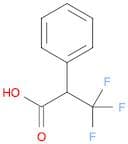
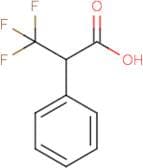
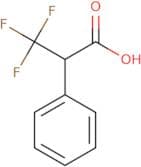
3,3,3-Trifluor-2-phenylpropansäure ist eine organische Verbindung, die durch das Vorhandensein einer Trifluormethylgruppe und einer Phenylgruppe, die an ein Propansäuregerüst gebunden ist, gekennzeichnet ist. Ihre molekulare Struktur weist drei Fluoratome auf, die an das Kohlenstoffatom in der Alpha-Position relativ zur Carbonsäurefunktion gebunden sind, was ihre chemischen Eigenschaften erheblich beeinflusst, einschließlich einer erhöhten Säure und Lipophilie. Das Vorhandensein der Phenylgruppe trägt zu ihren aromatischen Eigenschaften bei und kann ihre Reaktivität und Wechselwirkungen mit biologischen Systemen beeinflussen. Diese Verbindung ist typischerweise ein weißer Feststoff bei Raumtemperatur und in organischen Lösungsmitteln löslich, während ihre Löslichkeit in Wasser aufgrund der hydrophoben Natur der Phenylgruppe begrenzt ist. 3,3,3-Trifluor-2-phenylpropansäure ist in verschiedenen Bereichen von Interesse, einschließlich der medizinischen Chemie und der Materialwissenschaft, aufgrund ihrer potenziellen Anwendungen in der Arzneimittelentwicklung und als Baustein zur Synthese anderer fluorierter Verbindungen. Sicherheitsdaten sollten für den Umgang und die Lagerung konsultiert werden, da fluorierte Verbindungen einzigartige toxikologische Profile aufweisen können.
Formel:C9H7F3O2
InChl:InChI=1/C9H7F3O2/c10-9(11,12)7(8(13)14)6-4-2-1-3-5-6/h1-5,7H,(H,13,14)
SMILES:c1ccc(cc1)C(C(=O)O)C(F)(F)F
Sortieren nach
Reinheit (%)
0
100
|
0
|
50
|
90
|
95
|
100
3 Produkte.
(2R)-3,3,3-trifluoro-2-phenylpropanoic acid
CAS:Formel:C9H7F3O2Reinheit:97%Farbe und Form:SolidMolekulargewicht:204.14593,3,3-Trifluoro-2-phenylpropionic acid
CAS:3,3,3-Trifluoro-2-phenylpropionic acidFormel:C9H7F3O2Reinheit:≥95%Farbe und Form: off-white powderMolekulargewicht:204.15g/mol3,3,3-Trifluoro-2-phenylpropionic acid
CAS:3,3,3-Trifluoro-2-phenylpropionic acid (TFPA) is a chiral molecule that can be used as a derivatizing agent to identify compounds. It has antibacterial properties and may be used in the manufacture of thin films or coatings. TFPA is insoluble in water and exhibits antibacterial activity when applied to surfaces. This compound can also be used in the synthesis of perovskite solar cells, as well as for particle size measurements. TFPA reacts with alcohols and amides to form esters and amides respectively. TFPA is also reactive with phosphines such as triphenylphosphine to form phosphonium salts. TFPA has been shown to have anti-inflammatory effects in mice by inhibiting prostaglandin synthesis.Formel:C9H7F3O2Reinheit:Min. 95%Molekulargewicht:204.15 g/mol