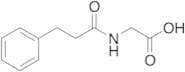
CAS 56613-60-6
:N-(3-phenylpropanoyl)glycin
Beschreibung:
N-(3-phenylpropanoyl)glycin, mit der CAS-Nummer 56613-60-6, ist eine organische Verbindung, die zur Klasse der Aminosäurederivate gehört. Sie weist ein Glycin-Rückgrat auf, das einfachste Aminosäure, das durch die Addition einer 3-Phenylpropanoyl-Gruppe modifiziert wurde. Diese Modifikation verleiht der Molekül einzigartige Eigenschaften, einschließlich einer erhöhten Hydrophobizität aufgrund der Phenylgruppe, die ihre Löslichkeit und Interaktion mit biologischen Systemen beeinflussen kann. Die Verbindung kann biologische Aktivität zeigen und möglicherweise als Ligand oder Modulator in verschiedenen biochemischen Wegen wirken. Ihre Struktur deutet darauf hin, dass sie an Wasserstoffbrückenbindungen und anderen intermolekularen Wechselwirkungen teilnehmen könnte, die für ihre Reaktivität und Stabilität entscheidend sind. Darüber hinaus ermöglicht die Anwesenheit sowohl einer Amin- als auch einer Carbonsäurefunktion eine potenzielle Teilnahme an der Bildung von Peptidbindungen, was sie im Kontext der Peptidsynthese und der Arzneimittelentwicklung relevant macht. Insgesamt ist N-(3-phenylpropanoyl)glycin von Interesse in der medizinischen Chemie und Biochemie aufgrund seiner potenziellen Anwendungen und Wechselwirkungen.
Formel:C11H13NO3
InChl:InChI=1/C11H13NO3/c1-2-10(13)12(8-11(14)15)9-6-4-3-5-7-9/h3-7H,2,8H2,1H3,(H,14,15)
InChI Key:InChIKey=YEIQSAXUPKPPBN-UHFFFAOYSA-N
SMILES:C(CC(NCC(O)=O)=O)C1=CC=CC=C1
Synonyme:- (3-Phenyl-propionylamino)-acetic acid
- (3-Phenylpropionyl)glycine
- 2-(3-Phenylpropanamido)acetic acid
- 56613-60-6
- Glycine, N-(1-oxo-3-phenylpropyl)-
- N-(1-Oxo-3-phenylpropyl)glycine
- N-(3-Phenylpropionyl)glycine
- N-(3-phenyl-propionyl)-glycine
- N-phenyl-N-propanoylglycine
- Phenylpropionylglycine
- [(3-Phenylpropanoyl)Amino]Acetic Acid
- [(3-Phenylpropionyl)amino]acetic acid
- N-(3-Phenylpropanoyl)glycine
- inhibit,N (3 Phenylpropionyl)glycine,Inhibitor,N(3Phenylpropionyl)glycine
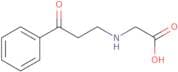
- 2-[(3-oxo-3-phenyl-propyl)amino]acetic acid
- Weitere Synonyme anzeigen
Sortieren nach
Reinheit (%)
0
100
|
0
|
50
|
90
|
95
|
100
8 Produkte.
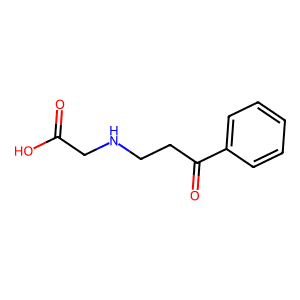
2-[(3-oxo-3-phenyl-propyl)amino]acetic acid
CAS:Formel:C11H13NO3Reinheit:98%Farbe und Form:SolidMolekulargewicht:207.2258N-(3-Phenylpropionyl)glycine
CAS:N-(3-Phenylpropionyl)glycineReinheit:≥95%Molekulargewicht:207.23g/mol3-Phenylpropionylglycine
CAS:Formel:C11H13NO3Reinheit:>96%Farbe und Form:LiquidMolekulargewicht:207.23N-(3-Phenylpropionyl)glycine
CAS:N-(3-Phenylpropionyl)glycine, an acyl glycine, indicates medium-chain acyl-CoA dehydrogenase deficiency when detected in urine.Formel:C11H13NO3Reinheit:97.25%Farbe und Form:SolidMolekulargewicht:207.23N-(3-Phenylpropionyl)glycine-3C2,15N
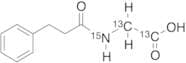
CAS:Kontrolliertes ProduktApplications N-(3-Phenylpropionyl)glycine-3C2,15N is a labelled analogue of N-(3-Phenylpropionyl)glycine (P336210), which is a useful diagnostic tool in the diagnosis of many organic acidemias and mitochondrial fatty acid β-oxidation defects. N-(3-Phenylpropionyl)glycine is present in the urine of medium-chain acyl-CoA dehydrogenase deficient (MCAD) patients who orally ingested 3-phenylpropionic acid.
References Duran, M. et al.: Prog. Clin. Biol. Res., 321, 419 (1988); Bonafe, L. et al.: Mol. Gen. Metab., 69, 311 (2000); Ombrone, D. et al.: Anal. Biochem., 417, 122 (2011);Formel:C913C2H1315NO3Farbe und Form:NeatMolekulargewicht:210.2N-(3-Phenylpropionyl)glycine
CAS:N-(3-Phenylpropionyl)glycine is a metabolite of the amino acid glycine that is produced by plants. It has been used in diagnostic tests to measure the activity of enzymes involved in fatty acid metabolism and as a marker for metabolic disorders. N-(3-Phenylpropionyl)glycine can be detected in urine samples and has been used to diagnose different types of orotic aciduria, including infantile orotic aciduria. This metabolite inhibits the activity of the enzyme hexanoylglycerol O-acyltransferase, which catalyzes the conversion of hexanoylglycine to p-hydroxybenzoic acid. Hexanoylglycine is an intermediate product of human liver metabolism and it can be found in high concentrations in body tissues such as heart tissue.Formel:C11H13NO3Reinheit:Min. 95%Farbe und Form:PowderMolekulargewicht:207.23 g/mol
![2-[(3-oxo-3-phenyl-propyl)amino]acetic acid](/_next/image/?url=https%3A%2Fstatic.cymitquimica.com%2Fproducts%2FIN%2Fthumb%2FDA00EENU.jpg&w=3840&q=75)