CAS 56676-70-1
:N-Cyclohexylglycin-Hydrochlorid (1:1)
Beschreibung:
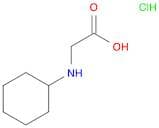
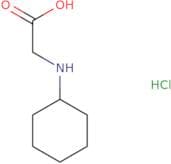
N-Cyclohexylglycin-Hydrochlorid (1:1) ist eine chemische Verbindung, die durch ihre Struktur gekennzeichnet ist, die eine Cyclohexylgruppe enthält, die an eine Glycinmoiety gebunden ist, wobei die Hydrochloridform das Vorhandensein von Salzsäure in ihrer Salzform anzeigt. Diese Verbindung erscheint typischerweise als weißes kristallines Feststoff und ist in Wasser löslich, was ein häufiges Merkmal vieler Aminosäurederivate ist. Sie wird häufig in der biochemischen Forschung und in pharmazeutischen Anwendungen verwendet, da sie eine potenzielle Rolle als Neurotransmitter oder bei der Modulation der Rezeptoraktivität spielt. Das Vorhandensein der Cyclohexylgruppe kann ihre Lipophilie und biologische Aktivität beeinflussen, was sie in der medizinischen Chemie von Interesse macht. Wie viele Hydrochloridsalze ist sie unter Standardbedingungen im Allgemeinen stabil, sollte jedoch an einem kühlen, trockenen Ort gelagert werden, um ihre Integrität zu bewahren. Sicherheitsdatenblätter sollten für Informationen zum Umgang und zur Toxizität konsultiert werden, wie bei jeder chemischen Substanz.
Formel:C8H16ClNO2
InChl:InChI=1/C8H15NO2.ClH/c10-8(11)6-9-7-4-2-1-3-5-7;/h7,9H,1-6H2,(H,10,11);1H
SMILES:C1CCC(CC1)NCC(=O)O.Cl
Synonyme:- glycine, N-cyclohexyl-, hydrochloride (1:1)
- H-D-Chg-Oh Hcl
- D-Cyclohexyl glycine hydrochloride
Sortieren nach
Reinheit (%)
0
100
|
0
|
50
|
90
|
95
|
100
3 Produkte.
2-(Cyclohexylamino)acetic acid hydrochloride
CAS:Formel:C8H16ClNO2Reinheit:96%Molekulargewicht:193.67112-(Cyclohexylamino)acetic acid hydrochloride
CAS:2-(Cyclohexylamino)acetic acid hydrochloride is a chiral compound that has been shown to inhibit the activity of metalloproteinases, including matrix metalloproteinase (MMP) and peptidyl-arginine deiminases. It also inhibits the production of inflammatory cytokines in response to viral infection. 2-(Cyclohexylamino)acetic acid hydrochloride may be useful for the treatment of liver diseases such as hepatitis or cirrhosis due to its ability to inhibit MMP-2. It is also being investigated as a potential drug for traumatic brain injury because it has been shown to reduce oxidative stress and inflammation in animal models.Formel:C8H16ClNO2Reinheit:Min. 95%Molekulargewicht:193.67 g/molRef: 3D-GCA67670
Ausgelaufenes produkt