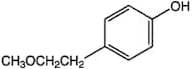
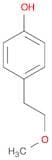
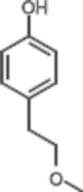
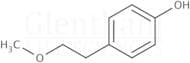
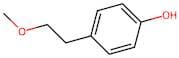
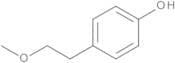
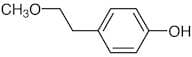
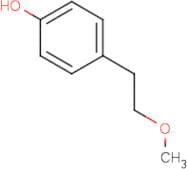
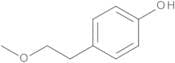
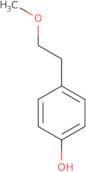
CAS 56718-71-9
:4-(2-Methoxyethyl)phenol
- 4-(2-Methoxy Ethyl) Phenol
- 4-(2-Methoxyethyl)-Pheno
- 4-(2-MethoxyethylPhenol
- 4-Methoxyethylphenol
- 4-beta-Methoxyethylphenol
- P-(2-Methoxyethyl)Phenol
- P-Methoxyethylphenol
- Phenol, 4-(2-methoxyethyl)-
- Phenol, p-(2-methoxyethyl)-
- Phme
- p-(2-Methoxyetyl)phenol
- p-Hydroxyphenethyl methyl ether
- Weitere Synonyme anzeigen
4-(2-Methoxyethyl)phenol, 98%
CAS:This Thermo Scientific Chemicals brand product was originally part of the Alfa Aesar product portfolio. Some documentation and label information may refer to the legacy brand. The original Alfa Aesar product / item code or SKU reference has not changed as a part of the brand transition to Thermo SciFormel:C9H12O2Reinheit:98%Farbe und Form:White to pale cream to pale yellow to pale brown, Crystals or powder or crystalline powder or lumpsMolekulargewicht:152.19Methoxyethyl Phenol
CAS:Ether-phenols, ether-alcohol-phenols and their halogenated, sulfonated, nitrated or nitrosated derivativesFormel:C9H12O2Farbe und Form:White PowderMolekulargewicht:152.08373p-(2-Methoxyethyl) phenol
CAS:p-(2-Methoxyethyl) phenol, a pharmaceutical intermediate for synthesizing metoprolol, treats cardiovascular disease.Formel:C9H12O2Reinheit:99.86%Farbe und Form:White To Light Yellow MeltMolekulargewicht:152.19Metoprolol EP Impurity B
CAS:Formel:C9H12O2Farbe und Form:Colorless Liquid To Semi-SolidMolekulargewicht:152.194-(2-Methoxyethyl)phenol
CAS:Kontrolliertes ProduktFormel:C9H12O2Farbe und Form:NeatMolekulargewicht:152.194-(2-Methoxyethyl)phenol
CAS:Formel:C9H12O2Reinheit:>98.0%(GC)Farbe und Form:White or Colorless to Almost white or Almost colorless powder to lump to clear liquidMolekulargewicht:152.194-(2-Methoxyethyl)phenol
CAS:Kontrolliertes ProduktImpurity Metoprolol EP Impurity B
Applications 4-(2-Methoxyethyl)phenol (Metoprolol EP Impurity B) is an impurity of Metoprolol.
References McGourty, J., et al.: Br. J. Clin. Pharmacol., 20, 555 (1985), Zhou, H., et al.: Clin. Pharmacol. Ther., 47, 686 (1990), Koyama, E., et al.: J. Pharmacol. Exp. Ther., 271, 860 (1994)Formel:C9H12O2Farbe und Form:NeatMolekulargewicht:152.194-(2-Methoxyethyl)phenol
CAS:4-(2-Methoxyethyl)phenol is a synthetic compound that is an antihypertensive agent. It is used to reduce high blood pressure, which may be due to its ability to block the action of angiotensin II, a potent vasoconstrictive hormone, by binding with its receptor. 4-(2-Methoxyethyl)phenol has been shown to be more potent than metoprolol succinate and less toxic than hydroxylated compounds such as propranolol in pharmacokinetic studies. In addition, 4-(2-Methoxyethyl)phenol has been found to have a low risk of congestive heart failure. The industrial process for this substance involves the reaction of hydrochloric acid with phenol in the presence of a catalyst such as aluminium chloride or zinc chloride.
Formel:C9H12O2Reinheit:Min. 95%Farbe und Form:PowderMolekulargewicht:152.19 g/mol