CAS 5703-21-9
:3,4-Dimethoxybenzolacetaldehyd
Beschreibung:
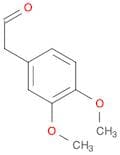
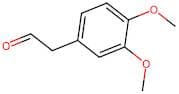
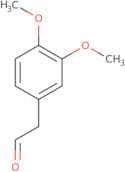
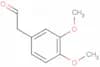
3,4-Dimethoxybenzolacetaldehyd, auch bekannt als Veratraldehyd, ist eine organische Verbindung, die durch ihre aromatische Struktur mit zwei Methoxygruppen (-OCH₃), die an einen Benzolring gebunden sind, sowie einer Aldehydfunktion (-CHO) an der Acetylposition gekennzeichnet ist. Diese Verbindung erscheint typischerweise als farblose bis blassgelbe Flüssigkeit mit einem süßen, angenehmen Geruch, der an Vanille oder andere blumige Noten erinnert. Sie ist in organischen Lösungsmitteln wie Ethanol und Ether löslich, hat jedoch eine begrenzte Löslichkeit in Wasser. Die Anwesenheit von Methoxygruppen erhöht ihre Reaktivität und beeinflusst ihre chemischen Eigenschaften, was sie zu einem wertvollen Zwischenprodukt in der organischen Synthese macht, insbesondere bei der Herstellung von Duftstoffen und Aromastoffen. Darüber hinaus kann 3,4-Dimethoxybenzolacetaldehyd an verschiedenen chemischen Reaktionen teilnehmen, einschließlich Oxidation und Kondensation, die für die Entwicklung komplexerer organischer Moleküle unerlässlich sind. Sicherheitsvorkehrungen sollten beim Umgang mit dieser Verbindung beachtet werden, da sie Haut- und Augenreizungen verursachen kann.
Formel:C10H12O3
InChl:InChI=1S/C10H12O3/c1-12-9-4-3-8(5-6-11)7-10(9)13-2/h3-4,6-7H,5H2,1-2H3
InChI Key:InChIKey=RIVVYJWUHXMGSK-UHFFFAOYSA-N
SMILES:O(C)C1=C(OC)C=CC(CC=O)=C1
Synonyme:- Homoveratraldehyde
- Homoveratrylaldehyde
- 3,4-Dimethoxybenzeneacetaldehyde
- Acetaldehyde, (3,4-dimethoxyphenyl)-
- Benzeneacetaldehyde, 3,4-dimethoxy-
Sortieren nach
Reinheit (%)
0
100
|
0
|
50
|
90
|
95
|
100
3 Produkte.
3,4-Dimethoxybenzeneacetaldehyde
CAS:Formel:C10H12O3Reinheit:95%Farbe und Form:LiquidMolekulargewicht:180.20052-(3,4-Dimethoxyphenyl)acetaldehyde
CAS:2-(3,4-Dimethoxyphenyl)acetaldehydeReinheit:95% (stabilized with Citric acid)Molekulargewicht:180.2g/mol2-(3,4-Dimethoxyphenyl)acetaldehyde
CAS:2-(3,4-Dimethoxyphenyl)acetaldehyde is a bioactive molecule that has shown anti-cancer properties in vitro and in vivo. It inhibits the activity of aldehyde dehydrogenase, an enzyme responsible for the oxidation of alcohols to aldehydes. This inhibition leads to accumulation of acetaldehyde in cells and induces apoptosis or cell death by caspase-independent mechanisms. 2-(3,4-Dimethoxyphenyl)acetaldehyde also has been shown to induce acidolysis reactions in the presence of acid. This reaction mechanism may be due to protonation of the phenolic hydroxyl group. The resulting 3,4-dimethoxyphenylacetic acid analog can inhibit cells' proliferation and induce apoptosis by blocking protein synthesis and cell division.
Formel:C10H12O3Reinheit:Min. 95%Farbe und Form:Clear LiquidMolekulargewicht:180.2 g/mol