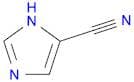
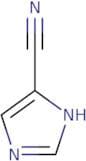
CAS 57090-88-7
:1H-Imidazol-5-carbonitril
Beschreibung:
1H-Imidazol-5-carbonitril, mit der CAS-Nummer 57090-88-7, ist eine heterocyclische organische Verbindung, die durch ihre Imidazolringstruktur gekennzeichnet ist, die aus zwei Stickstoffatomen und drei Kohlenstoffatomen in einem fünfgliedrigen Ring besteht. Die Anwesenheit einer Cyanogruppe (-C≡N) an der 5-Position des Imidazolrings verleiht einzigartige chemische Eigenschaften, wodurch sie ein wertvolles Zwischenprodukt in der organischen Synthese und in der Pharmazie ist. Diese Verbindung ist typischerweise ein Feststoff bei Raumtemperatur und ist bekannt für ihre moderate Löslichkeit in polaren Lösungsmitteln wie Wasser und Alkoholen. Ihre Reaktivität wird durch die elektronenanziehende Natur der Cyanogruppe beeinflusst, die an verschiedenen chemischen Reaktionen teilnehmen kann, einschließlich nucleophiler Substitutionen und Cycloadditionen. Darüber hinaus kann 1H-Imidazol-5-carbonitril als Baustein für die Synthese komplexerer Moleküle dienen, einschließlich biologisch aktiver Verbindungen. Ihre strukturellen Merkmale und Reaktivität machen sie von Interesse in der medizinischen Chemie und der Materialwissenschaft.
Formel:C4H3N3
InChl:InChI=1S/C4H3N3/c5-1-4-2-6-3-7-4/h2-3H,(H,6,7)
InChI Key:InChIKey=NWVGXXPWOYZODV-UHFFFAOYSA-N
SMILES:C(#N)C1=CN=CN1
Synonyme:- 1H-imidazole-5-carbonitrile
- 4-Cyano-1H-imidazole
- 4-Cyanoimidazole
- 4-Imidazolecarbonitrile
- 1H-Imidazole-4-carbonitrile
Sortieren nach
Reinheit (%)
0
100
|
0
|
50
|
90
|
95
|
100
5 Produkte.
1H-Imidazole-4-carbonitrile
CAS:Formel:C4H3N3Reinheit:97%Farbe und Form:SolidMolekulargewicht:93.08671H-Imidazole-4-carbonitrile
CAS:1H-Imidazole-4-carbonitrileFormel:C4H3N3Reinheit:98%Farbe und Form: off-white to light yellow solidMolekulargewicht:93.09g/mol1H-Imidazole-4-carbonitrile
CAS:Formamide is a prebiotic that is synthesized by the hydrolytic reaction of formaldehyde with ammonia. Formamide is also one of the most important industrial solvents and is used in the production of acetic acid, butanol, and ammonium sulfate. The functional theory states that formamide can serve as a growth regulator for plants. It has been shown to induce the expression of genes related to carbohydrate metabolism, such as ribulose-1,5-bisphosphate carboxylase/oxygenase (RuBisCO) and fructose-bisphosphate aldolase. Formamide has been identified in wastewater from chemical plants and industrial facilities in China and Russia. Formamide may be an environmental pollutant due to its ability to react with nitrate or perchlorate ions from wastewater to produce nitrous acid or perchloric acid. This chemical has also been found to act as a ligand for metal ions such as copper(IIFormel:C4H3N3Reinheit:Min. 95%Molekulargewicht:93.09 g/mol