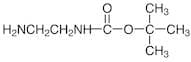
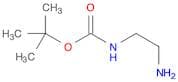
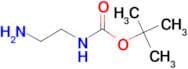
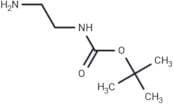
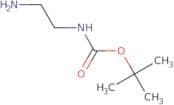
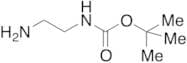
CAS 57260-73-8
:N-BOC-Ethylendiamin
- (2-Aminoethyl)carbamic acid 1,1-dimethylethyl ester
- (2-Aminoethyl)carbamic acid tert-butyl ester
- 1,1-Dimethylethyl (2-aminoethyl)carbamate
- 1-[(tert-Butoxycarbonyl)amino]-2-aminoethane
- 2-(N-tert-Butoxycarbonylamino)ethylamine
- 2-(tert-Butoxycarbonyl)amino-1-aminoethane
- 2-[(tert-Butoxycarbonyl)amino]ethylamine
- 2-[[(tert-Butyloxy)carbonyl]amino]ethylamine
- Carbamic acid, (2-aminoethyl)-, 1,1-dimethylethyl ester
- Carbamic acid, N-(2-aminoethyl)-, 1,1-dimethylethyl ester
- N-(2-Aminoethyl)carbamic acid 1,1-dimethylethyl ester
- N-(2-Aminoethyl)carbamic acid tert-butyl ester
- N-(t-Butyloxycarbonyl)ethylenediamine
- N-(tert-Butoxycarbonyl)-1,2-diaminoethane
- N-(tert-Butoxycarbonyl)-1,2-ethanediamine
- N-(tert-Butoxycarbonyl)ethylenediamine
- N-BOC-1,2-Diaminoethane
- N-Boc-1,2-ethylendiamine
- N-Boc-Ethane-1,2-Diamine
- N-Tert-Boc-Ethylenediamine
- N-tert-Butoxycarbonyl-1,2-ethylenediamine
- Tert-Butyl (2-Aminoethyl)Carbamate
- Tert-Butyl 2-Aminoethylcarbamate
- [(tert-Butyloxy)carbonyl]-1,2-ethylenediamine
- mono-BOC-ethylenediamine
- tert-Butyl N-(2-aminoethyl)carbamate
- tert-Butyl [(2-aminoethyl)amino]formate
- N-(2-AMINOETHYL)-N-BOC-AMINE
- N-1-T-BUTOXYCARBONYL-1,2-DIAMINOETHANE
- BUTTPARK 27\08-29
- 1-BOC-AMINO-1,2-ETHANEDIAMINE
- N-BOC-DIAMINOETHANE
- BOC-EDA
- BOC-NH-(CH2)2-NH2
- 1-BOC-ETHYLENEDIAMINE
- (2-AMINO-ETHYL)-CARBAMIC ACID TERT-BUTYL ESTER
- N-BOC-ETHYLENEDIAMINE
- N-(T-BOC)ETHYLENEDIAMINE
- AKOS 91563
- BOC-DIAMINOETHANE
- Weitere Synonyme anzeigen
N-(tert-Butoxycarbonyl)-1,2-diaminoethane
CAS:Formel:C7H16N2O2Reinheit:>97.0%(GC)Farbe und Form:Colorless to Light yellow clear liquidMolekulargewicht:160.22N-Boc-ethylenediamine, 98%, may cont up to 5% tert-butanol
CAS:N-Boc-ethylenediamine is used in the synthesis of thyronamine derivatives. It is also used in the preparation of (2-isothiocyanato-ethyl)-carbamic acid tert-butyl ester by reacting with carbon disulfide. Further, it is used in both oligonucleotide and peptide synthesis. This Thermo Scientific ChemicFormel:C7H16N2O2Reinheit:98%Farbe und Form:Clear, colorless to pale yellow, LiquidMolekulargewicht:160.22Ethane-1,2-diamine, N-BOC protected
CAS:Ethane-1,2-diamine, N-BOC protectedFormel:C7H16N2O2Reinheit:97%Farbe und Form: clear. almost colourless liquidMolekulargewicht:160.21413g/moltert-Butyl N-(2-aminoethyl)carbamate
CAS:Formel:C7H16N2O2Reinheit:98.0%Farbe und Form:Liquid, Clear or ViscousMolekulargewicht:160.217NH2-C2-NH-Boc
CAS:NH2-C2-NH-Boc (PROTAC Linker 22) (PROTAC Linker 22) is a alkyl chain-based PROTAC linker. NH2-C2-NH-Boc can be used in the synthesis of PROTACs.Formel:C7H16N2O2Reinheit:≥98%Farbe und Form:Colorless To Light YellowMolekulargewicht:160.21N-Boc-ethylenediamine
CAS:N-Boc-ethylenediamine is a chemical compound that belongs to the group of peptide hormones. It is historically used as a building block for peptides, such as luteinizing hormone releasing hormone (LHRH), which control reproduction and regulate the release of hormones. N-Boc-ethylenediamine has been shown to inhibit dpp-iv, an enzyme that breaks down proteins needed for cell growth and survival. This inhibition leads to cell death by apoptosis, or programmed cell death. N-Boc-ethylenediamine has also been shown to be an antimicrobial peptide against gram negative bacteria. The synthesis of this compound can be accomplished through several methods, including using diazonium salt or histone proteins. The analytical method involves hydrogen bonding between the amines and trifluoroacetic acid in order to produce the desired product.
Formel:C7H16N2O2Reinheit:Min. 95%Farbe und Form:Clear LiquidMolekulargewicht:160.21 g/molNH2-C2-NH-Boc
CAS:Kontrolliertes ProduktApplications N-Boc-ethylenediamine is used in the synthesis of Thyronamine derivatives and analogs.
Not a dangerous good if item is equal to or less than 1g/ml and there is less than 100g/ml in the package
References Anon., et al.: J. Pharmacol., 58, 53 (1936), Boissier, J., et al.: Eur. J. Pharmacol., 22, 141 (1973), Nillne, E., et al.: J. Biol. Chem., 277, 48587 (2002),Formel:C7H16N2O2Farbe und Form:NeatMolekulargewicht:160.21NHS-dPEG®4-Biotinidase Resistant Biotin
CAS:NHS-dPEG®4-Biotinidase Resistant Biotin is a PEG compound with two different functional groups (also known as heterobifunctional). Unlike homobifunctional PEG compounds (same functional group on both ends), this type of compounds are more versatile as have two different anchor points. NHS-dPEG®4-Biotinidase Resistant Biotin is used as a linker and spacer to add a PEG moiety, via pegylation (a bioconjugation technique) to proteins, peptides, oligonucleotides, small molecules and nanoparticles.Formel:C15H32N2O5Reinheit:Min. 95%Molekulargewicht:160.21 g/mol