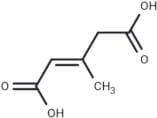
CAS 5746-90-7
:3-Methylglutaconsäure
Beschreibung:
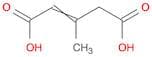
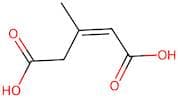
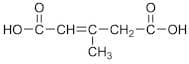
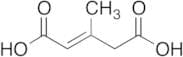
3-Methylglutaconsäure, mit der CAS-Nummer 5746-90-7, ist eine organische Verbindung, die durch ihre carboxylgruppenfunktionalen Gruppen und eine verzweigte Kettenstruktur gekennzeichnet ist. Es ist ein Derivat der Glutaconsäure und weist eine Methylgruppe an der dritten Kohlenstoffposition auf. Diese Verbindung ist typischerweise ein farbloser bis blassgelber Feststoff und ist aufgrund der Anwesenheit ihrer carboxylgruppenfunktionalen Gruppen in Wasser löslich. 3-Methylglutaconsäure ist von besonderem Interesse in der biochemischen Forschung, da es mit bestimmten Stoffwechselstörungen assoziiert ist, einschließlich 3-Methylglutaconsäureurie, die aus Defekten in der mitochondrialen Funktion resultieren kann. Die Verbindung kann an verschiedenen chemischen Reaktionen teilnehmen, einschließlich Veresterung und Decarboxylierung, was sie in der synthetischen organischen Chemie relevant macht. Ihre molekulare Formel spiegelt ihre Zusammensetzung aus Kohlenstoff, Wasserstoff und Sauerstoff wider, und ihre Struktur ermöglicht potenzielle Wechselwirkungen mit Enzymen und anderen biologischen Molekülen. Insgesamt dient 3-Methylglutaconsäure als wichtige Verbindung sowohl in klinischen als auch in synthetischen Kontexten.
Formel:C6H8O4
InChl:InChI=1S/C6H8O4/c1-4(2-5(7)8)3-6(9)10/h2H,3H2,1H3,(H,7,8)(H,9,10)
InChI Key:InChIKey=WKRBKYFIJPGYQC-UHFFFAOYSA-N
SMILES:C(C(=CC(O)=O)C)C(O)=O
Synonyme:- (2E)-3-Methyl-2-pentenedioic acid
- 2-Pentenedioic acid, 3-methyl-
- 2-pentenedioic acid, 3-methyl-, (2E)-
- 3-Methyl-2-pentenedioic acid
- 3-Methylglutaconic acid
- Glutaconic acid, 3-methyl-
- NSC 249232
- β-Methylglutaconic acid
- (2E)-3-Methylpent-2-enedioic acid
Sortieren nach
Reinheit (%)
0
100
|
0
|
50
|
90
|
95
|
100
7 Produkte.
3-Methylglutaconic Acid
CAS:Formel:C6H8O4Reinheit:>95.0%(GC)(T)Farbe und Form:White to Light yellow powder to crystalMolekulargewicht:144.133-Methylglutaconic Acid
CAS:Kontrolliertes ProduktStability Hygroscopic
Applications 3-Methylglutaconic acid is a glutarate which builds up in the urine in 3-methylglutaconic aciduria. 3-methylglutaconic aciduria is a term used to describe five different disorders that impair the functioning of energy-producing centers within cells (mitochondria)
References Walsh, R., et al.: J. Inherit. Metab. Dis., 22, 251 (1999); Gonzalez, I., et al.: Am J Med Genet A., 134, 409 (2005); MacKenzie, J., et al.: Biochim Biophys Acta., 1772, 509 (2007)Formel:C6H8O4Farbe und Form:NeatMolekulargewicht:144.133-Methylglutaconic acid
CAS:3-Methylglutaconic acid is a metabolite of creatine, which is an important energy source in the body. It is also involved in cholesterol synthesis and fatty acid production. The metabolic profile of 3-methylglutaconic acid can be used to diagnose metabolic disorders such as methylglutaconic aciduria and fatty acid oxidation defects. This compound can also be found in urine samples, but the concentration may vary depending on the patient's clinical condition. Nuclear DNA analysis has shown that 3-methylglutaconic acid is synthesized from acetyl coenzyme A and Mg2+, with the latter being supplied by ATP.Formel:C6H8O4Reinheit:Min. 95%Farbe und Form:PowderMolekulargewicht:144.13 g/mol3-Methylglutaconic acid
CAS:3-Methylglutaconic acid, a primary metabolite accumulating in 3-Methylglutaconic aciduria (MGTA), induces lipid and protein oxidation, while diminishing non-enzymatic antioxidant defenses in cerebral cortex supernatants, thereby promoting oxidative stress in the cerebral cortex. This compound is utilized in research concerning brain damage diseases [1].Formel:C6H8O4Reinheit:98%Farbe und Form:SolidMolekulargewicht:144.13