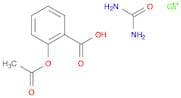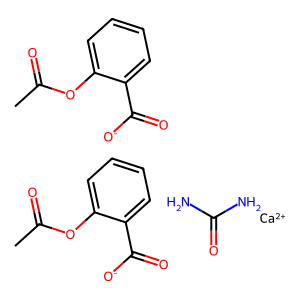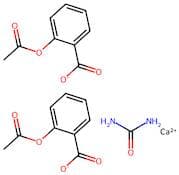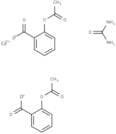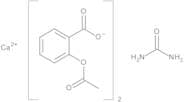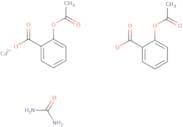
CAS 5749-67-7
:Carbasalatcalcium
- Acetylsalicylic acid calcium salt complex with urea
- Alcacyl
- Benzoic acid, 2-(acetyloxy)-, calcium salt, compd. with urea (1:1)
- Benzoic acid, 2-(acetyloxy)-, calcium salt, compd. with urea (2:1:2)
- Calcium 2-(Acetyloxy)Benzoate - Urea (1:2:1)
- Calcium acetyl salicylate carbamide
- Calcium carbasalate
- Calcium carbaspirin
- Calpirinsan
- Calurin
- Carbasalate Calcium
- Iromin
- Omegin
- Salicylic acid acetate, calcium salt, compd. with urea (1:1)
- Solupsan
- Soluspan
- Urea calcium acetylsalicylate
- Urea, compd. with calcium bis[2-(acetyloxy)benzoate] (1:1)
- Urea, compd. with salicylic acid acetate calcium salt (1:1)
- Weitere Synonyme anzeigen
Benzoic acid, 2-(acetyloxy)-, calcium salt, compd. with urea (1:1)OTHER CA INDEX NAMES:Urea, compd. with calcium bis[2-(acetyloxy)benzoate] (1:1)
CAS:Formel:C19H18CaN2O9Reinheit:97%Farbe und Form:SolidMolekulargewicht:458.4322Carbasalate Calcium Salt
CAS:Formel:C9H7O4·CH4N2O·CaFarbe und Form:White To Off-White SolidMolekulargewicht:2 179.15 60.06 40.08Carbasalate calcium
CAS:Carbasalate calcium (Rheomin) is an analgesic, antipyretic, and anti-inflammatory drug, as well as a platelet aggregation inhibitor.Formel:C19H18CaN2O9Reinheit:98%Farbe und Form:White Or Almost White Crystalline PowderMolekulargewicht:458.436Trichlormethiazide
CAS:Kontrolliertes ProduktApplications Carbasalate Calcium is an analgesic, antipyretic, and anti-inflammatory drug.
References van Es, R.F., et al.: Lancet, 360, 109 (2002).Formel:(C9H7O4)·CH4N2O·CaFarbe und Form:NeatMolekulargewicht:458.4Carbasalate calcium
CAS:Carbasalate calcium is useful in the treatment of chronic and acute infectious diseases, such as influenza, paratyphoid fever, bronchitis, and other respiratory tract infections. It also has been shown to be effective in the prevention of heart disease. Carbasalate calcium binds to the acetylsalicylic acid receptor site on the surface of platelets and prevents aggregation. This drug is a non-steroidal anti-inflammatory drug (NSAID) that inhibits prostaglandin synthesis by blocking cyclooxygenase enzymes. The pharmacological activity of carbasalate calcium is assessed by measuring its ability to inhibit platelet aggregation in whole blood samples from patients with congestive heart failure. The test solution is prepared by adding trifluoroacetic acid to a reaction solution that contains multivalent ions of calcium and acetylsalicylic acid. The amount of carbasalate calcium present in this mixture can be determined using LC-MS/MS analytical methods
Formel:C20H22CaN4O10Reinheit:Min. 95%Farbe und Form:PowderMolekulargewicht:518.49 g/mol