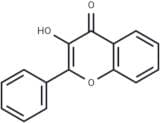
CAS 577-85-5
:Flavonol
Beschreibung:
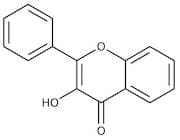
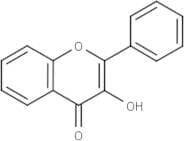
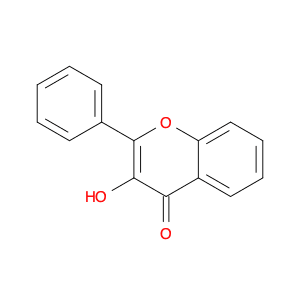
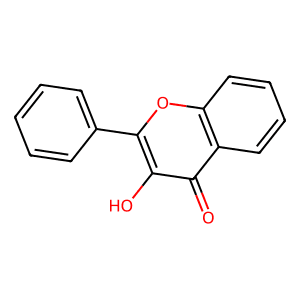
Flavonol, mit der CAS-Nummer 577-85-5, ist eine Art von Flavonoid, das eine Klasse von polyphenolischen Verbindungen ist, die weit verbreitet in Pflanzen vorkommen. Charakteristisch sind Flavonols bekannt für ihre antioxidativen Eigenschaften, die zu ihren potenziellen gesundheitlichen Vorteilen beitragen, einschließlich entzündungshemmender und krebsbekämpfender Wirkungen. Sie zeigen typischerweise eine gelbe Farbe und sind in organischen Lösungsmitteln löslich, aber weniger in Wasser. Die Struktur der Flavonols weist ein 15-Kohlenstoff-Skelett auf, das aus zwei aromatischen Ringen besteht, die durch eine drei-Kohlenstoff-Brücke verbunden sind, mit einer Ketogruppe und Hydroxylgruppen, die in Anzahl und Position variieren können, was ihre biologische Aktivität und Löslichkeit beeinflusst. Häufige Beispiele für Flavonols sind Quercetin und Kaempferol, die in Früchten, Gemüse und Getränken wie Tee reichlich vorhanden sind. Diese Verbindungen spielen eine bedeutende Rolle bei der Pflanzenpigmentierung und UV-Schutz und werden auch auf ihre potenziellen therapeutischen Wirkungen auf die menschliche Gesundheit untersucht, insbesondere im Zusammenhang mit Herz-Kreislauf-Erkrankungen und Stoffwechselstörungen.
Formel:C15H10O3
InChl:InChI=1S/C15H10O3/c16-13-11-8-4-5-9-12(11)18-15(14(13)17)10-6-2-1-3-7-10/h1-9,17H
InChI Key:InChIKey=HVQAJTFOCKOKIN-UHFFFAOYSA-N
SMILES:OC1=C(OC=2C(C1=O)=CC=CC2)C3=CC=CC=C3
Synonyme:- 3-Hf
- 3-Hidroxiflavona
- 3-Hydroxy-2-phenyl-4H-1-benzopyran-4-one
- 3-Hydroxy-2-phenylchromen-4-one
- 3-Hydroxy-2-phenylchromone
- 3-Hydroxyflavon
- 3-hydroxy-2-phenyl-4H-chromen-4-one
- 3HF
- 4H-1-Benzopyran-4-one, 3-hydroxy-2-phenyl-
- Flavon-3-ol
- Flavone, 3-hydroxy-
- Flavonol
- Hsdb 7572
- Nsc 57653
- Nsc 58585
- Nsc 58586
- Nsc 58587
- Weitere Synonyme anzeigen
Sortieren nach
Reinheit (%)
0
100
|
0
|
50
|
90
|
95
|
100
11 Produkte.
3-Hydroxy-2-phenyl-4H-chromen-4-one
CAS:Formel:C15H10O3Reinheit:98%Farbe und Form:SolidMolekulargewicht:238.2423-Hydroxyflavone, 98+%
CAS:3-Hydroxyflavone is a reactant involved in studies of photochemically-induced dioxygenase-type CO-release reactivity; phase-transfer protection and deprotection of hydroxychromones; and O-methylation with di-Me carbonate. As a reactant it is involved in the synthesis of biologically active moleculesFormel:C15H10O3Reinheit:98+%Farbe und Form:White to yellow or pale cream, PowderMolekulargewicht:238.253-Hydroxyflavone
CAS:3-Hydroxyflavone analytical standard provided with chromatographic purity, to be used as reference material for qualitative determination.Formel:C15H10O3Reinheit:(HPLC) ≥95%Farbe und Form:PowderMolekulargewicht:238.253-Hydroxyflavone
CAS:Formel:C15H10O3Reinheit:>98.0%(T)(HPLC)Farbe und Form:White to Yellow powder to crystalMolekulargewicht:238.24Flavonol
CAS:Flavonol (3-Hydroxyflavone) is a member of the class of compounds known as flavonols. Flavonol can be found in a number of food items.Formel:C15H10O3Reinheit:98.1% - 99.94%Farbe und Form:Yellow Needles Yellow Fluffy PowderMolekulargewicht:238.243-Hydroxyflavone
CAS:3-Hydroxyflavone is a naturally derived flavonoid compound found in various plants. As a member of the flavonoid family, it is synthesized through the phenylpropanoid pathway, starting from phenylalanine or tyrosine in plants. Its unique structure allows it to interact with a range of biological targets through its antioxidant, anti-inflammatory, and enzyme modulation properties. The mode of action primarily involves the scavenging of free radicals and reactive oxygen species, as well as the inhibition of specific enzymes such as cyclooxygenases and lipoxygenases. These actions contribute to its protective effects against oxidative stress and inflammation.Formel:C15H10O3Reinheit:Min. 95%Farbe und Form:PowderMolekulargewicht:238.24 g/mol