


CAS 5780-07-4
:Myristicinaldehyd
Beschreibung:
Myristicinaldehyd, mit der CAS-Nummer 5780-07-4, ist eine organische Verbindung, die durch ihre Aldehydfunktionalität und eine lange Kohlenstoffkette gekennzeichnet ist. Es handelt sich um eine farblose bis blassgelbe Flüssigkeit mit einem charakteristischen Geruch, der oft mit fettigen oder nussigen Düften assoziiert wird. Diese Verbindung wird aus Myristinsäure gewonnen, die eine gesättigte Fettsäure ist, die häufig in Muskatnuss und anderen natürlichen Quellen vorkommt. Myristicinaldehyd ist bekannt für seine potenziellen Anwendungen in der Duftstoffindustrie aufgrund seines angenehmen Aromas. Darüber hinaus kann es biologische Aktivitäten zeigen, was es in verschiedenen Bereichen, einschließlich Pharmazie und Lebensmittelwissenschaft, von Interesse macht. Die Verbindung ist unter normalen Bedingungen relativ stabil, sollte jedoch aufgrund ihrer reaktiven Aldehydgruppe mit Vorsicht behandelt werden, da sie an verschiedenen chemischen Reaktionen, einschließlich Oxidation und Kondensation, teilnehmen kann. Wie bei vielen organischen Verbindungen sollten beim Arbeiten mit Myristicinaldehyd angemessene Sicherheitsmaßnahmen getroffen werden, um eine Exposition zu vermeiden und eine sichere Handhabung zu gewährleisten.
Formel:C9H8O4
InChl:InChI=1/C9H8O4/c1-11-7-2-6(4-10)3-8-9(7)13-5-12-8/h2-4H,5H2,1H3
InChI Key:InChIKey=LOFRBHZYZCIOJO-UHFFFAOYSA-N
SMILES:O(C)C1=C2C(=CC(C=O)=C1)OCO2
Synonyme:- 1,3-Benzodioxole-5-carboxaldehyde, 7-methoxy-
- 3,4-(Methylenedioxy)-5-methoxybenzaldehyde
- 3-Methoxy-4,5-(methylenedioxy)benzaldehyde
- 5-Formyl-7-methoxy-1,3-benzodioxole
- 5-Methoxy-3,4-(methylenedioxy)benzaldehyde
- 5-Methoxypiperonal
- 7-Methoxy-1,3-Benzodioxole-5-Carbaldehyde
- 7-Methoxy-1,3-benzodioxole-5-carboxaldehyde
- 7-Methoxybenzo[d][1,3]dioxole-5-carboxaldehyde
- 7-Methyoxy-1,3-benzodioxole-5-carboxaldehyde
- Ai3-24290
- Benzaldehyde, 3-methoxy-4,5-(methylenedioxy)-
- Myristic aldehyde
- Myristicaldehyde
- Myristicinaldehyde
- 7-Methoxybenzo-1,3-dioxole-5-carboxaldehyde
- 3-METHOXY-4,5-METHYLENEDIOXYBENZALDEHYDE
- 5-Methoxypiperonal , (Myristicin Aldehyde)
- 7-methoxy-3-benzodioxole-5-carboxaldehyde
- MYRISTICIN ALDEHYDE
- Weitere Synonyme anzeigen
Sortieren nach
Reinheit (%)
0
100
|
0
|
50
|
90
|
95
|
100
5 Produkte.
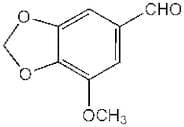
5-Methoxypiperonal, 97%
CAS:5-Methoxypiperonal is used in the synthesis of oxazole combretastatin A-4 analogs showing anti-tumor activity. It is also used in the synthesis of endothelin-A antagonist ABT-546, and further in the synthesis of antidepressant rolipram. This Thermo Scientific Chemicals brand product was originally pFormel:C9H8O4Reinheit:97%Farbe und Form:Powder, White to cream to brown or greyMolekulargewicht:180.167-Methoxybenzo[D][1,3]Dioxole-5-Carbaldehyde
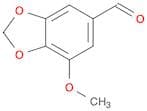
CAS:7-Methoxybenzo[D][1,3]Dioxole-5-CarbaldehydeReinheit:99%Molekulargewicht:180.16g/mol3-Methoxy-4,5-methylenedioxybenzaldehyde
CAS:Kontrolliertes Produkt3-Methoxy-4,5-methylenedioxybenzaldehyde (MMDA) is an amine that is used in the synthesis of drugs and pharmaceuticals. It is a major component of myristicin, which is found in nutmeg. MMDA can be synthesized from aluminium chloride, hydrochloric acid and pyridine. The molecule has a skeleton that is recemic at acidic pH values and mesoionic at basic pH values. This compound also reacts with acetyl chloride to form 3,4-dimethoxyacetophenone, which can be chromatographically separated from other compounds. The chromatography produces flavonoid derivatives such as quercetin, 3′-methoxyquercetin and 3′,4′-dimethoxyquercetin. Flavonoids are polyphenolic compounds found in plants that have antioxidant properties. Chromatographic separation of these compounds can be done using spectrometric methods toFormel:C9H8O4Reinheit:Min. 95 Area-%Farbe und Form:Off-White PowderMolekulargewicht:180.16 g/mol7-Methoxy-benzo[1,3]dioxole-5-carbaldehyde
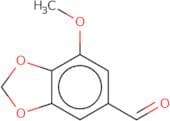
CAS:Formel:C9H8O4Reinheit:98%Farbe und Form:Cream coloured powderMolekulargewicht:180.159


![7-Methoxybenzo[D][1,3]Dioxole-5-Carbaldehyde](/_next/image/?url=https%3A%2Fstatic.cymitquimica.com%2Fproducts%2F54%2Fthumb%2FOR1012081.jpg&w=3840&q=75)


![7-Methoxy-benzo[1,3]dioxole-5-carbaldehyde](/_next/image/?url=https%3A%2Fstatic.cymitquimica.com%2Fproducts%2F10%2Fthumb%2FF057776.jpg&w=3840&q=75)
