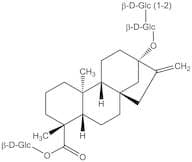
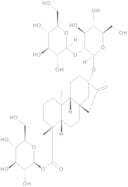
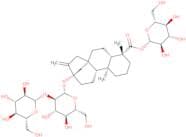
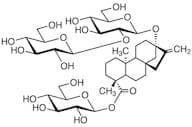
![Kaur-16-en-18-oic acid, 13-[(2-O-β-D-glucopyranosyl-β-D-glucopyranosyl)oxy]-, β-D-glucopyranosyl e…](/_next/image/?url=https%3A%2Fstatic.cymitquimica.com%2Fcas-image%2Fthumb-webp%2F397681-stevioside.webp&w=3840&q=75)
CAS 57817-89-7
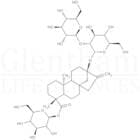
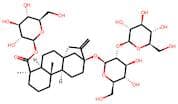
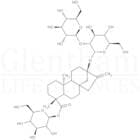
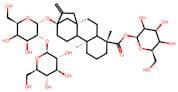
:Kaur-16-en-18-oic Säure, 13-[(2-O-β-D-glucopyranosyl-β-D-glucopyranosyl)oxy]-, β-D-glucopyranosylester, (4α)-
Beschreibung:
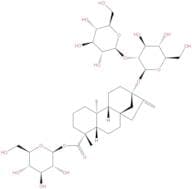
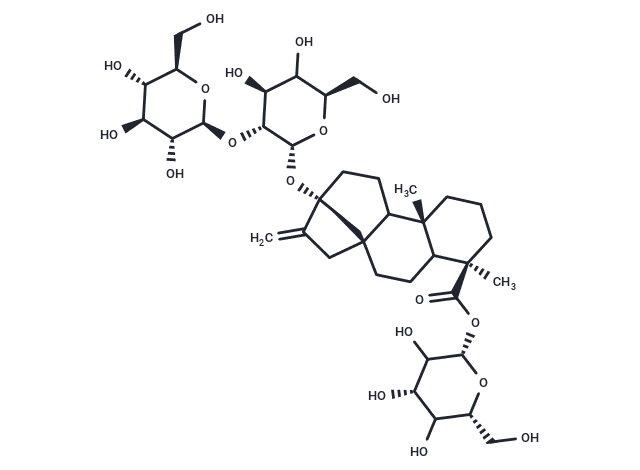
Die Kaur-16-en-18- Säure, 13-[(2-O-β-D-Glucopyranosyl-β-D-Glucopyranosyl)oxy]-, β-D-Glucopyranosylester, mit der CAS-Nummer 57817-89-7, ist eine komplexe glykosylierte Verbindung, die aus der Kaurenfamilie der Terpenoide stammt. Diese Substanz weist ein Kauren-Rückgrat auf, das durch eine fusionierte Struktur aus Cyclohexan- und Cyclopentanringen gekennzeichnet ist, die typisch für viele pflanzliche Terpene ist. Das Vorhandensein mehrerer Zuckermoleküle, insbesondere β-D-Glucopyranosyl-Einheiten, weist auf eine potenzielle Rolle in biologischen Systemen hin, möglicherweise zur Verbesserung der Löslichkeit und Bioverfügbarkeit. Eine solche Glykosylierung kann auch die pharmakologischen Eigenschaften der Verbindung beeinflussen, einschließlich ihrer Wechselwirkungen mit biologischen Rezeptoren und Enzymen. Derivate der Kaur-16-en-18-Säure werden häufig auf ihre potenziellen therapeutischen Anwendungen, einschließlich entzündungshemmender und krebsbekämpfender Aktivitäten, untersucht. Die spezifische Stereochemie, die durch die (4α)-Konfiguration bezeichnet wird, deutet auf eine bestimmte räumliche Anordnung der Atome hin, die die Reaktivität und biologische Funktion der Verbindung beeinflussen kann. Insgesamt veranschaulicht diese Verbindung die komplexe Beziehung zwischen Struktur und Funktion in Naturstoffen.
Formel:C38H60O18
InChl:InChI=1S/C38H60O18/c1-16-11-37-9-5-20-35(2,7-4-8-36(20,3)34(50)55-32-29(49)26(46)23(43)18(13-40)52-32)21(37)6-10-38(16,15-37)56-33-30(27(47)24(44)19(14-41)53-33)54-31-28(48)25(45)22(42)17(12-39)51-31/h17-33,39-49H,1,4-15H2,2-3H3/t17-,18-,19-,20+,21+,22-,23-,24-,25+,26+,27+,28-,29-,30-,31+,32+,33+,35-,36-,37-,38+/m1/s1
InChI Key:InChIKey=UEDUENGHJMELGK-HYDKPPNVSA-N
SMILES:C[C@]12[C@]3([C@]4(C[C@](O[C@H]5[C@H](O[C@@H]6O[C@H](CO)[C@@H](O)[C@H](O)[C@H]6O)[C@@H](O)[C@H](O)[C@@H](CO)O5)(C(=C)C4)CC3)CC[C@@]1([C@@](C(O[C@@H]7O[C@H](CO)[C@@H](O)[C@H](O)[C@H]7O)=O)(C)CCC2)[H])[H]
Synonyme:- (4α)-β-D-Glucopyranosyl-13-[(2-O-β-D-glucopyranosyl-β-D-glucopyranosyl)oxy]kaur-16-en-18-oat
- (4α)-β-D-glucopyranosyl 13-[(2-O-β-D-glucopyranosyl-β-D-glucopyranosyl)oxy]kaur-16-en-18-oate
- 1,2-Stevioside
- 13-[(2-O-β-D-glucopiranosil-β-D-glucopiranosil)oxi]kaur-16-en-18-oato de (4α)-β-D-glucopiranosilo
- 13-[(2-O-β-D-glucopyrannosyl-β-D-glucopyrannosyl)oxy]kaur-16-ene-18-oate de (4α)-β-D-glucopyrannosyle
- 1H-2,10a-Ethanophenanthrene, kaur-16-en-18-oic acid deriv.
- E 960
- Kaur-16-en-18-oic acid, 13-[(2-O-β-<span class="text-smallcaps">D</smallcap>-glucopyranosyl-β-<smallcap>D</smallcap>-glucopyranosyl)oxy]-, β-<smallcap>D</span>-glucopyranosyl ester, (4α)-
- Stevian 50
- Stevioside
- Steviosin
- α-G Sweet PX
- α-G-Sweet
- 1-O-[(5bêta,8alpha,9bêta,10alpha,13alpha)-13-{[2-O-(bêta-D-Glucopyranosyl)-bêta-D-glucopyranosyl]oxy}-18-oxokaur-16-én-18-yl]-bêta-D-glucopyranose
- (1R,4S,5R,9S,10R,13S)-13-{[(2S,3R,4S,5S,6R)-4,5-Dihydroxy-6-(hydroxyméthyl)-3-{[(2S,3R,4S,5S,6R)-3,4,5-trihydroxy-6-(hydroxyméthyl)tétrahydro-2H-pyran-2-yl]oxy}tétrahydro-2H-pyran-2-yl]oxy}-5,9-diméthyl-14-méthylènetétracyclo[11.2.1.0~1,10~.0~4,9~]hexadécane-5-carboxylate de (2S,3R,4S,5S,6R)-3,4,5-trihydroxy-6-(hydroxyméthyl)tétrahydro-2H-pyran-2-yle
- 1-O-[(5beta,8alpha,9beta,10alpha,13alpha)-13-{[2-O-(beta-D-Glucopyranosyl)-beta-D-glucopyranosyl]oxy}-18-oxokaur-16-en-18-yl]-beta-D-glucopyranose
- Kaur-16-en-18-oic acid, 13-[(2-O-β-D-glucopyranosyl-β-D-glucopyranosyl)oxy]-, β-D-glucopyranosyl ester, (4α)-
- (2S,3R,4S,5S,6R)-3,4,5-Trihydroxy-6-(hydroxymethyl)tetrahydro-2H-pyran-2-yl (1R,4S,5R,9S,10R,13S)-13-{[(2S,3R,4S,5S,6R)-4,5-dihydroxy-6-(hydroxymethyl)-3-{[(2S,3R,4S,5S,6R)-3,4,5-trihydroxy-6-(hydroxymethyl)tetrahydro-2H-pyran-2-yl]oxy}tetrahydro-2H-pyran-2-yl]oxy}-5,9-dimethyl-14-methylenetetracyclo[11.2.1.0~1,10~.0~4,9~]hexadecane-5-carboxylate
- Stevia Sugar
- (2S,3R,4S,5S,6R)-3,4,5-Trihydroxy-6-(hydroxymethyl)tetrahydro-2H-pyran-2-yl-(1R,4S,5R,9S,10R,13S)-13-{[(2S,3R,4S,5S,6R)-4,5-dihydroxy-6-(hydroxymethyl)-3-{[(2S,3R,4S,5S,6R)-3,4,5-trihydroxy-6-(hydroxymethyl)tetrahydro-2H-pyran-2-yl]oxy}tetrahydro-2H-pyran-2-yl]oxy}-5,9-dimethyl-14-methylentetracyclo[11.2.1.0~1,10~.0~4,9~]hexadecan-5-carboxylat
- Weitere Synonyme anzeigen
Sortieren nach
Reinheit (%)
0
100
|
0
|
50
|
90
|
95
|
100
Stevioside
CAS:Formel:C38H60O18Reinheit:>85.0%(HPLC)Farbe und Form:White to Almost white powder to crystalMolekulargewicht:804.88Stevioside
CAS:Stevioside analytical standard provided with w/w absolute assay, to be used for quantitative titration.Formel:C38H60O18Reinheit:(HPLC) ≥98%Farbe und Form:PowderMolekulargewicht:804.89Stevioside
CAS:Other glycosides, natural or reproduced by synthesis, aFormel:C38H60O18Farbe und Form:White PowderMolekulargewicht:804.37797Kaur-16-en-18-oic acid,13-[(2-O-b-D-glucopyranosyl-b-D-glucopyranosyl)oxy]-,b-D-glucopyranosyl ester, (4a)-
CAS:Formel:C38H60O18Reinheit:80%Farbe und Form:SolidMolekulargewicht:804.8722Stevioside, 95%
CAS:Formel:C38H60O18·xH2OReinheit:≥ 95.0%Farbe und Form:White to pale yellow or faint beige powderMolekulargewicht:804.87 (anhydrous)Stevioside, 98%
CAS:Formel:C38H60O18·xH2OReinheit:≥ 97.5%Farbe und Form:White to pale yellow or faint beige powderMolekulargewicht:804.87 (anhydrous)Stevioside
CAS:Stevioside is a safe natural sweetener, has no allergic reactions, suited for both diabetics, and PKU patients, as well as for obese persons intending to lose weight by avoiding sugar supplements in the diet. Stevioside enjoys a dual positive effect by acting as an antihyperglycemic and a blood pressure-lowering substance, it may have therapeutic potential in the treatment of type 2 diabetes and the metabolic syndrome.Stevioside exerts anti-inflammatory and anti-apoptotic properties by inhibiting the release of cytokines and the activation of TLR2 and proteins of the NF-κB and MAPK signaling pathways, as well as caspase-3 and Bax.Formel:C38H60O18Reinheit:95%~99%Molekulargewicht:804.88Stevia extract, contains approx. 40% stevioside
CAS:Formel:C38H60O18·xH2OMolekulargewicht:804.87 (anhydrous)Stevioside
CAS:Natural sweetener, 300x sweeter than sucrose, affects p-aminohippurate transport.Formel:C38H60O18Reinheit:97.82% - 99.89%Farbe und Form:White PowderMolekulargewicht:804.87Stevioside, 85%
CAS:Formel:C38H60O18·xH2OReinheit:≥ 85.0% (dried basis)Farbe und Form:White to off-white powderMolekulargewicht:804.87 (anhydrous)Stevioside
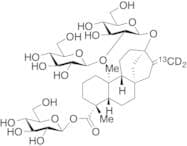
CAS:Natural glycosideFormel:C38H60O18Reinheit:≥ 95.0 % (HPLC)Farbe und Form:PowderMolekulargewicht:804.89Stevioside-13C,d2 (90%)
CAS:Formel:CC37D2H58O18Reinheit:90%Farbe und Form:NeatMolekulargewicht:807.877Steviol glycosides
CAS:Applications Stevioside is a glycoside from the stevia plant. Stevioside is a natural sweetening agent with sweetness about 250 times that of sugar with negligible effect on blood glucose. Stevioside, much like other steviol glycoside is known for its application in treatment of many diseases like diabetes and high blood pressure. It is also used as a food additive.
References Mishra, P. et al.: Glob. J. Biotechnol. Biochem., 5, 62 (2010); Gregersen, S. et al.: Metab. Clin. Exp., 53, 73 (2004); Chan, P. et al.: Life Sci., 63, 1679 (1998); Heerranz-Lopez, M. et al.: Agro Food Ind. Hi-Tech, 21, 38 (2010);Formel:C38H60O18Farbe und Form:WhiteMolekulargewicht:804.87Stevioside - min 75%
CAS:Stevioside - min 75% is a high-purity glycoside compound that functions as a natural sweetener. It is derived from the leaves of the Stevia rebaudiana plant, a member of the Asteraceae family, which is native to Paraguay and Brazil. This compound works by interacting with the sweet receptors on the tongue, specifically the TAS1R2 and TAS1R3 receptors, to provide a sweet taste sensation that is several hundred times sweeter than sucrose, without contributing to caloric intake.Formel:C38H60O18Reinheit:(%) Min. 75%Farbe und Form:White PowderMolekulargewicht:804.87 g/molStevioside - min 98%
CAS:Stevia glycoside is a natural sweetener found in the medicinal herb Stevia rebaudiana Bertoni. Stevia glycoside is a low calorie, high-intensity sweetener and is up to three hundred times sweeter than sucrose. Due to the sweet taste of Stevia glycoside, it has a high commercial value throughout the world as sugar substitute in medicine, foods products and beverages. The Stevia plant contains also other steviosides, which include: rebaudioside A, rebaudioside D and dulcoside D, all of which are known as Stevia sweeteners (Mathur, 2017).Formel:C38H60O18Reinheit:Min. 95%Farbe und Form:White Off-White PowderMolekulargewicht:804.87 g/mol



![Kaur-16-en-18-oic acid,13-[(2-O-b-D-glucopyranosyl-b-D-glucopyranosyl)oxy]-,b-D-glucopyranosyl est…](/_next/image/?url=https%3A%2Fstatic.cymitquimica.com%2Fproducts%2FIN%2Fthumb%2FDA00IKK5.jpg&w=3840&q=75)