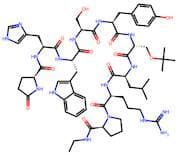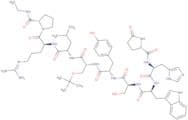
CAS 57982-77-1
:Buserelin
- 5-oxoprolylhistidyltryptophylseryltyrosyl-O-tert-butylserylleucyl-N~5~-(diaminomethylidene)ornithyl-N-ethylprolinamide
- 5-oxo-L-prolyl-L-histidyl-L-tryptophyl-L-seryl-L-tyrosyl-O-tert-butyl-D-seryl-L-leucyl-N~5~-(diaminomethylidene)-L-ornithyl-N-ethyl-L-prolinamide
- [D-Ser(tert-butyl)6,des-Gly-NH210]-LH-RH ethylamide
- [D-Ser6(t-Bu),de-Gly10-NH2]-LH-RH ethylamide
- 1-9-(D-Ser(t-butyl))6-LH-releasing hormone ethylamide
- 1-9-Luteinizing hormone-releasing factor (swine), 6-[O-(1,1-dimethylethyl)-D-serine]-9-(N-ethyl-L-prolinamide)-
- Buserelina
- Busereline
- Etilamide
- Hoe 766
- Hoe 766A
- Ici 123215
- Luteinizing hormone-releasing factor (pig), 6-[O-(1,1-dimethylethyl)-D-serine]-9-(N-ethyl-L-prolinamide)-10-deglycinamide-
- Receptal
- Weitere Synonyme anzeigen
(Des-Gly¹⁰,D-Ser(tBu)⁶,Pro-NHEt⁹)-LHRH
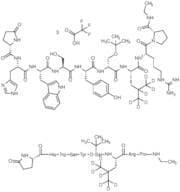
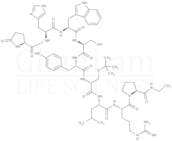
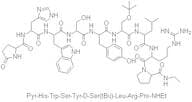
CAS:Buserelin is a longer acting synthetic peptide analog of the naturally occurring gonadotropin-releasing hormone (GnRH/LHRH). Substitution of glycine in position 6 by D-serine and that of glycinamide in position 10 by ethylamide, leads to a nonapeptide with a significantly enhanced LHRH effect. The effects of buserelin on follicle-stimulating hormone (FSH) and luteinizing hormone (LH) release are approximately 20 to 170 times higher than those of natural LHRH. CAS Number (buserelin acetate): 68630-75-1.Formel:C60H86N16O13Reinheit:98.0%Farbe und Form:WhiteMolekulargewicht:1239.44Buserelin Ditrifluoroacetate
CAS:Formel:C60H86N16O13·2C2HF3O2Farbe und Form:Off-White SolidMolekulargewicht:1239.45 2*114.02Buserelin Acetate
CAS:Formel:C60H86N16O13Reinheit:95%~99%Farbe und Form:White to Off-white PowderMolekulargewicht:1239.43(Des-Gly10,D-Ser(tBu)6,Pro-NHEt 9)-LHRH acetate salt
CAS:This drug is used for the treatment of endometriosis. It belongs to the class of drugs called GnRH analogues and acts by binding to receptors in the pituitary gland that control hormone production. The receptor is then activated, which leads to a decrease in the production of follicle-stimulating hormone (FSH) and luteinizing hormone (LH). This results in a reduction in estrogen levels, which decreases uterine growth and thickening. The drug is used for short periods of time, usually 3-6 months, before taking a break for 1-2 months.
Estradiol benzoate is an estrogen medication that can be taken orally or via injection. It has been shown to have more beneficial effects on endometriosis than estradiol because it can improve symptoms such as pain and heavy menstrual bleeding. Estradiol benzoate may also be effective at treating autoimmune diseases because it has anti-inflammatory properties.
The mechanism ofFormel:C60H86N16O13Reinheit:Min. 95%Molekulargewicht:1,239.42 g/mol