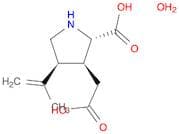
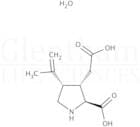
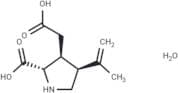
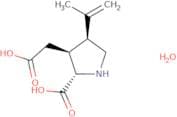
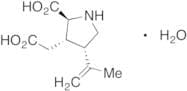
CAS 58002-62-3
:Kainsäure-Monohydrat
- (-)-Kainic acid Monohydrat
- (3S,4S)-3-(carboxymethyl)-4-prop-1-en-2-yl-L-proline hydrate (1:1)
- Kainic Acid 2-Carboxy-3-Carboxymethyl-4-Isopropenylpyrrolidine
- 2-CARBOXY-3-CARBOXYMETHYL-4-ISOPROPENYLPYRROLIDINE
- Kainic acid monohydrate,2-Carboxy-3-carboxymethyl-4-isopropenylpyrrolidine
- (2S,3S,4S)-3-(carboxyMethyl)-4-(prop-1-en-2-yl)pyrrolidine-2-carboxylic acid hydrate
- [2S-(2A,3BETA,4BETA)]-2-CAROXY-4-(1-METHYLETHENYL)-3-PYRROLIDINEACETIC ACID, MONOHYDRATE
- (?)-(α)-Kainic Acid hydrate
- (2S,3S,4S)-2-CARBOXY-4-ISOPROPENYL-3-PYRROLIDINEACETIC ACID
- KAINIC ACID MONOHYDRATE
- 3-Pyrrolidineaceticacid, 2-carboxy-4-(1-Methylethenyl)-, hydrate (1:1), (2S,3S,4S)-
- KAINIC ACID HYDRATE
- KAINIC ACID MONOHYDRATE, ISOLATED FROM D
- [2S-(2alpha,3beta,4beta)]-2-Carboxy-4-(1-methylethenyl)-3-pyrrolidineacetic acid monohydrate
- kainic acid monohydrate from digenea simplex
- 2-CARBOXYL-3-CARBOXYMETHYL-4-ISOPROPENYLPYRROLIDINE MONOHYDRATE
- KAINIC ACID 2-CARBOXY-3-CARBOXYMETHYL-4-ISOPROPENYLPYRROLIDINE USP/EP/BP
- (-)-KAINIC ACID, MONOHYDRATE
- ([2S-(2a,34]-2-Caroxy-4-(1-methylethenyl)-3-pyrrolidineacetic Acid
- Weitere Synonyme anzeigen
3-Pyrrolidineacetic acid, 2-carboxy-4-(1-methylethenyl)-, hydrate (1:1), (2S,3S,4S)-
CAS:Formel:C10H17NO5Reinheit:98%Farbe und Form:SolidMolekulargewicht:231.2457(-)-(α)-Kainic Acid (hydrate)
CAS:(-)-(α)-Kainic Acid (hydrate) is a potent excitotoxic agent that can induce seizures.
Formel:C10H17NO5Farbe und Form:SolidMolekulargewicht:231.25Kainic acid monohydrate
CAS:Agonist of kainate receptors, a subclass of ionotropic glutamate receptors with neuroexcitatory action. At high concentrations, it can induce seizures and act as neurotoxin, causing neuron death due to overstimulation.Formel:C10H15NO4·H2OReinheit:Min. 98 Area-%Farbe und Form:White PowderMolekulargewicht:231.25 g/mol(-)-Alpha-Kainic Acid Monohydrate
CAS:Kontrolliertes ProduktApplications (-)-α-Kainic Acid Monohydrate is the monohydrated form of (-)-α-Kainic Acid (K135010); a naturally occurring neuroexcitatory chemical that is a selective agonist for a subtype of ionotropic glutamate receptor. Administration of (-)-α-Kainic Acid has been shown to increase production of reactive oxygen species, mitochondrial dysfunction, and apoptosis in neurons in many regions of the brain, particularly in the hippocampal subregions and in the hilus of dentate gyrus.
References Wacker, D.A., et al.: Synlett, 503 (1997); Dunleavy, M., et al.: J. Molec. Neurosci., 49, 202 (2013); Zhang, J., et al.: Neuron., 76, 1133 (2012); Yamada, J., et al.: Neurosci., 226, 119 (2012); Wang,Q., et al.: Mol. Neurobiol., 31, 3 (2005)Formel:C10H15NO4·H2OFarbe und Form:NeatMolekulargewicht:231.246