CAS 5813-37-6
:4-Brom-1-hydroxynaphthalin-2-carbonsäure
Beschreibung:
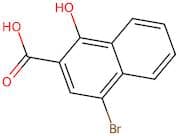
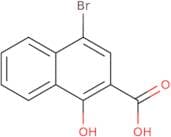
4-Brom-1-hydroxynaphthalin-2-carbonsäure, mit der CAS-Nummer 5813-37-6, ist eine organische Verbindung, die zur Klasse der Naphthalen-Derivate gehört. Diese Substanz weist ein Naphthalen-Ringsystem auf, das mit einem Bromatom, einer Hydroxylgruppe und einer Carbonsäuregruppe substituiert ist, die zu ihrer chemischen Reaktivität und ihren Eigenschaften beitragen. Die Anwesenheit der Hydroxylgruppe zeigt an, dass sie an Wasserstoffbrückenbindungen teilnehmen kann, was ihre Löslichkeit in polaren Lösungsmitteln erhöht. Die Carbonsäuregruppe verleiht saure Eigenschaften, die es ihr ermöglichen, Protonen in Lösung abzugeben. Darüber hinaus kann der Bromsubstituent die Reaktivität der Verbindung beeinflussen, was sie zu einem potenziellen Kandidaten für weitere chemische Modifikationen oder Reaktionen macht. Diese Verbindung kann biologische Aktivität zeigen, was sie für die pharmazeutische Forschung von Interesse macht. Ihre strukturellen Merkmale deuten auf potenzielle Anwendungen in der organischen Synthese, Materialwissenschaft und als Zwischenprodukt in der Herstellung anderer chemischer Verbindungen hin. Sicherheitsdaten sollten für den Umgang und die Lagerung konsultiert werden, wie bei allen chemischen Substanzen.
Formel:C11H7BrO3
InChl:InChI=1/C11H7BrO3/c12-9-5-8(11(14)15)10(13)7-4-2-1-3-6(7)9/h1-5,13H,(H,14,15)
SMILES:c1ccc2c(c1)c(cc(c2O)C(=O)O)Br
Synonyme:- 2-Naphthalenecarboxylic Acid, 4-Bromo-1-Hydroxy-
- 4-Bromo-1-hydroxy-2-naphthoic acid
Sortieren nach
Reinheit (%)
0
100
|
0
|
50
|
90
|
95
|
100
3 Produkte.
4-Bromo-1-hydroxy-2-naphthoic acid
CAS:4-Bromo-1-hydroxy-2-naphthoic acidReinheit:97%Molekulargewicht:267.08g/mol4-Bromo-1-hydroxy-2-naphthoic acid
CAS:Formel:C11H7BrO3Reinheit:97%Farbe und Form:SolidMolekulargewicht:267.0784-bromo-1-hydroxynaphthalene-2-carboxylic acid
CAS:4-Bromo-1-hydroxynaphthalene-2-carboxylic acid (4BHN) is a spectroscopic compound that has been used as a radioligand to study the binding of dopamine and dopamine D3 receptors. This compound binds to the d3 receptor with high affinity and specificity, but it does not interact with the d1 or d2 receptors. 4BHN has been shown to act as an agonist at the dopamine D3 receptor. It also acts as an antagonist at the piperidine site of the dopamine D2 receptor. The effects of 4BHN are reversible, which means that it can be displaced by unlabeled 4BHN or other compounds that bind to the same site on the receptor. This technique is useful for studying drug interactions and for determining whether drugs have a subtype selectivity profile.
Formel:C11H7BrO3Reinheit:Min. 95%Molekulargewicht:267.1 g/mol