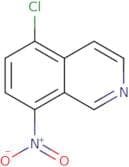
CAS 58142-95-3
:5-chlor-8-nitroisochinolin
Beschreibung:
5-chlor-8-nitroisochinolin ist eine heterocyclische organische Verbindung, die durch ihre Isoquinolinstruktur gekennzeichnet ist, die aus einem fusionierten Benzol- und Pyridinring besteht. Die Anwesenheit eines Chloratoms an der Position 5 und einer Nitrogruppe an der Position 8 trägt zu ihren einzigartigen chemischen Eigenschaften bei. Diese Verbindung erscheint typischerweise als gelb-orangefarbener Feststoff und ist in Wasser schwer löslich, aber in organischen Lösungsmitteln wie Ethanol und Dimethylsulfoxid besser löslich. Die Chlor- und Nitrosubstituenten können ihre Reaktivität beeinflussen, was sie zu einem potenziellen Kandidaten für verschiedene chemische Reaktionen macht, einschließlich elektrophiler Substitution und nucleophiler Angriff. Darüber hinaus kann 5-chlor-8-nitroisochinolin biologische Aktivität zeigen, was das Interesse an der medizinischen Chemie für potenzielle Anwendungen in der Arzneimittelentwicklung geweckt hat. Ihre Synthese umfasst oft mehrstufige organische Reaktionen, und es ist wichtig, diese Verbindung mit Vorsicht zu behandeln, da die Nitrogruppe empfindlich auf Reduktionsreaktionen reagieren kann. Insgesamt dient diese Verbindung als wertvolles Zwischenprodukt in der organischen Synthese und Forschung.
Formel:C9H5ClN2O2
InChl:InChI=1/C9H5ClN2O2/c10-8-1-2-9(12(13)14)7-5-11-4-3-6(7)8/h1-5H
SMILES:c1cc(c2cnccc2c1Cl)N(=O)=O
Sortieren nach
Reinheit (%)
0
100
|
0
|
50
|
90
|
95
|
100
1 Produkte.
5-Chloro-8-nitroisoquinoline
CAS:<p>5-Chloro-8-nitroisoquinoline is a cytotoxic agent that belongs to the class of pyridopyrimidines. It is an amidation product of 8-nitroisoquinoline and 5-chloroacetaldehyde, which is prepared by condensation of nitrostyrene with acetone. 5-Chloro-8-nitroisoquinoline has anticancer activity against human cancer cells in vitro and in vivo. The mechanism of action is multidrug resistance, mediated by overexpression of P glycoprotein. This drug also inhibits the reductive activation of hypoxia inducible factor (HIF) alpha, which leads to its cytotoxicity.</p>Formel:C9H5ClN2O2Reinheit:Min. 95%Molekulargewicht:208.6 g/mol