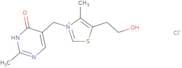
![Thiazolium, 3-[(1,6-dihydro-2-methyl-6-oxo-5-pyrimidinyl)methyl]-5-(2-hydroxyethyl)-4-methyl-, chl…](/_next/image/?url=https%3A%2Fstatic.cymitquimica.com%2Fcas-image%2Fthumb-webp%2F386741-5-2-hydroxyethyl-3-4-hydroxy-2-methylpyrimidin-5-ylmethyl-4-methylthiazolium-chloride.webp&w=3840&q=75)
CAS 582-36-5
:Thiazoliumchlorid, 3-[(1,6-dihydro-2-methyl-6-oxo-5-pyrimidinyl)methyl]-5-(2-hydroxyethyl)-4-methyl-, (1:1)
Beschreibung:
Thiazoliumchlorid, 3-[(1,6-dihydro-2-methyl-6-oxo-5-pyrimidinyl)methyl]-5-(2-hydroxyethyl)-4-methyl-, (1:1), mit der CAS-Nummer 582-36-5, ist eine chemische Verbindung, die durch ihre Thiazolium-Ringstruktur gekennzeichnet ist, die einen fünfgliedrigen heterozyklischen Ring enthält, der Schwefel und Stickstoff enthält. Diese Verbindung weist eine Pyrimidinyl-Gruppe auf, die zu ihrer biologischen Aktivität und potenziellen pharmakologischen Eigenschaften beiträgt. Das Vorhandensein von Hydroxyl- und Methylgruppen verbessert ihre Löslichkeit und Reaktivität. Als Chloridsalz existiert es in einer stabilen ionischen Form, die seine Wechselwirkung mit biologischen Systemen beeinflussen kann. Thiazolium-Verbindungen werden häufig hinsichtlich ihrer Rolle in verschiedenen biochemischen Prozessen, einschließlich der Enzymkatalyse und als Zwischenprodukte in der organischen Synthese, untersucht. Die spezifischen strukturellen Merkmale dieser Verbindung deuten auf potenzielle Anwendungen in der medizinischen Chemie hin, insbesondere bei der Entwicklung von Therapeutika, die auf spezifische biologische Wege abzielen. Ihre einzigartige Kombination funktioneller Gruppen kann auch interessante Eigenschaften verleihen, wie antioxidative oder antimikrobielle Aktivität, was weitere Untersuchungen in synthetischen und biologischen Kontexten rechtfertigt.
Formel:C12H16ClN3O2S
InChl:InChI=1/C12H15N3O2S.ClH/c1-8-11(3-4-16)18-7-15(8)6-10-5-13-9(2)14-12(10)17;/h5,7,16H,3-4,6H2,1-2H3;1H
InChI Key:InChIKey=RNUAEUWXRHCGKX-UHFFFAOYSA-N
SMILES:C([N+]=1C(C)=C(CCO)SC1)C=2C(=O)NC(C)=NC2.[Cl-]
Synonyme:- 3-[(1,4-Dihydro-2-methyl-4-oxo-5-pyrimidinyl)methyl]-5-(2-hydroxyethyl)-4-methylthiazolium Chloride
- 5-(2-Hydroxyethyl)-3-[(4-hydroxy-2-methyl-5-pyrimidinyl)methyl]-4-methylthiazolium Chloride
- 5-(2-Hydroxyethyl)-3-[(4-hydroxy-2-methylpyrimidin-5-yl)methyl]-4-methyl-1,3-thiazol-3-ium chloride
- 5-(2-Hydroxyethyl)-4-Methyl-3-[(2-Methyl-6-Oxo-1,6-Dihydropyrimidin-5-Yl)Methyl]-1,3-Thiazol-3-Ium Chloride
- 582-36-5
- Hydroxythiamine
- Oxythiamine chloride
- Thiazolium, 3-[(1,4-dihydro-2-methyl-4-oxo-5-pyrimidinyl)methyl]-5-(2-hydroxyethyl)-4-methyl-, chloride
- Thiazolium, 3-[(1,6-dihydro-2-methyl-6-oxo-5-pyrimidinyl)methyl]-5-(2-hydroxyethyl)-4-methyl-, chloride (1:1)
- Thiamine 4-Hydroxy
- 5-[[5-(2-hydroxyethyl)-4-methyl-thiazol-3-ium-3-yl]methyl]-2-methyl-1H-pyrimidin-6-one chloride
- 5-(2-hydroxyethyl)-3-(4-hydroxy-2-methylpyrimidin-5-ylmethyl)-4-methylthiazolium chloride
- Weitere Synonyme anzeigen
Sortieren nach
Reinheit (%)
0
100
|
0
|
50
|
90
|
95
|
100
1 Produkte.
Oxythiamine chloride
CAS:Oxythiamine chloride is a compound that binds to DNA in the nucleus of cells. It has been shown to inhibit cell growth and induce apoptosis by binding to a number of cellular molecules, including hydrogen bonding interactions with enzymes. Oxythiamine chloride also inhibits energy metabolism by inhibiting mitochondrial respiration and mitochondrial ATP production, and is toxic to cells. This drug has potent inducers, such as cell factor, which are necessary for the production of new cells. It also inhibits thiamine-dependent enzymes, such as pyruvate dehydrogenase kinase (PDK) and pyruvate dehydrogenase (PDH). The wild-type strain of Escherichia coli was used for these studies.
Formel:C12H15N3O2S·HClReinheit:Min. 95%Farbe und Form:White to off-white solid.Molekulargewicht:301.79 g/mol