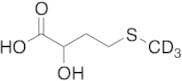
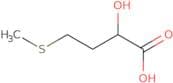
CAS 583-91-5
:2-Hydroxy-4-(methylthio)butansäure
Beschreibung:
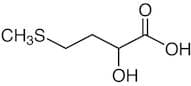
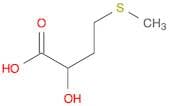
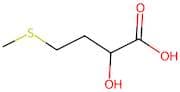
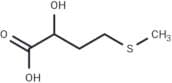
2-Hydroxy-4-(methylthio)butansäure, auch bekannt unter seiner CAS-Nummer 583-91-5, ist eine organische Verbindung, die durch das Vorhandensein einer Hydroxylgruppe (-OH) und einer Methylthiogruppe (-S-CH3) gekennzeichnet ist, die an einem Buttersäuregerüst angebracht sind. Diese Verbindung ist eine Art von Aminosäurederivat, spezifisch ein Thioether, was zu ihren einzigartigen chemischen Eigenschaften beiträgt. Sie ist typischerweise ein weißes bis schmutzig-weißes kristallines Feststoff, das aufgrund der polaren Hydroxylgruppe in Wasser löslich ist. Das Vorhandensein der Methylthiogruppe kann ihre Reaktivität und Wechselwirkungen mit anderen Molekülen beeinflussen, was sie in verschiedenen biochemischen Anwendungen von Interesse macht. Diese Verbindung kann an Stoffwechselwegen beteiligt sein und als Vorläufer oder Zwischenprodukt bei der Synthese anderer biologisch relevanter Moleküle dienen. Ihre Eigenschaften, einschließlich Schmelzpunkt, Siedepunkt und spezifische Reaktivität, können je nach Umweltbedingungen und dem Vorhandensein anderer Substanzen variieren. Insgesamt ist 2-Hydroxy-4-(methylthio)butansäure sowohl in der synthetischen als auch in der biologischen Chemie von Bedeutung.
Formel:C5H10O3S
InChl:InChI=1S/C5H10O3S/c1-9-3-2-4(6)5(7)8/h4,6H,2-3H2,1H3,(H,7,8)
InChI Key:InChIKey=ONFOSYPQQXJWGS-UHFFFAOYSA-N
SMILES:C(C(O)=O)(CCSC)O
Synonyme:- 2-Hydroxy-4-(Methylsulfanyl)Butanoic Acid
- 2-Hydroxy-4-(methylmercapto)butyric acid
- 2-Hydroxy-4-(methylthio)butanoic acid
- 2-Hydroxy-4-Methylthiobutyric acid = DL-2-Hydroxy-4-(methylthio)butyric Acid (68-72% in Water)
- <span class="text-smallcaps">DL</span>-2-Hydroxy-4-(methylmercapto)butanoic acid
- <span class="text-smallcaps">DL</span>-2-Hydroxy-4-(methylmercapto)butyric acid
- <span class="text-smallcaps">DL</span>-2-Hydroxy-4-(methylthio)butanoic acid
- <span class="text-smallcaps">DL</span>-2-Hydroxy-4-(methylthio)butyric acid
- <span class="text-smallcaps">DL</span>-α-Hydroxy-γ-methylmercaptobutyric acid
- Alimet
- At 88
- Biox-A
- Butanoic acid, 2-hydroxy-4-(methylthio)-
- Butyric acid, 2-hydroxy-4-(methylthio)-
- Butyric acid, α-hydroxy-γ-(methylmercapto)-
- DL-2-Hydroxy-4-(methylthio)butyric acid
- Desmenidol
- Desmeninol
- Hmtba
- Hydan L
- MHA acid
- Mha-Fa
- α-Hydroxy-4-(methylthio)butyric acid
- α-Hydroxy-γ-(methylmercapto)butyric acid
- α-Hydroxy-γ-(methylthio)butyric acid
- γ-(Methylmercapto)-α-hydroxybutyric acid
- Weitere Synonyme anzeigen
Sortieren nach
Reinheit (%)
0
100
|
0
|
50
|
90
|
95
|
100
7 Produkte.
2-Hydroxy-4-(methylthio)butyric Acid (65-72% in Water)
CAS:Formel:C5H10O3SFarbe und Form:White - Yellow LiquidMolekulargewicht:150.192-HYDROXY-4-(METHYLTHIO)BUTYRIC ACID
CAS:Reinheit:88%Farbe und Form:LiquidMolekulargewicht:150.19000242-Hydroxy-4-(methylthio)butyric acid
CAS:Formel:C5H10O3SReinheit:85%Farbe und Form:LiquidMolekulargewicht:150.19612-Hydroxy-4-(methylthio)butyric acid
CAS:2-Hydroxy-4-(methylthio)butyric acidReinheit:85%Molekulargewicht:150.20g/molDesmeninol
CAS:Desmeninol, found in urine and cytoplasm, is used in organic synthesis, dye-making, medicine, photo-coloring, and as a fungicide.Formel:C5H10O3SFarbe und Form:2-Hydroxy-4-(Methylthio)-Butanoic Acid Is A Light Brown Liquid (Uscg 1999)Molekulargewicht:150.2DL-2-Hydroxy-4-(methylthio)butanoic acid-d3
CAS:Kontrolliertes ProduktFormel:C5D3H7O3SFarbe und Form:NeatMolekulargewicht:153.2152-Hydroxy-4-(methylthio)butanoic acid
CAS:2-Hydroxy-4-(methylthio)butanoic acid (2HMB) is an amide that is used as a microbial metabolism inhibitor, especially for the inhibition of bacterial growth. 2HMB and its analogues are also used in plant physiology. 2HMB has been shown to have transport properties and can be used as an inorganic acid for the manufacture of hydrochloric acid. It has been found to have enzyme activities, such as polymerase chain reaction and hydroxyl group transferases, which make it a useful catalyst for reactions involving organic compounds. The hydroxyl group in 2HMB makes it a good candidate for use in fatty acid synthesis and oxidation reactions. Chronic exposure to this chemical may lead to carbonyl oxygen formation.Formel:C5H10O3SReinheit:Min. 95%Farbe und Form:Yellow PowderMolekulargewicht:150.2 g/mol