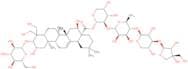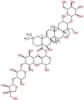
CAS 58479-68-8
:Platycodin D
Beschreibung:
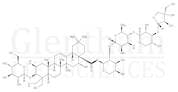
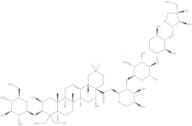
Platycodin D ist ein triterpenoider Saponin, der hauptsächlich aus der Wurzel von Platycodon grandiflorus gewonnen wird, einer Pflanze, die häufig in der traditionellen Medizin, insbesondere in Ostasien, verwendet wird. Es ist bekannt für seine verschiedenen biologischen Aktivitäten, einschließlich entzündungshemmender, immunmodulatorischer und krebsbekämpfender Eigenschaften. Die chemische Struktur von Platycodin D weist ein Dammarane-Skelett auf, das zu seiner Bioaktivität beiträgt. Es ist typischerweise durch seine Löslichkeit in Wasser und organischen Lösungsmitteln gekennzeichnet, obwohl seine Löslichkeit je nach verwendetem Lösungsmittel variieren kann. Platycodin D war Gegenstand zahlreicher Studien, die seine pharmakologischen Effekte untersuchen, einschließlich seines Potenzials zur Verbesserung der Atemwegsgesundheit und seiner Rolle bei der Modulation von Immunantworten. Darüber hinaus zeigt es zytotoxische Effekte gegen bestimmte Krebszelllinien, was es zu einer interessanten Verbindung in der Krebsforschung macht. Wie bei vielen Naturprodukten können die Extraktions- und Reinigungsprozesse seine Wirksamkeit und Bioverfügbarkeit beeinflussen, was die Bedeutung geeigneter analytischer Techniken bei der Untersuchung seiner Eigenschaften und Anwendungen hervorhebt.
Formel:C57H92O28
InChl:InChI=1S/C57H92O28/c1-23-40(81-45-39(72)41(28(64)18-76-45)82-49-43(73)56(75,21-61)22-78-49)36(69)38(71)46(79-23)83-42-33(66)27(63)17-77-48(42)85-50(74)57-12-11-51(2,3)13-25(57)24-7-8-30-52(4)14-26(62)44(84-47-37(70)35(68)34(67)29(16-58)80-47)55(19-59,20-60)31(52)9-10-53(30,5)54(24,6)15-32(57)65/h7,23,25-49,58-73,75H,8-22H2,1-6H3/t23-,25-,26-,27-,28+,29+,30+,31+,32+,33-,34+,35-,36-,37+,38+,39+,40-,41-,42+,43-,44-,45-,46-,47-,48-,49-,52+,53+,54+,56+,57+/m0/s1
InChI Key:InChIKey=CYBWUNOAQPMRBA-NDTOZIJESA-N
SMILES:C(O[C@H]1[C@H](O[C@H]2[C@H](O)[C@H](O)[C@@H](O[C@H]3[C@H](O)[C@@H](O[C@H]4[C@H](O)[C@](CO)(O)CO4)[C@H](O)CO3)[C@H](C)O2)[C@@H](O)[C@@H](O)CO1)(=O)[C@]56[C@](C=7[C@@](C)(C[C@H]5O)[C@@]8(C)[C@](CC7)([C@]9(C)[C@@](CC8)(C(CO)(CO)[C@@H](O[C@@H]%10O[C@H](CO)[C@@H](O)[C@H](O)[C@H]%10O)[C@@H](O)C9)[H])[H])(CC(C)(C)CC6)[H]
Synonyme:- (1-2)-L-arabinopyranosyl ester, (2beta,3beta,16alpha)-
- 2,16,23,24-tetrahydroxy-, O-D-apio-beta-D-furanosyl-(1-3)-O-
- 3-O-[(2S,3R,4R)-3,4-dihydroxy-4-(hydroxymethyl)tetrahydrofuran-2-yl]-beta-D-xylopyranosyl-(1->4)-6-deoxy-alpha-L-mannopyranosyl-(1->2)-1-O-[(2beta,3beta,16alpha)-3-(beta-D-glucopyranosyloxy)-2,16,23,24-tetrahydroxy-28-oxoolean-12-en-28-yl]-alpha-L-arabinopyranose
- Olean-12-en-28-oic acid, 3-(beta-D-glucopyranosyloxy)-
- Olean-12-en-28-oic acid, 3-(β-<span class="text-smallcaps">D</smallcap>-glucopyranosyloxy)-2,16,23,24-tetrahydroxy-, O-<smallcap>D</smallcap>-apio-β-<smallcap>D</smallcap>-furanosyl-(1→3)-O-β-<smallcap>D</smallcap>-xylopyranosyl-(1→4)-O-6-deoxy-α-<smallcap>L</smallcap>-mannopyranosyl-(1→2)-α-<smallcap>L</span>-arabinopyranosyl ester, (2β,3β,16α)-
- beta-D-xylopyranosyl-(1-4)-O-6-deoxy-alpha-L-mannopyranosyl-
- beta-D-xylopyranosyl-(1-4)-O-6-deoxy-alpha-L-mannopyranosyl-
- (1-2)-L-arabinopyranosyl ester, (2beta,3beta,16alpha)-
- Olean-12-en-28-oic acid, 3-(beta-D-glucopyranosyloxy)-
- 2,16,23,24-tetrahydroxy-, O-D-apio-beta-D-furanosyl-(1-3)-O-
- Olean-12-en-28-oic acid, 3-(β-D-glucopyranosyloxy)-2,16,23,24-tetrahydroxy-, O-D-apio-β-D-furanosyl-(1→3)-O-β-D-xylopyranosyl-(1→4)-O-6-deoxy-α-L-mannopyranosyl-(1→2)-α-L-arabinopyranosyl ester, (2β,3β,16α)-
- Weitere Synonyme anzeigen
Sortieren nach
Reinheit (%)
0
100
|
0
|
50
|
90
|
95
|
100
9 Produkte.
Platycodin D
CAS:Platycodon D (PD) and D3 (PD3) isolated from Platycodon grandiflorum has been previously reported to show anti-inflammatory activities in rats, PD may stimulate TNF-α synthesis or inhibit degradation of TNF-α mRNA, suggest a dichotomous regulation of these important proinflammatory mediators by PD and PD3.Formel:C57H92O28Reinheit:95%~99%Farbe und Form:White powderMolekulargewicht:1225.34Platycodin D
CAS:Platycodin D may stimulate TNF-α synthesis or inhibit degradation of TNF-α mRNA.Formel:C57H92O28Reinheit:99.2% - 99.65%Farbe und Form:SolidMolekulargewicht:1225.32Platycodin d
CAS:Natural glycosideFormel:C57H92O28Reinheit:≥ 98.0 % (HPLC)Farbe und Form:PowderMolekulargewicht:1225.34Platycodin D
CAS:Kontrolliertes ProduktApplications Platycodin D is a known inhibitor of the proliferation of human gastric cancer cells as well as inducing apoptosis. It also causes anti-atherosclerotic.
References Wu, J. et al.: Biol. Pharm. Bull. 35, 1216 (2012); Chun, J. et al.: J. Cell. Biochem., 114, 456 (2013);Formel:C57H92O28Farbe und Form:NeatMolekulargewicht:1225.32Platycodin D
CAS:Platycodin D is a natural product that belongs to the class of platycodins. It is a polysaccharide with anti-inflammatory properties and has been shown to suppress inflammation, oxidative injury, and improve mitochondrial function in vitro. Platycodin D also inhibits Toll-like receptor (TLR) signaling pathways that are activated by extracellular bacteria or their products. Platycodin D binds to dsDNA and inhibits DNA binding proteins such as dextran sulfate. This interaction prevents the induction of the inflammatory response. The effects of platycodin D have been demonstrated in an experimental model involving mice. In vivo studies on rats have shown that this compound has an anti-inflammatory effect and reduces oxidative injury.Formel:C57H92O28Reinheit:Min. 98 Area-%Farbe und Form:PowderMolekulargewicht:1,225.32 g/mol