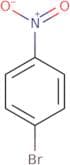
CAS 586-78-7
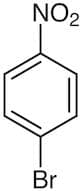
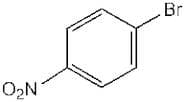
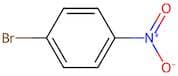
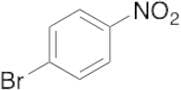
:1-Brom-4-nitrobenzol
Beschreibung:
1-Brom-4-nitrobenzol ist eine organische Verbindung, die durch das Vorhandensein von sowohl Brom- als auch Nitro-Funktionsgruppen, die an einen Benzolring gebunden sind, gekennzeichnet ist. Ihre molekulare Formel ist C6H4BrNO2, was darauf hinweist, dass sie sechs Kohlenstoffatome, vier Wasserstoffatome, ein Bromatom, ein Stickstoffatom und zwei Sauerstoffatome enthält. Diese Verbindung erscheint typischerweise als gelbes kristallines Feststoff und ist bekannt für ihre mäßige Löslichkeit in organischen Lösungsmitteln wie Ethanol und Aceton, jedoch begrenzte Löslichkeit in Wasser. 1-Brom-4-nitrobenzol wird hauptsächlich in der organischen Synthese verwendet und dient als Zwischenprodukt in der Herstellung verschiedener Arzneimittel, Farbstoffe und Agrochemikalien. Sie zeigt reaktive elektrophile aromatische Substitution aufgrund der Anwesenheit der Nitrogruppe, die eine starke elektronenanziehende Gruppe ist und die Reaktivität des aromatischen Rings erhöht. Darüber hinaus ist es wichtig, diese Verbindung mit Vorsicht zu behandeln, da sie Gesundheitsrisiken, einschließlich potenzieller Toxizität und Umweltgefahren, darstellen kann. Angemessene Sicherheitsmaßnahmen sollten beachtet werden, wenn mit dieser Substanz in Laborumgebungen gearbeitet wird.
Formel:C6H4BrNO2
InChl:InChI=1S/C6H4BrNO2/c7-5-1-3-6(4-2-5)8(9)10/h1-4H
InChI Key:InChIKey=ZDFBKZUDCQQKAC-UHFFFAOYSA-N
SMILES:N(=O)(=O)C1=CC=C(Br)C=C1
Synonyme:- 1-Brom-4-nitrobenzol
- 1-Bromo-4-Nitrobenceno
- 1-Bromo-4-nitro benzene
- 1-Nitro-4-bromobenzene
- 4-Bromo-1-nitrobenzene
- 4-Bromonitrobenzene
- 4-Nitro-1-bromobenzene
- 4-Nitrobromobenzene
- 4-Nitrophenyl Bromide
- Benzene, 1-bromo-4-nitro-
- Nitrobromobenzene
- Nsc 3526
- P-Bromonitrobenzene
- p-Nitrobromobenzene
- p-Nitrophenyl bromide
- Weitere Synonyme anzeigen
Sortieren nach
Reinheit (%)
0
100
|
0
|
50
|
90
|
95
|
100
7 Produkte.
1-Bromo-4-nitrobenzene
CAS:Formel:C6H4BrNO2Reinheit:>99.0%(GC)Farbe und Form:White to Light yellow to Green powder to crystalMolekulargewicht:202.011-Bromo-4-nitrobenzene, 98%
CAS:It can be employed as a syntheses material intermediate. It is also used as a pharmaceutical intermediate. This Thermo Scientific Chemicals brand product was originally part of the Alfa Aesar product portfolio. Some documentation and label information may refer to the legacy brand. The original AlfFormel:C6H4BrNO2Reinheit:98%Farbe und Form:White to cream to orange to brown, PowderMolekulargewicht:202.014-Bromonitrobenzene
CAS:4-BromonitrobenzeneFormel:C6H4BrNO2Reinheit:≥95%Farbe und Form: off white to pale yellow crystalline solidMolekulargewicht:202.00546g/mol1-Bromo-4-nitrobenzene
CAS:Formel:C6H4BrNO2Reinheit:95.0%Farbe und Form:Solid, Yellow powderMolekulargewicht:202.0071-Bromo-4-nitrobenzene
CAS:Kontrolliertes ProduktApplications 1-Bromo-4-nitrobenzene is part of a group of compounds that have the ability to stimulate the microbial degradation of polychlorinated biphenyls (PCBs), rendering them less harmful to the environment, animals and humans. 1-Bromo-4-nitrobenzene is also an electron-poor arene that has genotoxic effects on humans.
Not a dangerous good if item is equal to or less than 1g/ml and there is less than 100g/ml in the package
References DeWeerd, K. & Bedard, D.: Env. Sci. Tech., 33, 2057 (1999); Huang, Q., et al.: J. Env. Sci., 8, 103 (1995); Imperato. G., et al.: Adv. Synth. Cat. 348, 2243 (2006)Formel:C6H4BrNO2Farbe und Form:NeatMolekulargewicht:202.011-Bromo-4-nitrobenzene
CAS:1-Bromo-4-nitrobenzene is a bromonitrile that is used to synthesize optical sensors. It is an intermediate in the synthesis of 1,5-dibromo-4-nitrobenzane, which was used as a model system for the reaction mechanism of coupling reactions. The coupling of 1-bromo-4-nitrobenzane with hydrochloric acid and palladium catalysts leads to the formation of a diazonium salt. This reaction can be analyzed by looking at the nitro group and the halides in the molecule. The nitro group reacts with ammonia to form an aminonitrile and water. Halides react with ammonia to form ammonium salts and hydrogen halides. Diazonium salts are then generated by adding nitrous acid (HNO2) or hydroxylamine (NHOH) to these compounds. Finally, transfer reactions are carried out by heating 1Formel:C6H4BrNO2Reinheit:Min. 95%Molekulargewicht:202.01 g/mol