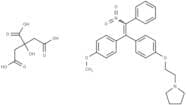
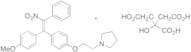
![Pyrrolidine, 1-[2-[4-[1-(4-methoxyphenyl)-2-nitro-2-phenylethenyl]phenoxy]ethyl]-, 2-hydroxy-1,2,3…](/_next/image/?url=https%3A%2Fstatic.cymitquimica.com%2Fcas-image%2Fthumb-webp%2F384411-pyrrolidine-1-2-4-1-4-methoxyphenyl-2-nitro-2-phenylethenyl-phenoxy-ethyl-2-hydroxy-123-propanetricarboxylate-1-1.webp&w=3840&q=75)
CAS 5863-35-4
:Pyrrolidin, 1-[2-[4-[1-(4-methoxyphenyl)-2-nitro-2-phenylethenyl]phenoxy]ethyl]-, 2-hydroxy-1,2,3-propantricarboxylat (1:1)
Beschreibung:
Pyrrolidin, 1-[2-[4-[1-(4-methoxyphenyl)-2-nitro-2-phenylethenyl]phenoxy]ethyl]-, 2-hydroxy-1,2,3-propantricarboxylat (1:1), mit der CAS-Nummer 5863-35-4, ist eine komplexe organische Verbindung, die durch ihre multifunktionale Struktur gekennzeichnet ist. Sie weist einen Pyrrolidinring auf, der ein fünfgliedriger, stickstoffhaltiger Heterozyklus ist und zu ihrer potenziellen biologischen Aktivität beiträgt. Das Vorhandensein einer Phenoxygruppe und einer methoxy-substituierten Phenylgruppe deutet darauf hin, dass die Verbindung eine signifikante Lipophilie aufweisen könnte, was potenziell ihre Löslichkeit und Interaktion mit biologischen Membranen beeinflusst. Die Nitrogruppe weist auf mögliche Reaktivität und das Potenzial für biologische Aktivität hin, während die Tricarboxylatkomponente Säure- und Chelatbildungseigenschaften verleihen kann. Diese Verbindung könnte aufgrund ihrer strukturellen Komplexität und des Potenzials für vielfältige pharmakologische Effekte von Interesse in der medizinischen Chemie sein. Bestimmte Eigenschaften wie Schmelzpunkt, Siedepunkt und Löslichkeit würden jedoch empirische Daten für eine präzise Charakterisierung erfordern. Insgesamt deutet die komplexe Struktur dieser Verbindung auf eine Vielzahl potenzieller Anwendungen in Forschung und Entwicklung hin.
Formel:C27H28N2O4·C6H8O7
InChl:InChI=1S/C27H28N2O4.C6H8O7/c1-32-24-13-9-21(10-14-24)26(27(29(30)31)23-7-3-2-4-8-23)22-11-15-25(16-12-22)33-20-19-28-17-5-6-18-28;7-3(8)1-6(13,5(11)12)2-4(9)10/h2-4,7-16H,5-6,17-20H2,1H3;13H,1-2H2,(H,7,8)(H,9,10)(H,11,12)
InChI Key:InChIKey=LHAPNDAERSFWSC-UHFFFAOYSA-N
SMILES:C(=C(N(=O)=O)C1=CC=CC=C1)(C2=CC=C(OCCN3CCCC3)C=C2)C4=CC=C(OC)C=C4.C(CC(O)=O)(CC(O)=O)(C(O)=O)O
Synonyme:- 1-(2-(p-(alpha-(p-Methoxyphenyl)-beta-nitrostyryl)phenoxy)ethyl) pyrrolidine monocitrate
- 1-(2-(p-(alpha-(p-Methoxyphenyl)-beta-nitrostyryl)phenoxy)ethyl)pyrrolidine citrate (1:1)
- 1-[2-(p-[a-(p-Methoxyphenyl)-β-nitrostyryl]-phenoxy)ethyl]pyrrolidine monocitrate
- 1-[2-[4-[2-(4-Methoxyphenyl)-1-nitro-2-phenylethenyl]phenoxy]ethyl]pyrrolidine monocitrate
- 1-[2-[p-[α-(p-Methoxyphenyl)-β-nitrostyryl]phenoxy]ethyl]pyrrollidine monocitrate
- Ai3-52826
- CI-628 citrate
- Ci-628
- Cn-55945-27
- Nitromifene citrate [USAN]
- Nsc 110407
- Parke davis CI-628
- Pyrrolidine, 1-(2-(4-(1-(4-methoxyphenyl)-2-nitro-2-phenylethenyl)phenoxy)ethyl)-, 2-hydroxy-1,2,3-propanetricarboxylate (1:1)
- Pyrrolidine, 1-(2-(p-(alpha-(p-methoxyphenyl)-beta-nitrostyryl)phenoxy)ethyl)-, citrate (1:1) (8CI)
- Pyrrolidine, 1-[2-[p-[α-(p-methoxyphenyl)-β-nitrostyryl]phenoxy]ethyl]-, citrate
- Pyrrolidine, 1-[2-[p-[α-(p-methoxyphenyl)-β-nitrostyryl]phenoxy]ethyl]-, citrate (1:1)
- Weitere Synonyme anzeigen
Sortieren nach
Reinheit (%)
0
100
|
0
|
50
|
90
|
95
|
100
3 Produkte.
Nitromifene Citrate
CAS:Nitromifene Citrate is a nonsteroidal estrogen antagonist most commonly used as a research tool in animal studies.Formel:C33H36N2O11Farbe und Form:SolidMolekulargewicht:636.654Nitromifene Citrate (E/Z mixture)
CAS:Kontrolliertes ProduktApplications Nitromifene citrate is a non-steroidal estrogen antagonist. It is structurally similar to Tamoxifen (T006000) which is a selective estrogen response modifier (SERM).
References Rudick, C., et al.: Endorcrinol., 144, 179 (2003); Sutherland, R., et al.: Nature, 267, 434 (1977)Formel:C33H36N2O11Farbe und Form:Yellow To OrangeMolekulargewicht:636.65Nitromifene citrate
CAS:Nitromifene citrate is a nonsteroidal drug that inhibits the enzyme fatty acid synthase, thereby preventing the production of prostaglandins. It has been shown to inhibit tumor growth in mice and to be effective against autoimmune diseases, such as rheumatoid arthritis and multiple sclerosis. Nitromifene citrate also binds to neurokinin-1 receptor and inhibits tissue culture granulosa cells. This drug has been shown to have clinical significance in the treatment of breast cancer. Nitromifene citrate is metabolized by the liver and is taken up into the brain where it can affect brain functions, such as emotional behavior or memory. Nitromifene citrate is synthesized by cultured cells in vitro and has been used for research purposes in vivo.Formel:C33H36N2O11Reinheit:Min. 95%Molekulargewicht:636.6 g/mol