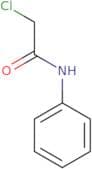
CAS 587-65-5
:Chloracetanilid
- 2-Chloro-N-phenylacetamide
- Acetamide, 2-chloro-N-phenyl-
- Acetanilide, 2-chloro-
- Acetanilide, α-chloro-
- Alpha-Chloroacetanilide
- Chloracetanilide
- Chloroacetanilide
- N-(2-Chloroacetyl)aniline
- N-(Chloroacetyl)aniline
- N-Phenyl-2-chloroacetamide
- N-Phenyl-2-chloroethanamide
- N-Phenylchloroacetamide
- N1-phenyl-2-chloroacetamide
- NSC 311
- Phenylcarbamoylmethyl chloride
- α-Chloro-N-phenylacetamide
- α-Chloroacetanilide
- ω-Chloroacetanilide
- Weitere Synonyme anzeigen
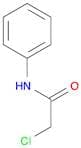
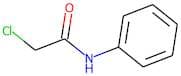
2-Chloro-N-phenylacetamide
CAS:Formel:C8H8ClNOReinheit:98%Farbe und Form:SolidMolekulargewicht:169.6082Acetaminophen Impurity 10 (2-Chloroacetanilide)
CAS:Formel:C8H8ClNOFarbe und Form:Off-White SolidMolekulargewicht:169.61N-(Chloroacetyl)aniline
CAS:N-(Chloroacetyl)anilineFormel:C8H8ClNOReinheit:97%Farbe und Form: faint beige crystalline solidMolekulargewicht:169.61g/mol2-Chloro-N-phenylacetamide- 13C6
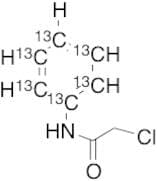
CAS:Kontrolliertes ProduktApplications 2-Chloro-N-phenylacetamide- 13C6 is an intermediate in the synthesis of Diclofenac-13C6 (D436449). Diclofenac-13C6 is a labelled analogue of Diclofenac Acid (D436465), which is a nonsteroidal anti-inflammatory compound and decycloxygenase (COX) inhibitor. Diclofenac-13C6 is also an intermediate in synthesizing Diclofenac-13C6 Sodium Salt (D436453), which is a labelled analogue of Diclofenac Sodium Salt (D436450).
References Yagi, K., et. al.: Biol. Pharm. Bull., 37, 1234 (2014); Kenny, J. R., et al.: J. Med. Chem., 47, 2816 (2004); Sasaki, A., et al.: J. Pharmacol. Sci., 108, 266 (2008); Dalvie, D., et al.: Chem. Res. Toxicol., 22, 357 (2009); Kenny, J. R., et al.: J. Med. Chem., 47, 2816 (2004), Sasaki, A., et al.: J. Pharmacol. Sci., 108, 266 (2008); Dalvie, D., et al.: Chem. Res. Toxicol., 22, 357 (2009)Formel:C6C2H8ClNOFarbe und Form:NeatMolekulargewicht:175.5642-Chloro-N-phenylacetamide
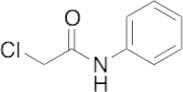
CAS:Kontrolliertes ProduktApplications 2-Chloro-N-phenylacetamide is used as a reagent in the synthesis of indolylmethylene benzo[h]thiazolo[2,3-b]quinazolinones which exhibit anticancer and antimicrobial activities in vitro.
References Gali, R., et al.: Bioorg. Med. Chem. Lett., 24, 4239 (2014)Formel:C8H8ClNOFarbe und Form:NeatMolekulargewicht:169.032-Chloro-N-phenylacetamide
CAS:Formel:C8H8ClNOReinheit:98%Farbe und Form:SolidMolekulargewicht:169.612-Chloro-N-phenylacetamide
CAS:2-Chloro-N-phenylacetamide (2CPA) is a chemical that is stable in the presence of strong acids, bases, and oxidizing agents. It can be used as an herbicide and has been shown to inhibit plant metabolism by interfering with the synthesis of picolinic acid. 2CPA also binds to proteins, causing inhibition of protein synthesis. This may occur by competitively binding to the enzyme polymerase chain reaction (PCR). 2CPA is metabolized into trifluoroacetic acid and chloroacetanilides in mammals. The detoxification enzymes glutathione S-transferase (GST) and cytochrome P450 can reactivate 2CPA by conjugation with glutathione or methyl ethyl. This detoxification process is known as phase II metabolism.Formel:C8H8NOClReinheit:Min. 95%Molekulargewicht:169.61 g/mol