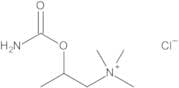
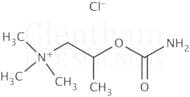
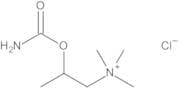
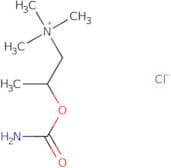
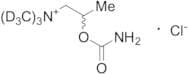
CAS 590-63-6
:Bethanecholchlorid
Beschreibung:
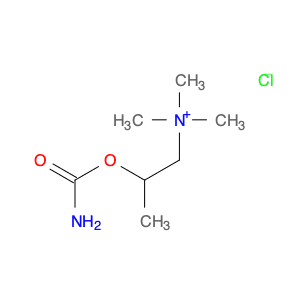
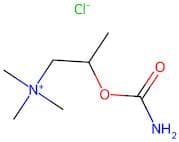
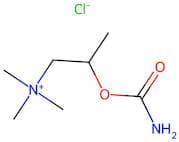
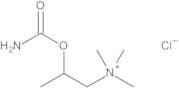
Bethanecholchlorid ist ein synthetischer Cholinester und ein muskarinischer Agonist, der hauptsächlich in klinischen Umgebungen zur Behandlung von Harnverhalt und zur Stimulierung der gastrointestinalen Motilität eingesetzt wird. Er zeichnet sich durch seine Fähigkeit aus, die Wirkung von Acetylcholin nachzuahmen, indem er gezielt die muskarinischen Rezeptoren im Körper anspricht. Diese Verbindung wird typischerweise oral oder durch subkutane Injektion verabreicht und ist bekannt für ihre relativ kurze Wirkungsdauer. Bethanecholchlorid ist in Wasser löslich, was seine Absorption und Bioverfügbarkeit erleichtert. Seine chemische Struktur umfasst eine quartäre Ammoniumgruppe, die zu seiner positiven Ladung bei physiologischem pH beiträgt, was seine Pharmakokinetik und Verteilung beeinflusst. Häufige Nebenwirkungen können gastrointestinales Unbehagen, erhöhte Speichelproduktion und Schwitzen umfassen, was seine cholinergische Aktivität widerspiegelt. Aufgrund seiner spezifischen Wirkung auf die Blase und den gastrointestinalen Trakt ist es kontraindiziert bei Patienten mit bestimmten Erkrankungen wie Asthma oder peptischen Geschwüren, bei denen erhöhte Sekretionen und Muskelkontraktionen die Symptome verschlimmern könnten. Insgesamt spielt Bethanecholchlorid eine bedeutende Rolle bei der Behandlung spezifischer medizinischer Zustände, die mit der Blasen- und Verdauungsfunktion zusammenhängen.
Formel:C7H17N2O2·Cl
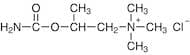
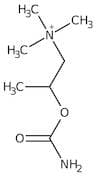
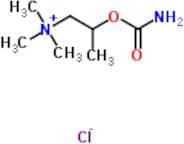
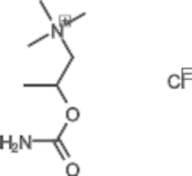
InChl:InChI=1S/C7H16N2O2.ClH/c1-6(11-7(8)10)5-9(2,3)4;/h6H,5H2,1-4H3,(H-,8,10);1H
InChI Key:InChIKey=XXRMYXBSBOVVBH-UHFFFAOYSA-N
SMILES:C([N+](C)(C)C)C(OC(N)=O)C.[Cl-]
Synonyme:- (2-Hydroxypropyl)trimethylammonium chloride carbamate
- (±)-Bethanechol
- 1-(Trimethylazaniumyl)propan-2-yl carbamate chloride
- 1-Propanaminium, 2-[(aminocarbonyl)oxy]-N,N,N-trimethyl-, chloride
- 1-Propanaminium, 2-[(aminocarbonyl)oxy]-N,N,N-trimethyl-, chloride (1:1)
- 1-propanaminium, 2-[(aminocarbonyl)oxy]-N,N,N-trimethyl-, hydrochloride (1:1)
- 2-(carbamoyloxy)-N,N,N-trimethylpropan-1-aminium chloride
- 2-Carbamoyloxypropyltrimethylammonium Chloride
- Ammonium, (2-hydroxypropyl)trimethyl-, chloride, carbamate
- Besacholine
- Bethanechol chloride
- Carbamylmethylcholine chloride
- Mechotane
- Mechothane
- Mecothane
- Mictone
- Myocholine
- Myotonachol
- Myotonine chloride
- NSC 30783
- Trimethyl(2-carbamoyloxypropyl)ammonium chloride
- Urecholine
- Urecholine chloride
- Uro-Carb
- β-Methyl carbachol chloride
- Weitere Synonyme anzeigen
Sortieren nach
Reinheit (%)
0
100
|
0
|
50
|
90
|
95
|
100
15 Produkte.
Bethanechol Chloride
CAS:Formel:C7H17ClN2O2Reinheit:>98.0%(T)Farbe und Form:White to Almost white powder to crystalMolekulargewicht:196.68Bethanechol chloride, 98%
CAS:A cholinergic receptor agonistFormel:C7H17ClN2O2Reinheit:98%Molekulargewicht:196.68Bethanechol Chloride
CAS:Acyclic amides (including acyclic carbamates) and their derivatives and salts thereof, nesoiFormel:C7H17N2O2·ClFarbe und Form:White Crystalline PowderMolekulargewicht:196.09786Bethanechol chloride
CAS:Bethanechol chloride: muscarinic agonist, boosts smooth muscle tone, used post-abdominal surgery & for urinary retention; may cause hypotension & bronchospasm.Formel:C7H17N2O2·ClReinheit:95% - 99.73%Farbe und Form:White CrystallineMolekulargewicht:196.68Bethanechol-d6 Chloride
CAS:Formel:C7H11D6N2O2·ClFarbe und Form:White To Off-White SolidMolekulargewicht:167.26 35.45Bethanechol Chloride
CAS:Kontrolliertes ProduktFormel:C7H17N2O2·ClFarbe und Form:NeatMolekulargewicht:196.68Carbamyl-β-methylcholine chloride
CAS:Formel:C7H17ClN2O2Reinheit:≥ 98.0%Farbe und Form:White or almost white crystalline powderMolekulargewicht:196.68Bethanechol Chloride
CAS:Kontrolliertes ProduktApplications A selective muscarinic receptor stimulant, used to treat cerebral palsy.
References Buehler, M., et al.: Res. Vet. Sci., 84, 444 (2008), Fliri, A., et al.: J. Med. Chem., 52, 8038 (2009), Gohil, V., et al.: Nat. Biotechnol., 28, 249 (2010),Formel:C7H17N2O2·ClFarbe und Form:White To Off-WhiteMolekulargewicht:196.68Bethanechol chloride
CAS:Bethanechol chloride is an ester of bethanechol and phosphorus oxychloride. It has been used as a cholinergic agent to treat urinary infections and other disorders in which the bladder muscles are not working properly. Bethanechol chloride functions by increasing the activity of the group P2 receptors in the hippocampus, which can increase cytosolic calcium levels. The drug is absorbed when applied topically or taken orally, with absorption being greater when applied topically. Bethanechol chloride has shown little toxicity in animals, but has been shown to cause headache, nausea, vomiting, diarrhea, abdominal pain and cramps, dry mouth and throat, thirstiness, dizziness, drowsiness or fatigue after oral administration.Formel:C7H17ClN2O2Reinheit:Min. 95%Farbe und Form:PowderMolekulargewicht:196.67 g/molBethanechol-d9
CAS:Kontrolliertes ProduktFormel:C7H8D9ClN2O2Farbe und Form:NeatMolekulargewicht:170.278