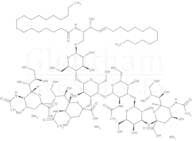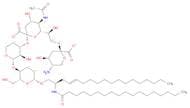
CAS 59247-13-1
:Gangliosid GT1B aus Rinderhirn
Beschreibung:
Gangliosid GT1b ist ein komplexes Glycosphingolipid, das überwiegend im Nervengewebe vorkommt, insbesondere im Gehirn von Säugetieren, einschließlich Rindern. Es ist durch seine Struktur gekennzeichnet, die aus einem Ceramid-Rückgrat besteht, das mit einer Kohlenhydratkomponente verbunden ist, die Sialinsäurereste enthält. Dieses Gangliosid spielt eine entscheidende Rolle in der Zellkommunikation, der neuronalen Entwicklung und der Modulation der synaptischen Übertragung. GT1b ist bekannt für seine Beteiligung an verschiedenen biologischen Prozessen, einschließlich Neuroprotektion und Zellidentifikation. Seine Anwesenheit im Gehirn trägt zur Bildung von Lipidraft bei, die für das ordnungsgemäße Funktionieren von Membranproteinen unerlässlich sind. Darüber hinaus sind Ganglioside wie GT1b an neurodegenerativen Erkrankungen beteiligt und werden auf ihr therapeutisches Potenzial untersucht. Die CAS-Nummer 59247-13-1 identifiziert diese Verbindung spezifisch und erleichtert ihre Erkennung in wissenschaftlicher Literatur und Datenbanken. Insgesamt ist Gangliosid GT1b in der Neurowissenschaft und Biochemie aufgrund seiner strukturellen Komplexität und funktionalen Bedeutung in den zellulären Interaktionen innerhalb des Nervensystems von Bedeutung.
Formel:C88H157N5O44
InChl:InChI=1/C88H157N5O44/c1-4-6-8-10-12-14-16-18-19-21-23-25-27-29-31-33-56(107)92-37-51(45(101)32-30-28-26-24-22-20-17-15-13-11-9-7-5-2)124-80-66(113)65(112)70(54(42-98)127-80)129-82-69(116)77(136-87(84(120)121)35-46(102)57(89)72(132-87)61(108)49(105)38-94)71(55(43-99)128-82)130-79-60(93-44(3)100)75(63(110)52(40-96)125-79)131-81-68(115)76(64(111)53(41-97)126-81)135-86(83(118)119)34-47(103)59(91)74(134-86)67(114)78(117)137-88(85(122)123)36-48(104)58(90)73(133-88)62(109)50(106)39-95/h30,32,45-55,57-82,94-99,101-106,108-117H,4-29,31,33-43,89-91H2,1-3H3,(H,92,107)(H,93,100)(H,118,119)(H,120,121)(H,122,123)/b32-30+/t45?,46-,47-,48-,49?,50?,51?,52-,53-,54+,55-,57+,58+,59+,60-,61?,62?,63+,64+,65+,66+,67?,68-,69-,70+,71+,72+,73+,74+,75-,76+,77-,78?,79+,80+,81+,82+,86+,87+,88+/m0/s1
Synonyme:- Ganglioside, GT1
- GT(1)Ganglioside
- GT1b Ganglioside
- Ganglioside GT1b
- N-Acetylneuraminylgalactosyl-N-acetylgalactosaminyl -(N-acetylneuraminyl-N-acetylneuraminyl)galactosyl- glucosylceramide
- Polysialoganglioside
- Trisialoganglioside GT1b
- (2R,4S,5R,6R)-2-[(2R,3S,4S,5R,6S)-5-[(2R,3S,4S,5S,6S)-3-acetamido-4-[(2S,3S,4R,5R,6S)-4-[(2R,4S,5R,6R)-5-amino-6-[2-[(2R,4S,5R,6R)-5-amino-2-carboxy-4-hydroxy-6-(1,2,3-trihydroxypropyl)tetrahydropyran-2-yl]oxy-1,2-dihydroxy-ethyl]-2-carboxy-4-hydroxy-tetrahydropyran-2-yl]oxy-3,5-dihydroxy-6-(hydroxymethyl)tetrahydropyran-2-yl]oxy-5-hydroxy-6-(hydroxymethyl)tetrahydropyran-2-yl]oxy-2-[(2R,3S,4R,5R,6R)-4,5-dihydroxy-2-(hydroxymethyl)-6-[(E)-2-hydroxy-1-[(octadecanoylamino)methyl]heptadec-3-enoxy]tetrahydropyran-3-yl]oxy-3-hydroxy-6-(hydroxymethyl)tetrahydropyran-4-yl]oxy-5-amino-4-hydroxy-6-(1,2,3-trihydroxypropyl)tetrahydropyran-2-carboxylic acid
Sortieren nach
Reinheit (%)
0
100
|
0
|
50
|
90
|
95
|
100
8 Produkte.
Ganglioside GT1b Mixture (sodium salt)
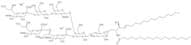
CAS:GT1b, a trisialoganglioside, binds neurotoxins and MCPyV VP1, inhibits IL-6, IL-10, IgG, IgM, IgA, and has C18:1/C20:1 sphingoid backbones.Formel:C95H162N5O473NaFarbe und Form:SolidMolekulargewicht:2195.27GT1b-Ganglioside
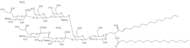
CAS:Formel:C95H162N5O47·3NaReinheit:≥ 98%Farbe und Form:White to off-white powderMolekulargewicht:2159.3GT1b-Ganglioside sodium
CAS:GT1b (sodium salt) has a core tetrasaccharide structure (Galβ1,3GalNAcβ1,4Galβ1,4Glc) with two sialic acids (NeuAc) linked α2,3/α2,8 to the inner galactose residue, sialic acid (NeuAc) linked α2,3 to the terminal galactose residue and ceramide linked β to position 1 on the reducing terminal glucose residue (Ledeen, 2009). GT1b is one of the major gangliosides in neuronal and glial membranes, it interacts with the myelin-associated glycoprotein (MAG) and is essential for long-term axon-myelin stability. GT1b ganglioside also acts as a receptor for bacterial toxins, such as, tetanus and botulinum toxins (Nishik,i 1996), as well as for viruses, a few examples include: Merkel cell polyomavirus, JC virus, BK virus, norovirus, and others (Low, 2006).Formel:C95H165N5O48·xNaFarbe und Form:White PowderMolekulargewicht:2,145.33 g/molGT1b-Ganglioside ammonium
CAS:GT1b ganglioside (ammonium salt) has a core tetrasaccharide structure (Galβ1,3GalNAcβ1,4Galβ1,4Glc) with two sialic acids (NeuAc) linked α2,3/α2,8 to the inner galactose residue, sialic acid (NeuAc) linked α2,3 to the terminal galactose residue, and ceramide linked β to position 1 on the reducing terminal glucose residue (Ledeen, 2009). GT1b ganglioside is one of the major gangliosides in neuronal and glial membranes. It interacts with myelin-associated glycoprotein (MAG) and is essential for long-term axon-myelin stability. GT1b ganglioside also acts as a receptor for bacterial toxins, such as, tetanus and botulinum toxins (Nishiki, 1996), as well as for viruses. A few examples of which include: Merkel cell polyomavirus, JC virus, BK virus, norovirus, and others (Low, 2006).Formel:C95H165N5O48·xNH4Reinheit:Min. 95%Farbe und Form:PowderMolekulargewicht:2,145.33 g/molGanglioside GT1b trisodium salt
CAS:Kontrolliertes ProduktApplications Ganglioside GT1b trisodium salt (bovine brain) is a glycosphingolipid neuroprotectant.
Formel:C95H162N5Na3O47Farbe und Form:NeatMolekulargewicht:2195.28Ganglioside GT1b
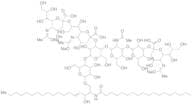
CAS:Formel:C88H157N5O44Reinheit:98%Farbe und Form:SolidMolekulargewicht:1989.1952799999976