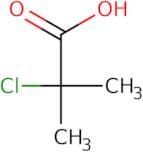
CAS 594-58-1
:2-Chlor-2-methylpropansäure
Beschreibung:
2-Chlor-2-methylpropansäure, auch bekannt als Chloroisobuttersäure, ist eine farblose bis blassgelbe Flüssigkeit mit einem stechenden Geruch. Es wird als Carbonsäure klassifiziert, da es eine Carboxylgruppe (-COOH) enthält. Die Verbindung weist ein Chloratom und eine Methylgruppe auf, die am zweiten Kohlenstoff eines drei-Kohlenstoff-Rückgrats angebracht sind, was zu seinen einzigartigen Eigenschaften beiträgt. Es ist in Wasser und organischen Lösungsmitteln löslich, was es vielseitig für verschiedene Anwendungen macht. Diese Substanz wird hauptsächlich in der organischen Synthese verwendet, insbesondere bei der Herstellung von Herbiziden und Arzneimitteln. Es zeigt eine moderate Toxizität und kann bei Kontakt Haut-, Augen- und Atemwegsreizungen verursachen. Es sollten angemessene Sicherheitsvorkehrungen getroffen werden, wenn mit diesem Chemikalien umgegangen wird, einschließlich der Verwendung von persönlicher Schutzausrüstung. Darüber hinaus ist es wichtig, es an einem kühlen, gut belüfteten Ort fern von inkompatiblen Substanzen zu lagern. Insgesamt ist 2-Chlor-2-methylpropansäure eine bedeutende Verbindung in der chemischen Forschung und in industriellen Anwendungen.
Formel:C4H7ClO2
InChl:InChI=1S/C4H7ClO2/c1-4(2,5)3(6)7/h1-2H3,(H,6,7)
InChI Key:InChIKey=MYCXCBCDXVFXNE-UHFFFAOYSA-N
SMILES:C(C(O)=O)(C)(C)Cl
Synonyme:- 2-Chloro isobutyric acid
- 2-Chloro-2-methylpropanoic acid
- 2-Chloroisobutyric acid
- Propanoic acid, 2-chloro-2-methyl-
- Propionic acid, 2-chloro-2-methyl-
- α-Chloroisobutyric acid
- 2-Chloro-2-methylpropionic acid
Sortieren nach
Reinheit (%)
0
100
|
0
|
50
|
90
|
95
|
100
1 Produkte.
2-Chloro-2-methylpropionic acid
CAS:2-Chloro-2-methylpropionic acid (MCPA) is a chemical compound that belongs to the group of organic compounds called acyl chlorides. It is used in industry for the production of acrylic acid and polyacrylic acid, as well as in the production of herbicides. MCPA is produced by reacting an alkali metal with 2-chloroethanol and thioacetic acid. This reaction can be catalyzed by a variety of compounds, including palladium chloride, nickel chloride, and titanium tetrachloride. The high yield of this reaction makes it suitable for commercial use. MCPA also has been shown to stimulate cell growth through its inhibition of monomers from polymerization into polymers.
Formel:C4H7ClO2Reinheit:Min. 95%Farbe und Form:PowderMolekulargewicht:122.55 g/mol