CAS 59401-28-4
:Alpha(1)-Paarungsfaktor von Saccharomyces cerevisiae
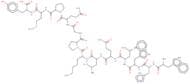
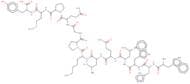
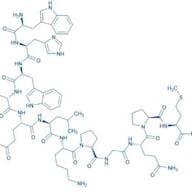
- H-Trp-His-Trp-Leu-Gln-Leu-Lys-Pro-Gly-Gln-Pro-Met-Tyr-OH
- Mating Factor .alpha.
- a-Mating Factor, Yeast
- alpha1-Mating factor Saccharomyces cerevisiae
- L-tryptophyl-L-histidyl-L-tryptophyl-L-leucyl-L-glutaminyl-L-leucyl-L-lysyl-L-prolylglycyl-L-glutaminyl-L-prolyl-L-methionyl-L-tyrosine
- Trp-His-Trp-Leu-Gln-Leu-Lys-Pro-Gly-Gln-Pro-Met-Tyr
L-Tryptophyl-L-histidyl-L-tryptophyl-L-leucyl-L-glutaminyl-L-leucyl-L-lysyl-L-prolylglycyl-L-glutaminyl-L-prolyl-L-methionyl-L-tyrosine
CAS:Formel:C82H114N20O17SReinheit:98%Molekulargewicht:1683.9714α-Factor Mating Pheromone, yeast
CAS:Alpha factor mating pheromone is a peptide of 13 amino acids secreted by Saccharomyces cerevisiae α cells.Formel:C82H114N20O17SReinheit:98%Farbe und Form:White PowderMolekulargewicht:1684Alpha-Mating Factor
CAS:Alpha-Mating Factor is a peptide that belongs to the group of ligands. It has been shown to bind to the androgen receptor with high affinity and act as an activator for this receptor. Alpha-Mating Factor is also able to bind to the beta-adrenergic receptor. This protein has been shown to have ion channel activity, which may be due to its inhibition of potassium channels. Alpha-Mating Factor is used in research as a tool for studying cell biology and cell signalling pathways.
Formel:C82H114N20O17SReinheit:Min. 95%Molekulargewicht:1,684 g/molAlpha-Factor
CAS:The alpha factor pheromone arrests yeast in the G1 phase of their cell cycle, this allows the opposite mating type cells to synchronise. Alpha factor mating pheromone induces the expression of mating genes, changes in nuclear architecture, and polarizes growth toward the mating partner. STE2 encodes the alpha factor pheromone transmembrane G-protein coupled receptor (GPCR) found on mating-type-A cells in yeast. Alpha factor binds Ste2 and activates prototypic mitogen-activated protein kinase (MAPK) cascade. The dose of pheromone exposure differentially activates the MAPK Fus3 for alternate effects. A high dose of alpha factor leads to growth arrest and schmooing formation for mating, a lower dose causes elongated cell growth.Formel:C82H114N20O17SReinheit:Min. 95%Farbe und Form:PowderMolekulargewicht:1,683.97 g/molMating factor α trifluoroacetate
CAS:Mating factor α trifluoroacetate is a research tool with CAS No. 59401-28-4 that is used in Cell Biology, Pharmacology, and Ion channels. Mating factor α trifluoroacetate inhibits ligand binding to receptor by competing with the natural substrate for the active site. It has been shown to be an activator of ion channels, which allow ions to flow through the cell membrane. Mating factor α trifluoroacetate can also be used as a research tool in antibody production and protein interactions.
Formel:C82H114N20O17SReinheit:Min. 95%Molekulargewicht:1,684.01 g/molMating Factor a trifluoroacetate salt
CAS:Please enquire for more information about Mating Factor a trifluoroacetate salt including the price, delivery time and more detailed product information at the technical inquiry form on this pageFormel:C82H114N20O17S·xC2HF3O2Reinheit:Min. 95%Molekulargewicht:1,683.97 g/molMating Factor α
CAS:Mating pheromone of mating type α cells of S. cerevisiae. This factor inhibits DNA synthesis, thereby preventing cell division of mating type a cells. The hydrophobic peptide binds to a class D G-protein-coupled receptor Ste2p.Formel:C82H114N20O17SReinheit:98.4%Farbe und Form:White PowderMolekulargewicht:1684.01