CAS 59461-30-2
:Cobinamid, Co-hydroxy-, f-(Dihydrogenphosphat), innere Salz, 3'-Ester mit (5,6-dimethyl-1-α-D-ribofuranosyl-1H-benzimidazol-κN3), Hydrochlorid (1:1)
Beschreibung:
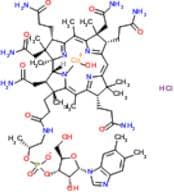
Cobinamid, Co-hydroxy-, f-(Dihydrogenphosphat), innere Salz, 3'-Ester mit (5,6-dimethyl-1-α-D-ribofuranosyl-1H-benzimidazol-κN3), Hydrochlorid (1:1) ist eine komplexe chemische Verbindung, die hauptsächlich mit dem Metabolismus von Vitamin B12 assoziiert ist. Es weist ein Kobaltion auf, das an eine Cobinamidstruktur koordiniert ist, die ein Derivat von Cobalamin ist, und enthält eine Phosphatgruppe, die seine Löslichkeit und Bioverfügbarkeit verbessert. Die Anwesenheit der 5,6-Dimethyl-1-α-D-Ribofuranosyl-1H-Benzimidazol-Gruppe weist auf seine potenzielle Rolle in biologischen Systemen hin, insbesondere im Nukleinsäuremetabolismus und in zellulären Energieprozessen. Als Hydrochloridsalz ist es typischerweise stabiler und löslicher in wässrigen Lösungen, was es für verschiedene pharmazeutische Anwendungen geeignet macht. Die Bildung von Innensalzen des Verbindungsstoffs deutet auf eine einzigartige strukturelle Anordnung hin, die seine Reaktivität und Wechselwirkung mit biologischen Zielen beeinflussen kann. Insgesamt sind Cobinamid-Derivate von Interesse in der Biochemie und der medizinischen Chemie aufgrund ihrer Rollen in enzymatischen Reaktionen und potenziellen therapeutischen Anwendungen.
Formel:C62H89CoN13O15P·ClH
InChl:InChI=1S/C62H90N13O14P.ClH.Co.H2O/c1-29-20-39-40(21-30(29)2)75(28-70-39)57-52(84)53(41(27-76)87-57)89-90(85,86)88-31(3)26-69-49(83)18-19-59(8)37(22-46(66)80)56-62(11)61(10,25-48(68)82)36(14-17-45(65)79)51(74-62)33(5)55-60(9,24-47(67)81)34(12-15-43(63)77)38(71-55)23-42-58(6,7)35(13-16-44(64)78)50(72-42)32(4)54(59)73-56;;;/h20-21,23,28,31,34-37,41,52-53,56-57,76,84H,12-19,22,24-27H2,1-11H3,(H15,63,64,65,66,67,68,69,71,72,73,74,77,78,79,80,81,82,83,85,86);1H;;1H2/q;;+3;/p-3
InChI Key:InChIKey=KEHNCSYXYMMUCO-UHFFFAOYSA-K
SMILES:[OH-][Co+3]1234[N]=5C6(C)C7[N-]1C(C(C)(C7CC(N)=O)CCC(=O)NCC(C)OP(=O)([O-])OC8C(O)C(N9C=[N]2C=%10C9=CC(C)=C(C)C%10)OC8CO)=C(C)C%11=[N]3C(=CC%12=[N]4C(=C(C)C5C(CCC(N)=O)C6(CC(N)=O)C)C(CC(N)=O)(C)C%12CCC(N)=O)C(C)(C)C%11CCC(N)=O.Cl
Synonyme:- Cobinamide, dihydroxide, dihydrogen phosphate (ester), inner salt, 3′-ester with 5,6-dimethyl-1-α-D-ribofuranosyl-1H-benzimidazole, monohydrochloride
- Cobinamide, Co-hydroxy-, f-(dihydrogen phosphate), inner salt, 3′-ester with (5,6-dimethyl-1-α-D-ribofuranosyl-1H-benzimidazole-κN3), hydrochloride (1:1)
- Cobinamide, Co-hydroxy-, f-(dihydrogen phosphate), inner salt, 3′-ester with (5,6-dimethyl-1-α-D-ribofuranosyl-1H-benzimidazole-κN3), monohydrochloride
Sortieren nach
Reinheit (%)
0
100
|
0
|
50
|
90
|
95
|
100
3 Produkte.
Hydroxocobalamin Chloride
CAS:Vitamin b12 (cyanocobalamin and related compounds with vitamin b12 activity) and its derivativesFormel:C62H89CoN13O15P·HClFarbe und Form:Red Brown Crystalline PowderMolekulargewicht:1381.54374Hydroxocobalamin chloride
CAS:Hydroxocobalamin chloride is a molecule that contains hydrochloric acid. It is used as a sample preparation reagent in the analysis of fatty acids, and as a chemical intermediate in the synthesis of magnesium salt. Hydroxocobalamin chloride reacts with an organic acid to form an ester or amide. The reaction mechanism for this process involves a nucleophilic attack by the hydroxyl group on the carbonyl carbon atom of the organic acid, followed by displacement of HCl from water. In analytical chemistry, Hydroxocobalamin chloride is used to determine the concentration of dehydroascorbic acid in a sample, which can be indicative of skin condition or dietary supplement intake. This compound also serves as an analytical method for measuring fatty acids and their derivatives (e.g., methyl esters). Symptoms associated with exposure to this compound include skin conditions such as dermatitis and eczema, together with symptoms such as fatigue and irritability that are related to high levelsFormel:C62H89CoN13O15P•HClReinheit:Min. 95%Farbe und Form:PowderMolekulargewicht:1,382.82 g/molhydroxocobalamin monohydrochloride
CAS:Formel:C62H90ClCoN13O15PReinheit:98%Molekulargewicht:1382.8160609999993Ref: IN-DA00ELGF
Ausgelaufenes produkt