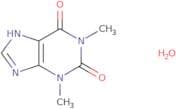
CAS 5967-84-0
:1H-Purin-2,6-dion, 3,9-dihydro-1,3-dimethyl-, hydrat (1:1)
Beschreibung:
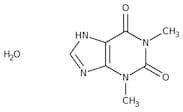
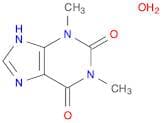
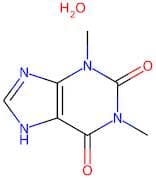
1H-Purin-2,6-dion, 3,9-dihydro-1,3-dimethyl-, hydrat (1:1), allgemein bekannt als Theobromin, ist eine Methylxanthin-Verbindung mit einer molekularen Formel, die ihre Purinstruktur widerspiegelt. Sie zeichnet sich durch ihr weißes kristallines Aussehen aus und ist in Wasser löslich, insbesondere in ihrer hydratisierten Form. Die Verbindung hat einen bitteren Geschmack und ist bekannt für ihre stimulierenden Eigenschaften, ähnlich wie Koffein, obwohl sie weniger potent ist. Theobromin hat verschiedene biologische Effekte, einschließlich Vasodilatation, Diurese und Muskelentspannung, was sie sowohl in der Lebensmittelwissenschaft als auch in der Pharmakologie von Interesse macht. Es kommt hauptsächlich in Kakaobohnen vor und ist ein wichtiger Bestandteil von Schokolade. Die Substanz hat einen Schmelzpunkt, der je nach Hydratationszustand variiert, und ist unter normalen Bedingungen stabil. Ihre CAS-Nummer, 5967-84-0, wird zur Identifizierung in chemischen Datenbanken verwendet. Die Rolle von Theobromin in der menschlichen Gesundheit, insbesondere ihre Auswirkungen auf die Herz-Kreislauf-Gesundheit und potenzielle therapeutische Anwendungen, bleibt ein Forschungsbereich.
Formel:C7H10N4O3
InChl:InChI=1/C7H8N4O2.H2O/c1-10-5-4(8-3-9-5)6(12)11(2)7(10)13;/h3H,1-2H3,(H,8,9);1H2
InChI Key:InChIKey=INQSMEFCAIHTJG-UHFFFAOYSA-N
SMILES:O=C1C2=C(N(C)C(=O)N1C)N=CN2.O
Synonyme:- 1,3-Dimethylxanthine monohydrate
- 1,3-dimethyl-3,7-dihydro-1H-purine-2,6-dione hydrate (1:1)
- 1H-Purine-2,6-dione, 3,7-dihydro-1,3-dimethyl-, monohydrate
- 1H-Purine-2,6-dione, 3,9-dihydro-1,3-dimethyl-, hydrate (1:1)
- Theophyline monohydrate
- Theophylline hydrous
- Theopylline monohydrate
- Theophylline, monohydrate
- Theophyllinemonohydrate,99%
- 1,3-Dimethyl-7H-purine-2,6-dione hydrate
- 1,3-Dimethyl-1H-purine-2,6(3H,7H)-dione·hydrate
- Weitere Synonyme anzeigen
Sortieren nach
Reinheit (%)
0
100
|
0
|
50
|
90
|
95
|
100
5 Produkte.
Theophylline monohydrate, 99%
CAS:Theophylline monohydrate is a methylxanthine drug used in therapy for respiratory diseases such as COPD and asthma This Thermo Scientific Chemicals brand product was originally part of the Alfa Aesar product portfolio. Some documentation and label information may refer to the legacy brand. The origiFormel:C7H8N4O2•H2OReinheit:99%Farbe und Form:Powder, WhiteMolekulargewicht:198.18 (180.16anhy)Theophylline monohydrate
CAS:Theophylline monohydrate (Quibron) appears to inhibit phosphodiesterase and prostaglandin production, regulate calcium flux and intracellular calciumFormel:C7H8N4O2·H2OReinheit:99.78%Farbe und Form:SolidMolekulargewicht:198.18Theophylline monohydrate
CAS:Kontrolliertes ProduktTheophylline is a water-soluble drug that belongs to the group of xanthine derivatives. It is used in the treatment of respiratory diseases such as asthma, chronic bronchitis and emphysema. Theophylline is absorbed by the lungs and enters the bloodstream, where it is transported to cells throughout the body. Theophylline has a rapid onset of action, with maximal response occurring within one hour after administration. The metabolism of Theophylline occurs mainly in the liver and involves three major pathways: hydrolysis by esterases or glucuronidases, oxidation by cytochrome P450 enzymes, reduction by glutathione reductase, or conjugation with glucuronic acid. Theophylline can be detected in plasma for up to 48 hours after an oral dose. It can also be measured in saliva and urine for up to two days after an oral dose.Formel:C7H10N4O3Reinheit:Min. 95%Farbe und Form:PowderMolekulargewicht:198.18 g/mol