![Benzeneacetic acid, α-methylene-, 8-methyl-8-azabicyclo[3.2.1]oct-3-yl ester, hydrochloride, endo-](/_next/image/?url=https%3A%2Fstatic.cymitquimica.com%2Fcas-image%2Fthumb-webp%2F6179-benzeneacetic-acid-a-methylene-8-methyl-8-azabicyclo-3-2-1-oct-3-yl-ester-hydrochloride-endo.webp&w=3840&q=75)
CAS 5978-81-4
:Benzolessigsäure, α-methylen-, 8-methyl-8-azabicyclo[3.2.1]oct-3-yl ester, hydrochlorid, endo-
Beschreibung:
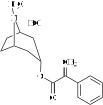
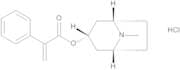
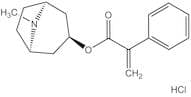
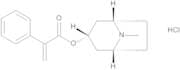
Benzolessigsäure, α-methylen-, 8-methyl-8-azabicyclo[3.2.1]oct-3-yl ester, hydrochlorid, endo- ist eine chemische Verbindung, die durch ihre bicyclische Struktur gekennzeichnet ist, die ein Stickstoffatom im Ring enthält, was zu ihrer Klassifizierung als azabicyclische Verbindung beiträgt. Das Vorhandensein der Benzensäureacetat-Gruppe weist darauf hin, dass sie sowohl aromatische als auch carboxylsäure Eigenschaften hat, obwohl die Säuregruppe in dieser Verbindung verestert ist. Die Hydrochloridform deutet darauf hin, dass es sich um ein Salz handelt, das typischerweise seine Löslichkeit in Wasser erhöht und seine pharmakologischen Eigenschaften beeinflussen kann. Diese Verbindung ist von Interesse in der medizinischen Chemie, insbesondere wegen ihrer potenziellen biologischen Aktivität, die Auswirkungen auf Neurotransmittersysteme aufgrund ihrer strukturellen Ähnlichkeit mit bestimmten Neurotransmittern umfassen kann. Ihre Stereochemie, die durch den "endo"-Begriff angezeigt wird, deutet auf eine spezifische räumliche Anordnung ihrer Substituenten hin, die ihre Reaktivität und Wechselwirkung mit biologischen Zielen erheblich beeinflussen kann. Insgesamt veranschaulicht diese Verbindung die Komplexität und Vielfalt organischer Moleküle, die in pharmazeutischen Anwendungen verwendet werden.
Formel:C17H21NO2·ClH
InChl:InChI=1/C17H21NO2.ClH/c1-12(13-6-4-3-5-7-13)17(19)20-16-10-14-8-9-15(11-16)18(14)2;/h3-7,14-16H,1,8-11H2,2H3;1H/t14-,15+,16+;
InChI Key:InChIKey=RALAARQREFCZJO-CNKDKAJDNA-N
SMILES:O(C(C(=C)C1=CC=CC=C1)=O)[C@H]2C[C@@]3(N(C)[C@](C2)(CC3)[H])[H].Cl
Synonyme:- 1α<span class="text-smallcaps">H</smallcap>,5α<smallcap>H</span>-Tropan-3α-ol, atropate (ester), hydrochloride
- 8-Methyl-8-Azabicyclo[3.2.1]Oct-3-Yl 2-Phenylprop-2-Enoate Hydrochloride (1:1)
- Apoatropine HCl
- Benzeneacetic acid, α-methylene-, 8-methyl-8-azabicyclo[3.2.1]oct-3-yl ester, hydrochloride, endo-
- 1αH,5αH-Tropan-3α-ol, atropate (ester), hydrochloride
- Apoatropine hydrochloride
- Apoatropine, hydrochloride
Sortieren nach
Reinheit (%)
0
100
|
0
|
50
|
90
|
95
|
100
5 Produkte.
Atropine EP Impurity A HCl (Hyoscyamine EP Impurity G HCl, Apoatropine HCl)
CAS:Formel:C17H21NO2·HClMolekulargewicht:271.36 36.46Atropine EP Impurity A (Hyoscyamine Sulfate Impurity G) as Hydrochloride
CAS:Kontrolliertes ProduktFormel:C17H21NO2·ClHFarbe und Form:NeatMolekulargewicht:307.82Apoatropine hydrochloride
CAS:Natural alkaloidFormel:C17H21NO2HClReinheit:≥ 90.0 % (HPLC)Farbe und Form:SolidMolekulargewicht:307.82Apoatropine Hydrochloride
CAS:Applications Apoatropine is an alkaloid derivative with the potential to be an antibacterial.
References Cherkaoui, S. et al.: Electrophor., 19, 2900 (1998); Marrero-Ponce, Y. et al.: Bioorg. Med. Chem., 13, 2881 (2005);Formel:C17H21NO2·ClHFarbe und Form:White To Off-WhiteMolekulargewicht:307.82Apoatropine hydrochloride
CAS:Apoatropine hydrochloride is a medication that is used to treat spasms, including those caused by multiple sclerosis. It belongs to the class of drugs called spasmolytics and works by blocking nerve impulses. Apoatropine hydrochloride can be found in atropine sulfate, which is a pharmaceutical dosage form of apoatropine. This drug has been shown to contain impurities such as nitro compounds and nitroethane. Nitro compounds are products of the reaction between nitric acid and organic substances such as amino acids, proteins, or sugars. Nitro compounds are also used in the production of explosives such as TNT and other high-performance liquid chromatography (HPLC) calibration standards.Formel:C17H22ClNO2Reinheit:Min. 95%Farbe und Form:PowderMolekulargewicht:307.8 g/mol