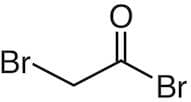
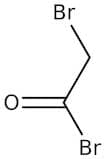
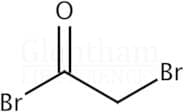
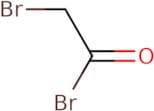
CAS 598-21-0
:Bromoacetylbromid
Beschreibung:
Bromoacetylbromid ist eine organische Verbindung mit der chemischen Formel C2H2Br2O. Sie zeichnet sich als farblose bis blassgelbe Flüssigkeit mit einem stechenden Geruch aus, der auf ihre Reaktivität und potenzielle Gefahren hinweist. Diese Verbindung wird als Acylhalogenid klassifiziert, speziell als Acylbromid, und ist bekannt für ihre elektrophile Natur, was sie zu einem nützlichen Reagenz in der organischen Synthese macht, insbesondere bei der Bildung verschiedener bromierter Verbindungen. Bromoacetylbromid ist hochreaktiv, insbesondere mit Nucleophilen, und kann an Acylierungsreaktionen teilnehmen. Sie ist auch empfindlich gegenüber Feuchtigkeit und kann in Gegenwart von Wasser hydrolysieren, wobei Bromwasserstoff freigesetzt wird. Aufgrund ihrer korrosiven Eigenschaften birgt sie erhebliche Gesundheitsrisiken, einschließlich Reizungen der Haut, Augen und des Atmungssystems. Angemessene Sicherheitsvorkehrungen, einschließlich der Verwendung von persönlicher Schutzausrüstung und der Arbeit in einer Abzugshaube, sind beim Umgang mit dieser Substanz unerlässlich. Ihre Anwendungen erstrecken sich auf die Synthese von Arzneimitteln und Agrochemikalien, was ihre Bedeutung in der chemischen Forschung und Industrie unterstreicht.
Formel:C2H2Br2O
InChl:InChI=1/C2H2Br2O/c3-1-2(4)5/h1H2
InChI Key:InChIKey=LSTRKXWIZZZYAS-UHFFFAOYSA-N
SMILES:C(CBr)(Br)=O
Synonyme:- 2-Bromoacetyl bromide
- Acetyl bromide, 2-bromo-
- Acetyl bromide, bromo-
- Bromacetylbromid
- Bromcacetyl Bromide
- Bromoacety bromide
- Bromure de bromoacetyle
- Bromuro De Bromoacetilo
- Monobromoacetyl bromide
- α-Bromoacetyl bromide
- Bromoacetyl bromide
- 1,2-Dibromoethanone
- BROMOACETIC ACID BROMIDE
- acetylbromide,bromo-
- bromo-acetylbromid
- AKOS BBS-00004286
- ALPHA-BROMOACETYL BROMIDE
- BROMOACETYL BROMIDE, 98+%
- Weitere Synonyme anzeigen
Sortieren nach
Reinheit (%)
0
100
|
0
|
50
|
90
|
95
|
100
6 Produkte.
Bromoacetyl Bromide
CAS:Formel:C2H2Br2OReinheit:>98.0%(GC)(T)Farbe und Form:Colorless to Light yellow to Light orange clear liquidMolekulargewicht:201.85Bromoacetyl bromide, 98%
CAS:Bromoacetyl bromide is widely used in the synthesis of fine chemicals, agrochemicals, dyes and pharmaceuticals. As an acylating agent, it reacts with 10H-phenothiazine to give 10-bromoacetyl-10H-phenothiazine. Similarly, it is also involved in the preparation of bromoactylated starch which is a biod
Formel:C2H2Br2OReinheit:98%Farbe und Form:Clear colorless to yellow, LiquidMolekulargewicht:201.85Bromoacetyl bromide
CAS:Formel:BrCH2COBrReinheit:≥ 98.0%Farbe und Form:Colourless to light yellow liquidMolekulargewicht:201.86Bromoacetyl bromide
CAS:Formel:C2H2Br2OReinheit:99.0%Farbe und Form:Colourless to yellow liquidMolekulargewicht:201.8452-Bromoacetyl Bromide
CAS:Kontrolliertes ProduktStability Moisture Sensitive
Applications 2-Bromoacetyl Bromide, is a builidng block used for various organic synthesis. It can be used for the synthesis of novel biofunctional molecules for target-selective photodegradation of proteins and carbohydrates.
Not a dangerous good if item is equal to or less than 1g/ml and there is less than 100g/ml in the package
References Toshima, K., et al.: Yuki Gosei Kagaku Kyokaishi, 70, 1187 (2012);Formel:C2H2Br2OFarbe und Form:NeatMolekulargewicht:201.842-Bromoacetyl bromide
CAS:2-Bromoacetyl bromide is an acylating agent that is used in the production of sulfa drugs. It can be prepared by the reaction of sodium carbonate with bromoacetic acid and a primary amine. The hemolytic activity of 2-bromoacetyl bromide has been shown to be due to its ability to bind to sulfhydryl groups on hemoglobin. This binding leads to a conformational change in the protein, which causes it to lose its ability to bind oxygen, resulting in its inability to deliver oxygen throughout the body. 2-Bromoacetyl bromide also has anticancer properties because it inhibits mitochondrial function, leading to cancer cell death.Formel:C2H2Br2OReinheit:Min. 95%Farbe und Form:Clear LiquidMolekulargewicht:201.84 g/mol